
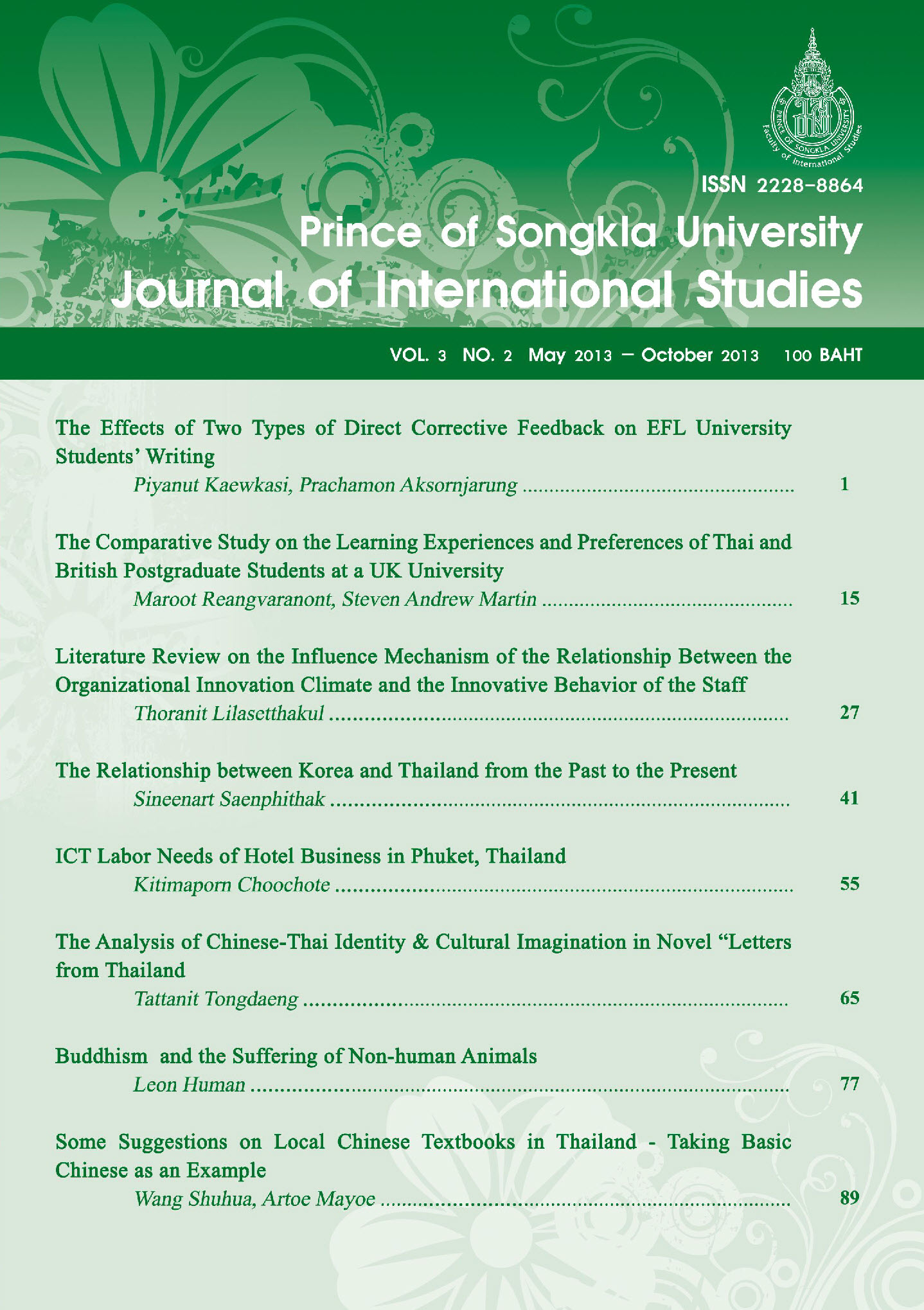
ความต้องการแรงงานด้านเทคโนโลยีสารสนเทศของธุรกิจโรงแรมในภูเก็ต ประเทศไทย
Article Sidebar
Main Article Content
บทคัดย่อ
การวิจัยครั้งนี้มีวัตถุประสงค์ เพื่อศึกษาความต้องการแรงงานด้านเทคโนโลยีสารสนเทศ และการสื่อสารของธุรกิจโรงแรม จังหวัดภูเก็ต เป็นการศึกษาเชิงปริมาณ (Quantitative Research) โดยใช้การสํารวจ ซึ่งกลุ่มของการศึกษาคือธุรกิจโรงแรมในจังหวัดภูเก็ต มีจํานวนกลุ่มตัวอย่าง 255 แห่ง เครื่องมือในการวิจัยใช้แบบสอบถาม (Questionnaire) สถิติที่ใช้ในการวิเคราะห์ ได้แก่ ความถี่ (Frequency) ร้อยละ (Percentage) และการวิเคราะห์เนื้อหา (Content Analysis)
ผลการวิจัยพบว่า ฝ่ายเทคโนโลยีสารสนเทศของธุรกิจโรงแรม ให้หน่วยงานภายนอกเข้ามาดูแล มากที่สุด ไม่มีพนักงานด้านเทคโนโลยีสารสนเทศมากที่สุด และหากมีจะเป็นตําแหน่ง EDP (Electric Data Processing) โดยมีสถานะเป็นพนักงานประจํา ความรับผิดชอบของบุคลากรด้าน เทคโนโลยีสารสนเทศ คือทําหน้าที่ดูแลระบบอินเตอร์เน็ตและระบบเครือข่ายคอมพิวเตอร์ ในโรงแรมมากที่สุด ไม่มีความต้องการพนักงานเทคโนโลยีสารสนเทศในระหว่างปี 2556 - 2558 มากที่สุด คุณสมบัติของบุคลากรด้านเทคโนโลยีสารสนเทศของธุรกิจโรงแรม ด้านความรู้ความสามารถ คือ ความรู้ความสามารถในการปฏิบัติงานมากที่สุด ด้านบุคลิกภาพ คือ บุคลิกภาพในการปฏิบัติงาน มากที่สุด ด้านภาษาต่างประเทศ คือการสนทนา การสื่อสารภาษาอังกฤษมากที่สุด และด้านความรอบรู้ คือความสามารถแก้ไขปัญหาแก่ลูกค้าและเพื่อนร่วมงานมากที่สุด
Article Details
ข้อความและความคิดเห็นที่แสดงในบทความ เป็นแนวคิดของผู้เขียน มิใช่ความรับผิดชอบของกองบรรณาธิการ และคณะผู้จัดทำแต่อย่างใด
บทความ ข้อมูล เนื้อหา รูปภาพ ฯลฯ ที่ได้รับการตีพิมพ์ในวารสารวิเทศศึกษา ถือเป็นลิขสิทธิ์ของวารสารวิเทศศึกษา หากบุคคลหรือหน่วยงานใดต้องการนำทั้งหมดหรือส่วนหนึ่งส่วนใดไปเผยแพร่ต่อหรือเพื่อกระทำการใด ๆ จะต้องได้รับอนุญาตเป็นลายลักษณ์อักษรจากวารสารวิเทศศึกษา ก่อนเท่านั้น
เอกสารอ้างอิง
Association of Thai Travel Agents. (2012). Project development plan to support the liberalization of travel services. Retrieved from
http://www.atta.or.th/Upload/News/228/Chapter_4.pdf.
Community development Department, Ministry of Interior. (2012). The eleventh national economic and social Development Plan. Retrieved from http:// www.cdd.go.th.Denney G. Rutherford. (1990). Hotel management and operations. New York: Van Nostrand
Reinhold.
Department Of Skill Development. (2005). Direction and the need for skilled labor industry of Thailand (2004-2009). Planning and Information Technology Division, Ministry of Labour.
National Electronics and Computer Technology Center.(n.d.). Executive summary: the second Thailand information and communication technology (ICT) master plan (2009-2013). National Science and Technology Development Agency. Ministry of science and
technology.
Office of the National Economic and Social Development Board.(2011). The eleventh national economic and social development plan B.E. 2555-2559(A.D. 2012-2016). Office of the Prime Minister, 2011. Retrieved from http://www.nesdb.go.th/Portals/0/news/plan/p11/plan11.pdf.(2012).
Pimravee Taharnkrawe, and Jirawat Samitsant. (2011). Information technogy for hotel. Suan Dusit Rajabhat University. M & M Laser Printed.
Ranee Hisichaikun. (2003). Tourism management information system (unit 1 basic knowledge about the tourism industry). Sukhothai Thammathirat Open University.
Rodolfo Baggio. (2004). Information and communication technologies in the hospitality industry: the Italian case. e-Review of Tourism Research (eRTR), Vol.2, No. 5. Retrieved from http://ertr.tamu.edu.
Sirawit Sirirak. (2012). Relationship between information and communication technology (ICT) adoption and hotel productivity: the case of Phuket, Thailand. Faculty of Technology and Environment, Prince of Songkla University, Phuket.
Steadmon, C. E. & Kasavana, M. L.(1988). Managing front office operations. East Lansing, MI: The Education Institute of the American Hotel & Motel Association.
Supanee Sengsee, (2003). Information and communication technologies for education. Faculty of Education: Naresuan University.
Tanja Mihalic,. Dimitrios Buhalis. (2012). ICT as a new competitive advantage factorcase of small transitional hotel sector. Economic and Business Review. Vol.15. No. 1 (33-56).
