
ACADEMIC AND CONTEXTUAL DIMENSIONS OF PERCEIVED LANGUAGE PROFICIENCY: A COMPARATIVE STUDY OF ENGLISH AND CHINESE AMONG SECONDARY SCHOOL STUDENTS IN PHUKET
Article Sidebar
Main Article Content
Abstract
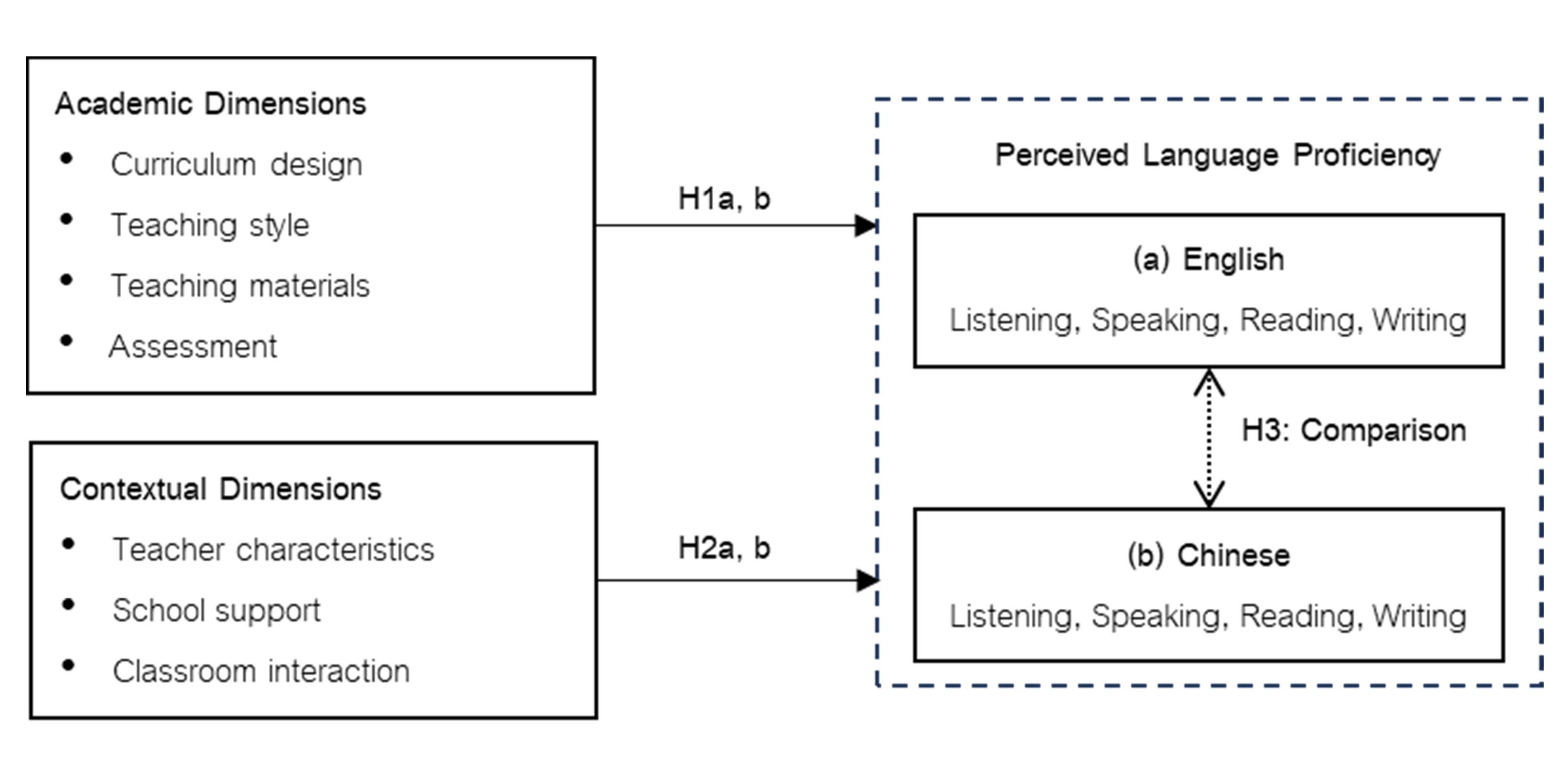
This study examined how academic and contextual dimensions influence perceived English and Chinese language proficiency among secondary school students in public schools in Phuket, guided by Communicative Language Teaching (CLT). From an accessible population of 2,693 students across five schools, Yamane's formula required a minimum sample of 348 participants; however, 533 completed and usable responses were obtained. Data were collected through a structured questionnaire with content validity confirmed by three experts (IOC > 0.50). The data were then analyzed using exploratory factor analysis and multiple regression. Results revealed that academic dimensions—such as curriculum, assessment, and instructional exposure—consistently and significantly predicted all language skills in both English and Chinese. In contrast, contextual dimensions—including teaching style, teacher characteristics, and school support—significantly enhanced all English skills but demonstrated weaker and inconsistent effects for Chinese, particularly in speaking skills. These findings reveal a structural asymmetry: English proficiency benefits from both academic and contextual support, whereas Chinese proficiency remains largely dependent on academic structures due to limited institutional readiness. The study extends CLT by demonstrating that the effectiveness of contextual factors depends on institutional conditions and that the academic–contextual distinction varies across languages. The findings suggest practical implications for Chinese teacher development, communicative curriculum design, and language-enriched school environments in tourism-driven contexts.
Downloads
Article Details
References
Alomoush, O. I. S. & Al-Na’imat, G. K. (2018). English as the Lingua Franca in Visual Touristic Jordan: The Case of Petra. International Journal of Applied Linguistics and English Literature, 7(4), 1. doi: https://doi.org/10.7575/aiac.ijalel.v.7n.4p.1
Apridayani, A. & Teo, A. (2021). The Interplay among SRL Strategies, English Self-Efficacy, and English Proficiency of Thai University Students. Studies in English Language and Education, 8(3), 1123 – 1143. doi: https://doi.org/10.24815/siele.v8i3.20213
Aziz, M. N. A., Mohd Yusoff, N. & Mohd Yaakob, M. F. (2020). Challenges in Using Authentic Assessment in 21st Century ESL Classrooms. International Journal of Evaluation and Research in Education (IJERE), 9(3), 759. doi: https://doi.org/10.11591/ijere.v9i3.20546
Baker, W. (2012). English as a Lingua Franca in Thailand: Characterizations and Implications. Englishes in Practice, 1, 18 – 27.
Brown, H. D. (2014). Principles of Language Learning and Teaching. 6th edition. Pearson.
Cohen, J. (1988). Statistical Power Analysis for the Behavioral Sciences. 2nd edition. Lawrence Erlbaum Associates.
Darasawang, P. & Reinders, H. (2021). Willingness to Communicate and Second Language Proficiency: A Correlational Study. Education Sciences, 11(9), 517. doi: https://doi.org/10.3390/educsci11090517
Dos Santos, L. M. (2020). The Discussion of Communicative Language Teaching Approach in Language Classrooms. Journal of Education and E-Learning Research, 7(2), 104 – 109. doi: https://doi.org/10.20448/journal.509.2020.72.104.109
Fauzi, N. I., & Ridwan, R. (2025). The Impact of Communicative Language Teaching on English Speaking Skills. Dinasti International Journal of Education Management and Social Science, 6(3), 1774–1781. https://doi.org/10.38035/dijemss.v6i3.3819
Hakami, A. (2025). The Impact of the CLT Approach in Developing English Language Skills among Saudi EFL Students: Students’ Perceptions. European Scientific Journal, ESJ, 21(11), 12. doi: https://doi.org/10.19044/esj.2025.v21n11p12
Jakaria, S. Y. (2024). Thai Students’ Perceptions of Foreign English Teachers: Implications for Public Education Policy. Zenodo, 2(10), 674 – 684. doi: https://doi.org/10.5281/zenodo.13973855
Kholmurodovna, D. S. (2024). Communicative Language Teaching (CLT) Approaches for Teaching English. JournalNX - a Multidisciplinary Peer Reviewed Journal, 10(1), 61 – 64.
Kelasi, V. (2025). Effectiveness of Communicative Language Teaching in Thai Classrooms. Journal of Asian Language Teaching and Learning, 6(2), 77 – 83.
Larsen-Freeman, D. & Anderson, M. (2011). Techniques and Principles in Language Teaching 3rd edition. Oxford University Press.
Ministry of Tourism and Sports. (2026a). Domestic Tourism Statistics (Classify by region and province 2025). Retrieved April 16, 2026, from https://www.mots.go.th/news/category/808
Ministry of Tourism and Sports. (2026b). International Tourist Arrivals to Thailand Jan - Dec 2025. Retrieved April 16, 2026, from https://www.mots.go.th/news/category/806
Nasimova, M. (2022). Communicative Language Teaching. Общество и инновации, 3(5), 222 – 228. doi: https://doi.org/10.47689/2181-1415-vol3-iss5/s-pp222-228
Pallant, J. (2020). SPSS Survival Manual. Routledge.
Phetsangkhad, P. K. (2023). Exploring the Thai EFL Landscape: Implications for English Language Teaching. Law and Humanities Quarterly Reviews, 2(1), 44 - 50. doi: https://doi.org/10.31014/aior.1996.02.01.50
Photip, C. (2020). The study into Current Condition and Problem related to the Instruction of the Chinese Language at High School Education in Surat Thani Province. Journal of Humanities and Social Sciences Suratthani Rajabhat University, 12(2), 1 – 33.
Rabob, C., Sureerattanan, C. & Sanongpong, K. (2016). Supply Chain in Tourism Industry of China. Business Administration and Management Journal Review, 8(1), 199 – 214.
Rahmatillah, K. (2019). Communicative Language Teaching (CLT) through Role Play and Task-based Instruction. Script Journal: Journal of Linguistic and English Teaching, 4(2), 161. doi: https://doi.org/10.24903/sj.v4i2.339
Richards, J. (2006). Communicative Language Teaching Today. Cambridge University Press.
Saengngoen, C. & Sincharoenkul, K. (2025). Determining selection Criteria for Hospitality and Tourism Programs in Higher Education in Southern Thailand. Journal of Education and Innovative Learning, 5(2), 421 – 435.
Saunders, M., Lewis, P. & Thornhill, A. (2019). Research methods for business students. 8th edition. Pearson Education Limited.
Silarak, P. (2021). Adaptation of the Chinese Language Role under the New Context of Normal Life in the 21st Century. Chinese Language and Culture Journal, 8(1), 61 – 72.
Tabachnick, B. G. & Fidell, L. S. (2019). Using Multivariate statistics. 7th edition. Boston Pearson.
The Economist. (2017). Poor schools are at the heart of Thailand’s political malaise. Retrieved September 18, 2025, from https://www.economist.com/news/asia/21715011-countrys-class-war-has-its-roots-classroom-poor-schools-are-heart-thailands
Wathawatthana, P., Hongsa, N., Phonchad, P. & Thambunrueang, T. (2025). Breaking the Silence: The Impact of the CLT Method on Grade 12 Students’ Speaking Skills. International Journal of Education and Literacy Studies, 13(2), 612 – 621. doi: https://doi.org/10.7575/aiac.ijels.v.13n.2p.612
Watson Todd, R. & Darasawang, P. (2020). English Language Teacher Education in Thailand: A Mix of Global and Local in English Language Teaching and Teacher Education in East Asia. Cambridge University Press. doi: https://doi.org/10.1017/9781108856218.011
Widiyati, E. & Pangesti, W. (2022). Project-based Learning in Teaching Speaking to Young Learners: Is it Effective? EduLite: Journal of English Education, Literature and Culture, 7(1), 71. doi: https://doi.org/10.30659/e.7.1.71-81
Xiao, D. & Tian, C. (2024). Chinese Language Education under the Integration of Chinese and Thai Languages and Cultures. International Journal of Sociologies and Anthropologies Science Reviews, 4(3), 65 – 70. doi: https://doi.org/10.60027/ijsasr.2024.4011
Yamane, T. (1973). Statistics: An Introductory Analysis. 2nd edition. Harper and Row.
