
THE IMPACT OF WORK–FAMILY CONFLICT ON ENTREPRENEURIAL PERFORMANCE: THE ROLES OF JOB RESOURCES AND WORK ENGAGEMENT AMONG CHINESE FEMALE LEADERS
Article Sidebar
Main Article Content
Abstract
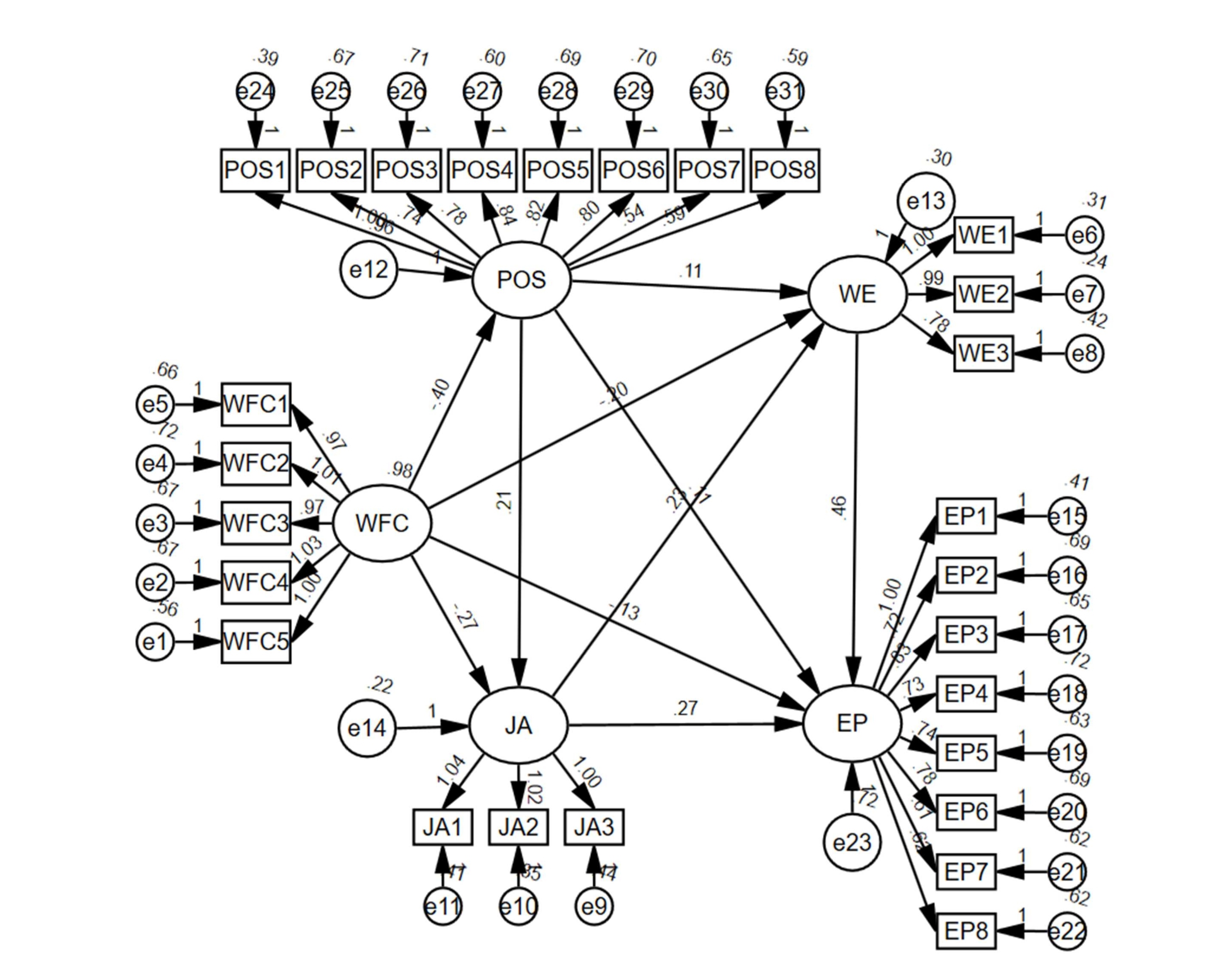
This study examined how work–family conflict affects entrepreneurial performance among Chinese female leaders by integrating job resources and motivational mechanisms. Although previous studies have examined the relationship between work–family conflict and women’s work outcomes, limited research has simultaneously investigated the structural relationships among work–family conflict, perceived organizational support, job autonomy, work engagement, and entrepreneurial performance within the context of Chinese female leadership. To address this gap, a structural model was proposed linking work–family conflict, perceived organizational support, job autonomy, work engagement, and entrepreneurial performance. Survey data were collected from 450 Chinese female leaders, including managers and entrepreneurs across different managerial levels in China, using a purposive and snowball sampling approach. Measurement quality was evaluated through Cronbach’s alpha reliability analysis, exploratory factor analysis, and confirmatory factor analysis, and hypotheses were tested using structural equation modeling with maximum likelihood estimation. The results indicated that work–family conflict had significant negative effects on perceived organizational support, job autonomy, and work engagement, and also exerted a significant negative direct effect on entrepreneurial performance. In contrast, perceived organizational support had significant positive effects on both job autonomy and work engagement, while work engagement demonstrated the strongest positive direct effect on entrepreneurial performance. These findings suggested that work–family conflict undermines entrepreneurial performance both directly and indirectly by eroding key job resources and reducing work engagement. The study contributes to the literature by providing an integrated resource-based explanation of how work–family conflict influences entrepreneurial performance among Chinese female leaders and highlights the importance of organizational support and job autonomy in sustaining motivational and performance outcomes.
Downloads
Article Details
References
Bakker, A. B., Demerouti, E. & Sanz-Vergel, A. (2023). Job Demands-Resources Theory: Ten Years Later. Annual Review of Organizational Psychology and Organizational Behavior, 10, 25 - 53.
Brieger, S. A., Sonbol, D. & De Clercq, D. (2024). Gender Differences in Entrepreneurs’ Work–family Conflict and Well-being during COVID-19: Moderating Effects of Gender-Egalitarian Contexts. Journal of Small Business Management, 62(5), 2322 - 2363.
De Clercq, D., Kaciak, E. & Thongpapanl, N. (2022). Work-to-family Conflict and Firm Performance of Women Entrepreneurs: Roles of Work-related Emotional Exhaustion and Competitive Hostility. International Small Business Journal, 40(3), 364 - 384.
Dong, X., Guo, X., Fu, Y. & Fu, T. (2025). Impact of Work-family Conflict on Work Engagement among Female University Teachers: Evidence from China. Plos one, 20(3), e0319785.
Eisenberger, R., Huntington, R., Hutchison, S. & Sowa, D. (1986). Perceived Organizational Support. Journal of Applied Psychology, 71(3), 500 – 507.
Mazzetti, G., Robledo, E., Vignoli, M., Topa, G., Guglielmi, D. & Schaufeli, W. B. (2023). Work Engagement: A Meta-analysis Using the job Demands–resources Model. Psychological Reports, 126(3), 1069 – 1107.
Morgeson, F. P. & Humphrey, S. E. (2006). The Work Design Questionnaire (WDQ): Developing and Validating a Comprehensive Measure for Assessing Job Design and the Nature of Work. Journal of Applied Psychology, 91(6), 1321 – 1339.
Netemeyer, R. G., Boles, J. S. & McMurrian, R. (1996). Development and Validation of Work–family Conflict and Family–work Conflict Scales. Journal of Applied Psychology, 81(4), 400 – 410.
Oubibi, M., Fute, A., Xiao, W., Sun, B. & Zhou, Y. (2022). Perceived Organizational Support and Career Satisfaction among Chinese Teachers: The Mediation Effects of Job Crafting and Work Engagement during COVID-19. Sustainability, 14(2), 623.
Pan, Y., Aisihaer, N., Li, Q., Jiao, Y. & Ren, S. (2022). Work-family Conflict, Happiness and Organizational Citizenship Behavior among Professional Women: A Moderated Mediation Model. Frontiers in Psychology, 13, 923288.
Schaufeli, W. B., Bakker, A. B. & Salanova, M. (2006). The Measurement of Work Engagement with a Short Questionnaire: A Cross-national Study. Educational and Psychological Measurement, 66(4), 701 – 716.
Wiklund, J. & Shepherd, D. (2005). Entrepreneurial Orientation and Small Business Performance: A Configurational Approach. Journal of Business Venturing, 20(1), 71 – 91.
World Bank. (2024). Labor Force Participation Rate, Female (% of Female Population Ages 15+) (modeled ILO estimate)—China. World Bank Open Data.
