
THE EFFECT OF PARASOCIAL INTERACTION, FLOW, AND SOCIAL IDENTITY IN CROSS-BORDER E-COMMERCE VALUE CO-CREATION
Article Sidebar
Main Article Content
Abstract
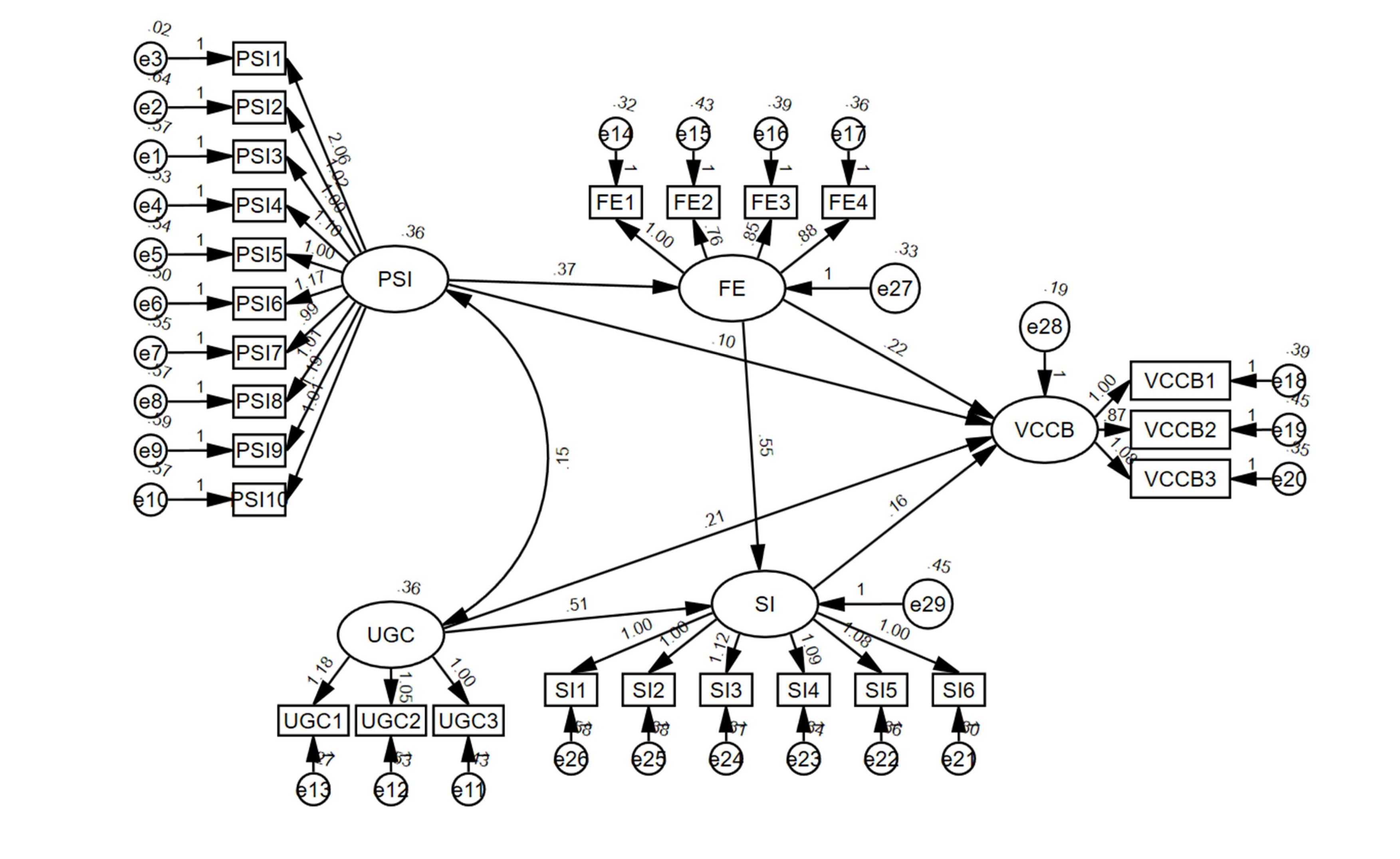
This study investigates the relationships among parasocial interaction, user-generated content, flow experience, social identity, and value co-creation behavior in cross-border livestream shopping. A structured questionnaire was distributed to Chinese consumers who have used Thai e-commerce platforms, and 509 valid responses were analyzed using reliability tests, exploratory factor analysis, and structural equation modeling. The measurement instruments demonstrated strong reliability and validity. The structural model exhibited acceptable fit (χ²/df = 2.441, RMSEA = 0.054, CFI = 0.937, TLI = 0.930). Difference analyses revealed that gender significantly influenced parasocial interaction (t = 2.832, p < 0.01) and user-generated content (t = 2.355, p < 0.05), while monthly income and cross-border shopping experience produced variations in flow experience, social identity, and value co-creation behavior. Structural modeling showed that parasocial interaction positively predicted flow experience (β = 0.358, p < 0.001), which in turn strongly influenced social identity (β = 0.412, p < 0.001). Both user-generated content (β = 0.224, p < 0.01) and social identity (β = 0.237, p < 0.001) significantly contributed to value co-creation behavior. Flow experience also had a significant direct effect on value co-creation behavior (β = 0.252, p < 0.001). The findings highlight the psychological mechanisms through which Chinese consumers form engagement and co-create value on cross-cultural digital platforms.
Downloads
Article Details
References
Chu, S. & Kim, Y. (2011). Determinants of Consumer Engagement in Electronic Word-of-mouth in Social Networking Sites. International Journal of Advertising, 30(1), 47 – 75.
Dhaigude, S. A. & Mohan, B. C. (2023). Customer Experience in Social Commerce: A Systematic Literature Review and Research Agenda. International Journal of Consumer Studies, 47(5), 1629 - 1668.
Dong, W. W., Wang, Y. Q. & Qin, J. (2023). An Empirical Study on Impulse Consumption Intention of Livestreaming E-commerce: the Mediating Effect of Flow Experience and the Moderating Effect of Time Pressure. Frontiers in Psychology, 13, 1019024.
Gunawan, G. (2024). User-Generated Content in Increasing Consumer Engagement: Opportunities and Challenges. Jurnal Ilmiah Multidisiplin Indonesia, 3(01), 59 - 67.
Gorini, A., Capideville, C. S., De Leo, G., Mantovani, F. & Riva, G. (2011). The Role of Immersion and Narrative in Mediated Presence: The Virtual Hospital Experience. Cyberpsychology, Behavior, and Social Networking, 14(3), 99 – 105.
Hartmann, T. & Goldhoorn, C. (2011). Horton and Wohl Revisited: Exploring Viewers' Experience of Parasocial Interaction. Journal of Communication, 61(6), 1104 – 1121.
Hein, A., Weking, J., Schreieck, M., Wiesche, M., Böhm, M. & Krcmar, H. (2019). Value Co-creation Practices in Business-to-business Platform Ecosystems. Electronic markets, 29(3), 503 - 518.
Jen-Hung, H. & Yi-Chun, Y. (2010). Gender Differences in Adolescents’ Online Shopping Motivations. African journal of business management, 4(6), 849 - 857.
Ji, M., Gao, X. & Liang, Y. (2023). Opportunities and Challenges of Cross-border E-commerce Development Cooperation between China and Southeast Asian Countries—based on the Perspective of the Entry into Force of RCEP. Academic Journal of Business & Management, 5(13), 133 - 139.
Ke, Y. & Wisaeng, K. (2025). Factors Influencing Consumers' Behavior Towards Chinese Products on E-commerce Platforms in Thailand. International Journal of Analysis and Applications, 23, 108 - 108.
Koufaris, M. (2002). Applying the Technology Acceptance Model and Flow Theory to Online Consumer Behavior. Information Systems Research, 13(2), 205 – 223.
Kuo, Y. F. & Hou, J. R. (2017). Oppositional Brand Loyalty in Online Brand Communities: Perspectives on Social Identity Theory and Consumer-brand Relationship. Journal of Electronic Commerce Research, 18(3), 254.
Mael, F. & Ashforth, B. E. (1992). Alumni and their Alma Mater: A Partial Test of the Reformulated Model of Organizational Identification. Journal of Organizational Behavior, 13(2), 103 – 123.
Ranjan, K. R. & Read, S. (2016). Value Co-creation: Concept and Measurement. Journal of the Academy of Marketing Science, 44, 290 – 315.
Rogers, P. & Lea, M. (2005). Social Presence in Distributed Group Environments: The Role of Social Identity. Behaviour & information technology, 24(2), 151 – 158.
Rubin, A. M., Perse, E. M. & Powell, R. A. (1985). Loneliness, Parasocial Interaction, and Local Television News Viewing. Human Communication Research, 12(2), 155 – 180.
Sokolova, K. & Kefi, H. (2020). Instagram and YouTube Bloggers Promote It, Why should I Buy? How Credibility and Parasocial Interaction Influence Purchase Intentions. Journal of Retailing and Consumer Services, 53, 101742.
Wang, X., Li, G. & Wang, L. (2021). How Consumer Experience Shapes Social Commerce Participation. Computers in Human Behavior, 124, 106922.
Ward, C., Bochner, S. & Furnham, A. (2001). The Psychology of Culture Shock. 2nd edition. Routledge.
Xiao, L., Guo, F., Yu, F. & Liu, S. (2019). The Effects of Online Shopping Context Cues on Consumers’ Purchase Intention for Cross-border E-commerce Sustainability. Sustainability, 11(10), 2777.
Yen, C. H., Teng, H. Y. & Tzeng, J. C. (2020). Innovativeness and Customer Value Co-creation Behaviors: Mediating Role of Customer Engagement. International Journal of Hospitality Management, 88, 102514.
Yi, Y. & Gong, T. (2013). Customer Value Co-creation Behavior: Scale Development and Validation. Journal of Business Research, 66(9), 1279 - 1284.
