สายการบินแห่งชาติและอัตลักษณ์ทางวัฒนธรรม: การวิเคราะห์เชิงสัญญวิทยา ระบบการตั้งชื่อเครื่องบินของสายการบิน Air France และ Thai Airways
สายการบินแห่งชาติและอัตลักษณ์ทางวัฒนธรรม: การวิเคราะห์เชิงสัญญวิทยา ระบบการตั้งชื่อเครื่องบินของสายการบิน Air France และ Thai Airways
คำสำคัญ:
สัญญวิทยา, การตั้งชื่อ, สายการบินแห่งชาติ, อัตลักษณ์ทางวัฒนธรรม, ซอฟต์พาวเวอร์บทคัดย่อ
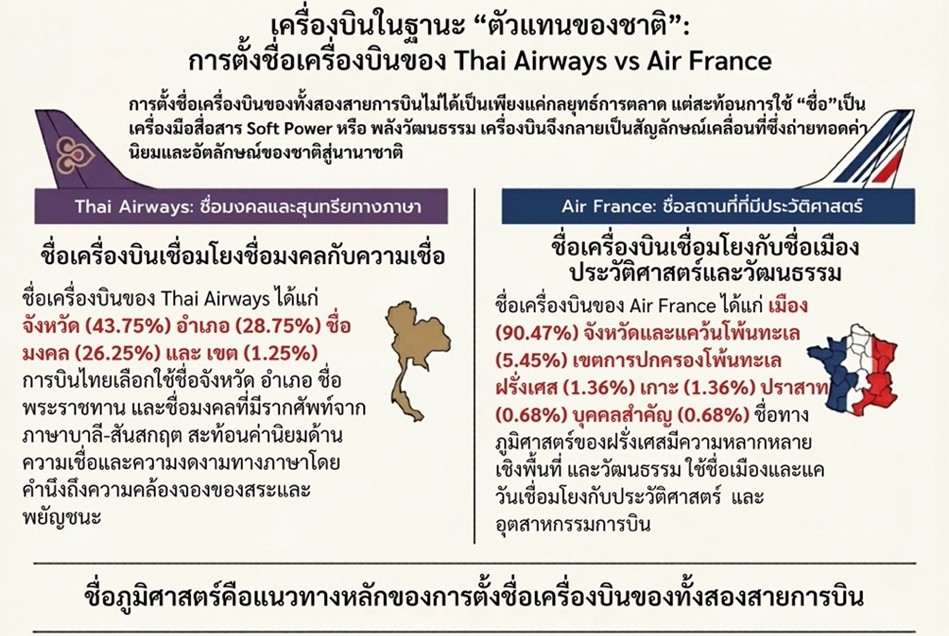
บทความวิจัยนี้ มีวัตถุประสงค์เพื่อศึกษาความสัมพันธ์ระหว่างการตั้งชื่อเครื่องบินกับการถ่ายทอดอัตลักษณ์ทางวัฒนธรรมของสายการบินแห่งชาติ โดยเปรียบเทียบกรณีของ Thai Airways และ Air France ภายใต้กรอบแนวคิดสัญญวิทยา (semiotics) และศาสตร์การตั้งชื่อ (onomastics) และวิเคราะห์รูปแบบ เงื่อนไข ความหมายเชิงสัญลักษณ์ของชื่อเครื่องบิน และบทบาทของชื่อในฐานะเครื่องมือสื่อสารอัตลักษณ์ชาติและ Soft Power ในระดับสากล งานวิจัยนี้ใช้วิธีการดำเนินการวิจัยโดยรวบรวมข้อมูลรายชื่อเครื่องบินของสายการบิน Thai Airways และ Air France จำนวน 227 ลำ จากเว็บไซต์ Planespotters.net จำแนกหมวดหมู่ชื่อ วิเคราะห์เชิงความหมาย และเปรียบเทียบระหว่างสองสายการบิน ผลการวิจัยพบว่า ชื่อเครื่องบินของสายการบิน Thai Airways สามารถจัดหมวดหมู่การตั้งชื่อที่พบมากที่สุดได้ดังนี้ (1) ชื่อจังหวัด (2) ชื่ออำเภอ (3) ชื่อมงคล และ (4) ชื่อเขต สายการบิน Air France สามารถแบ่งประเภทและจัดลำดับได้ดังนี้ (1) ชื่อเมืองเทศบาลตามเขตการปกครองระดับแคว้น (2) ชื่อจังหวัดและแคว้นโพ้นทะเล (3) ชื่อเขตการปกครองโพ้นทะเลฝรั่งเศส (4) ชื่อเกาะ (5) ชื่อปราสาท และ (6) ชื่อบุคคล แม้ทั้งสองสายการบินจะใช้ชื่อเชิงภูมิศาสตร์มาตั้งชื่อเครื่องบินเป็นหลัก แต่มีแนวทางการสื่อสารอัตลักษณ์ที่แตกต่างกันอย่างชัดเจน Thai Airways มีการใช้ชื่อมงคลที่มีรากศัพท์จากภาษาบาลี-สันสกฤต สะท้อนค่านิยมด้านความเชื่อและความงดงามทางภาษา ขณะที่ Air France ใช้ชื่อเมือง ภูมิภาค และดินแดนโพ้นทะเลเป็นหลัก โดยเชื่อมโยงกับอุตสาหกรรมการบิน ประวัติศาสตร์ และวัฒนธรรมท้องถิ่น สะท้อนความหลากหลายเชิงพื้นที่และความเป็นเลิศทางเทคโนโลยีของชาติฝรั่งเศส การตั้งชื่อในองค์กรระดับชาติเป็นกลไกหนึ่งของ Soft Power ที่สะท้อนโลกทัศน์ของสังคม และสามารถนำไปประยุกต์ใช้ในการวิเคราะห์การสื่อสารอัตลักษณ์ขององค์กรในบริบทอื่นได้
เอกสารอ้างอิง
กันตพงศ์ จิตต์กล้า, สุปรียา ป้องเรือ, และวรรณฤดี คุระวรรณ. (2568). สถานีขนส่งทางรางในแคว้นอีล-เดอ-ฟร็องส์ : ชื่อและภาพสะท้อนพื้นที่สตรีในฝรั่งเศส. วารสารสมาคมครูภาษาฝรั่งเศสแห่งประเทศไทย, 48(149). 121-146.
ชรัณ โภคสกลวานิช, และอธิชาติ บุญญยศยิ่ง. (2567). การศึกษาวัฒนธรรมการใช้ภาษาในการตั้งชื่อต่อความเชื่อเรื่องมงคล โดยใช้พยัญชนะ ก-ฮ เป็นตัวกำหนดชื่อตัวมงคล. วารสารสมาคมพัฒนาวิชาชีพการบริหารการศึกษาแห่งประเทศไทย (สพบท.), 6(4), 325–336.
ณัฐนนท์ ดวงสูงเนิน. (2568). เจาะลึกศาสตร์และปรัชญาของการตั้งชื่อยานอวกาศของแต่ละวัฒนธรรม. Spaceth.co. สืบค้นจาก https://spaceth.co/naming-spacecraft/
เตือนจิต บูรณะ, และเพ็ญประภา สิงห์สวัสดิ์. (2564). ลักษณะทางภาษาและกลวิธีการตั้งชื่อบัญชีผู้ใช้เฟซบุ๊กของนิสิตมหาวิทยาลัยมหาสารคาม. วารสารมนุษยศาสตร์และสังคมศาสตร์ มหาวิทยาลัยมหาสารคาม, 40(1), 117–128.
นรุตม์ คุปต์ธนโรจน์, สุนทรี โชติดิลก, และอุทัยวรรณ สามิภักดิ์ศิลป์. (2568). การศึกษาเนื้อหาและการใช้ภาษาใน “เพจเฟซบุ๊ก อนุสาร อ.ส.ท.”. วารสารวิชาการมนุษยศาสตร์และสังคมศาสตร์ มหาวิทยาลัยราชภัฏธนบุรี, 8(3), 69–83.
นนทวงค์, ปภาวินท์. (2567). การศึกษาเปรียบเทียบกลยุทธ์การสร้าง Soft Power ระหว่างประเทศเกาหลีใต้กับประเทศไทยผ่านอุตสาหกรรมภาพยนตร์ (วิทยานิพนธ์ปริญญามหาบัณฑิต). จุฬาลงกรณ์มหาวิทยาลัย, กรุงเทพฯ.
บัณฑูร พานแก้ว, และนันทพร วงษ์เชษฐา. (2568). Soft power ในความหมายของ Joseph Nye กับนโยบายของรัฐและข่าวในเว็บไซต์. วารสารศาสตร์, 18(1), 151-198.
บุษยารัตน์ คู่เทียม. (2549). ย้อนอดีต...วัดบวรนิเวศวิหาร. วารสารศิลปากร, 49(5), 77-89.
วิมล โคตรทุมมี. (2568). ภูมินามวิทยา (toponymy): การเมืองของการตั้งชื่อสถานที่. ศูนย์มานุษยวิทยาสิรินธร (องค์การมหาชน). สืบค้นจาก https://www.sac.or.th/ portal/ th/article/detail/741
สุเมตตา ประสาทแก้ว, จริญญา ธรรมโชโต และอนันต์ อารีย์พงศ์. (2561). การตั้งชื่อเรือประมงพื้นบ้านกลุ่มคนมลายูชายฝั่งทะเลตะวันออกภาคใต้ตอนล่าง. ใน การประชุมทางวิชาการของมหาวิทยาลัยเกษตรศาสตร์ ครั้งที่ 56 (น. 758-765). กรุงเทพฯ : มหาวิทยาลัยเกษตรศาสตร์.
Aeroclass. (2022). How to name a plane. Aeroclass. Retrieved from https://www.aeroclass.org/how-to-name-a-plane/
Anholt, S. (2007). Competitive identity: The new brand management for nations, cities and regions. New York: Palgrave Macmillan.
Avion-Chasse. (2023). Comment l’OTAN donne des noms aux avions. Retrieved from https://www.avion-chasse.fr/comment-lotan-donne-des-noms-aux-avions/
Drab, E. (2011). Air France présente sa nouvelle cabine Alizé inspirée de sa Premium Voyageur. Retrieved from https://www.journal-aviation.com/ actualites-transport-aerien/air-france-presente-sa-nouvelle-cabine-alize -inspiree-de-sa-premium-voyageur-20110421.html.
Hai, A. (2019). Thai Airways retire l’A380 mais ajoute 3 vols hebdomadaires en A350 sur Bangkok-Paris. Air Journal. Retrieved from https://www.air-journal.fr/2019-09-24-thai-airways-retire-la380-mais-ajoute-3-vols-hebdomadaires-en-a350-sur-bangkok-paris-5215162.html
Larousse. (n.d.). rafale. Retrieved from https://www.larousse.fr/dictionnaires/ francais/rafale/66166
Le Figaro avec AFP. (2024). Le château de Chambord enregistre un record de fréquentation en 2023. Le Figaro. Retrieved from https://www.lefigaro.fr/ culture/patrimoine/le-chateau-de-chambord-enregistre-un-record-de-frequentation-en-2023-20240113
Le Parisien. (2018). Air France KLM : Anne-Marie Couderc épaulée d'une direction collégiale. Le Parisien. Retrieved from https://www.leparisien.fr/ economie/air-france-klm-une-solution-de-transition-pour-la-succession-de -jean-marc-janaillac-15-05-2018-7716531.php
Loewenstein, G. (1994). The psychology of curiosity: A review and reinterpretation. Psychological Bulletin, 116(1), 75–98. https://doi.org/10.1037/0033-2909.116.1.75
Marine nationale. (2020). #LeSaviezVous « Athéna, Aphrodite et Andromède ». Retrieved from https://web.facebook.com/share/p/18XtSrpR1J/
Navily. (2025). Les vents : Dieux des mers et guides des marins. Retrieved from https://blog.navily.com/blog/les-vents-dieux-des-mers-et-guides-des-marins/
Nye, J. S. (2004). Soft power: The means to success in world politics. New York: PublicAffairs.
Petit, G. (2012). Présentation : La dénomination. Langue française, (174), 3–9.
Staszak, J-F. (2008). Qu’est-ce que l’exotisme ?. Le Globe. Revue genevoise de géographie, (148), 7-30. https://doi.org/10.3406/globe.2008.1537
Vicens, E. (2025). Pourquoi le nouvel avion d’Air France porte le nom d’une ville des Pyrénées-Orientales. Actu.fr. Retrieved from https://actu.fr/ occitanie/rivesaltes_66164/pourquoi-le-nouvel-avion-d-air-france-porte-le-nom-d-une-ville-des-pyrenees-orientales_62480722.html
Vie publique. (2024). Qu'est-ce que le “soft power”?. Retrieved from https://www.vie-publique.fr/fiches/38155-quest-ce-que-le-soft-power
Zajonc, R. (1965). The Attitude Effects of Mere Exposure. Technical report No.34. Institute of Social Research, the University of Michigan.
ดาวน์โหลด
เผยแพร่แล้ว
รูปแบบการอ้างอิง
ฉบับ
ประเภทบทความ
สัญญาอนุญาต
ลิขสิทธิ์ (c) 2026 วารสารภาษา ศาสนา และวัฒนธรรม

อนุญาตภายใต้เงื่อนไข Creative Commons Attribution-NonCommercial-NoDerivatives 4.0 International License.