The Development of a Dual Vocational Education Training Model to Enhance Functional Competencies in the Workplace for Vocational Teachers under the Office of the Vocational Education Commission
Article Sidebar
Main Article Content
Abstract
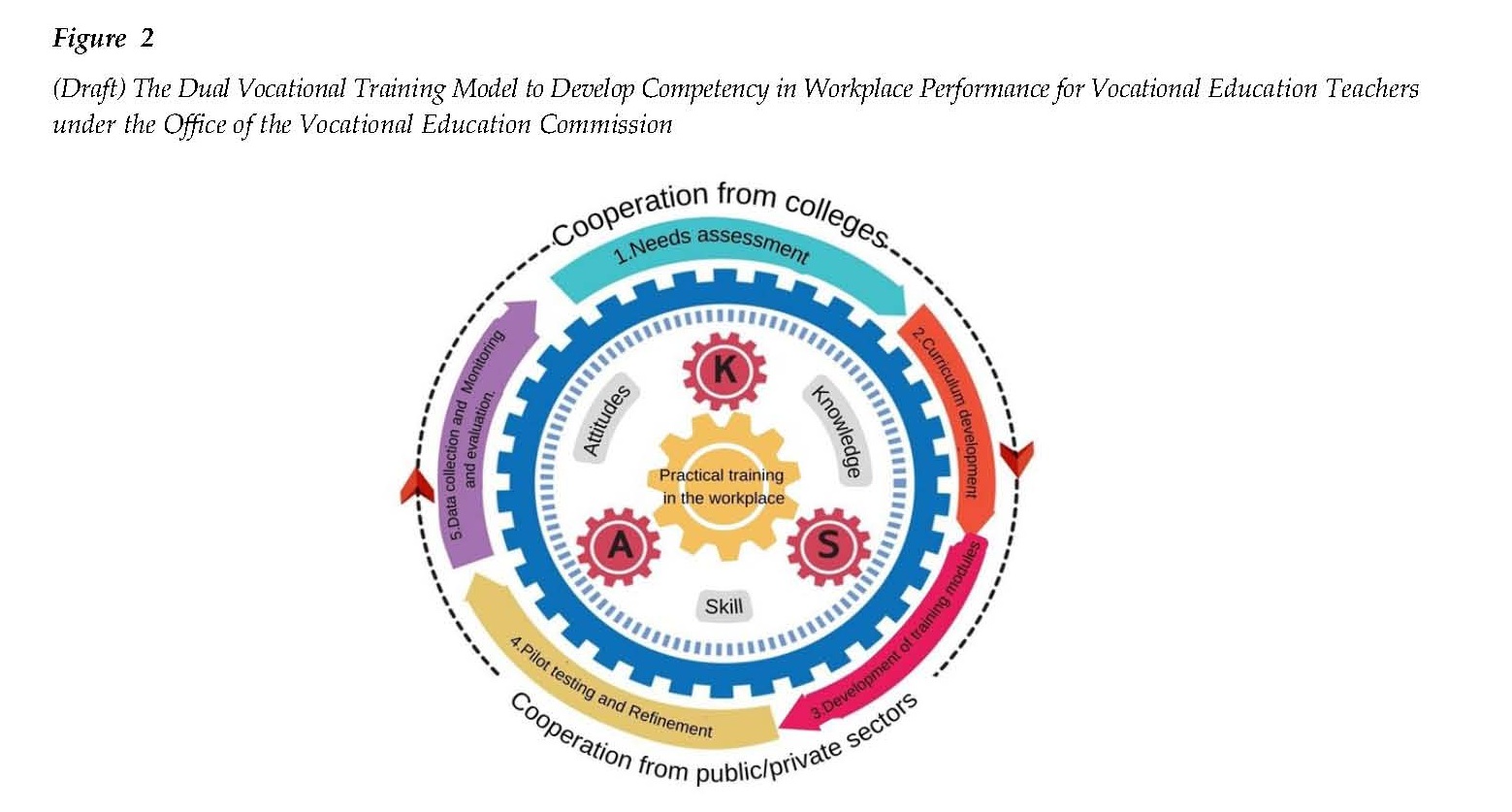
This research aimed to 1) investigate the problems and needs related to the dual system training model, 2) develop and evaluate the dual system training model, 3) trial the implementation of the model, and 4) monitor and evaluate the outcomes of the model. A research and development (R&D) methodology was employed, comprising four phases. In phase 1, the problems and needs associated with the dual system training model were studied. In phase 2, the dual system training model was developed and evaluated based on findings from phase 1. In phase 3, the developed model was trialed through implementation in a real-world context. In phase 4, the outcomes of the trial implementation were monitored and evaluated. Data were analyzed using content analysis, mean, percentage, and standard deviation. The research results found that the development of vocational teachers' workplace competencies achieved a high average score. The demand for a dual training system was also high among department heads, instructors, and administrators, all of whom emphasized the importance of hands-on training before, during, and after the training period. Notably, the highest emphasis was placed on experiential learning during and after training. The overall suitability of the proposed training model was rated at the highest level (x̄ = 4.66, S.D. = 0.47), and its overall accuracy was also at the highest level (x̄ = 4.57, S.D. = 0.49). The trial implementation and evaluation of the dual training system revealed that the overall usefulness of the model was rated as high (x̄ = 4.28, S.D. = 0.42), while its feasibility was rated at the highest level (x̄= 4.57, S.D. = 0.40). The efficiency of the model was recorded at 89.22/ 81.83, surpassing the predetermined criterion of 80/80. Overall, the trainees expressed a high level of satisfaction with the program (x̄ = 4.49, S.D. = 0.44). Additionally, the follow-up assessment by academic affairs deputy directors, industrial engineering department heads, and workplace training supervisors indicated that the trainees demonstrated the highest level of competency in practical applications (x̄ = 4.82, S.D. = 0.26). These findings underscore the quality and effectiveness of the well-designed and appropriately structured training program.
Article Details

This work is licensed under a Creative Commons Attribution-NonCommercial-NoDerivatives 4.0 International License.
References
Boonsri, S. (2019). The development of a training curriculum for preparing occupational competencies in the enterprise of dual vocational training students (Doctoral dissertation, King Mongkut's Institute of Technology Ladkrabang).
Boyatzis, R. E. (1982). The competent manager: A model for effective performance. Wiley.
Bua-in, P. (2021). The manual development for a supervisory teacher in workplace under the Office of the Vocational Education Commission in Chumphon Province (Master’s thesis, Surat Thani Rajabhat University).
Independent Committee for Educational Reform. (2019). National education reform plan. Office of the Education Council.
McClelland, D. C. (1973). Testing for competence rather than for “intelligence.” American Psychologist, 28(1), 1–14.
Noe, R. A. (2017). Employee training and development (7th ed.). McGraw-Hill Education.
Office of the Vocational Education Commission. (2024). Dual vocational education management system manual.
Sutiwandhanawat, T. (2021). Approaches for development of in-company trainers for public vocational college network in Bangkok based on the concept of trainer competencies for dual vocational education. Chulalongkorn University.
Thailand Development Research Institute. (2016). Project to develop strategic plans and action plans for promoting small enterprises. Thailand Development Research Institute Foundation.
Vocational Education Evaluation and Monitoring Division. (2019). Annual report 2018, Office of the Vocational Education Commission, Ministry of Education. Office of the Vocational Education Commission.
Vocational Education Evaluation and Monitoring Division. (2021). Annual report 2020, Office of the Vocational Education Commission, Ministry of Education. Office of the Vocational Education Commission.
