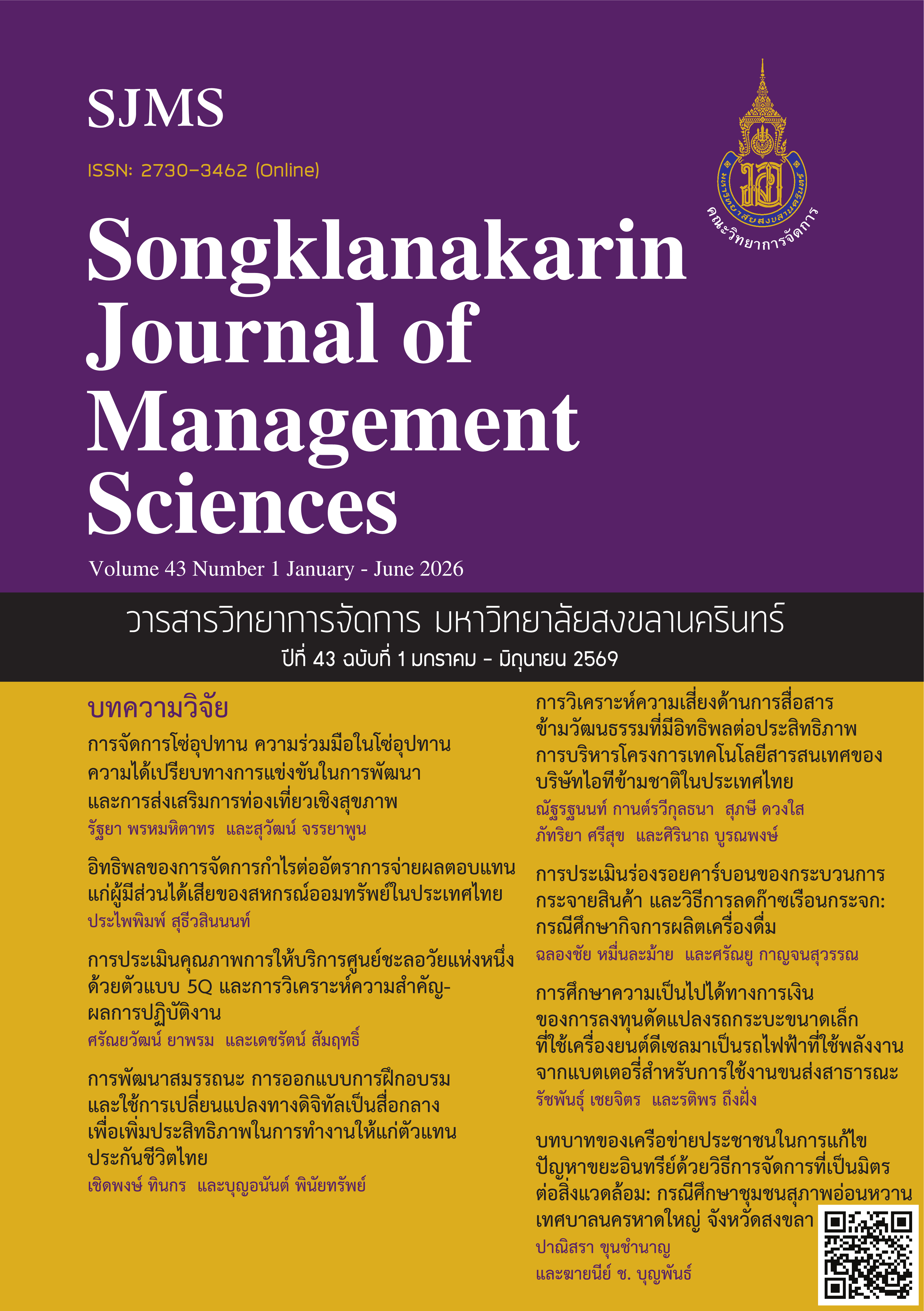
The Influence of Earnings Management on Stakeholder Returns in Thai Savings and Credit Cooperatives
Article Sidebar
Main Article Content
Abstract
This research aims to examine the influence of earnings management on the stakeholder returns allocation in Thai Savings and Credit Cooperatives, including dividend rates, patronage refund rates, and board and staff bonus rates. The study employed secondary data from 263 savings cooperatives between 2015 and 2024, totaling 2,630 observations. The analysis was conducted using a panel data approach with a Fixed Effect model. The results indicate that earnings management has a statistically significant negative influence on dividend rates at the significant 0.10 level, while no significant influence was found on patronage refund rates or board and staff bonus rates. Conversely, profitability, cooperative size, and the growth of reserve and accumulated funds have a positive influence on stakeholder payouts. These findings suggest that the return allocations in Savings and Credit Cooperatives are associated with profitability and internal financial stability. Furthermore, as cooperative payouts are subject to legal and regulatory frameworks that emphasize financial stability, earnings management is not employed as a signaling tool or a mechanism to increase returns for cooperative stakeholders.
Article Details

This work is licensed under a Creative Commons Attribution-NonCommercial-NoDerivatives 4.0 International License.
All published articles are SJMS’s copyright. The editorial board allows all published articles to be copied, excerpted, or disseminated with academic citation.
References
Abu Afifa, M., Saleh, I., Al-shoura, A., & Vo Van, H. (2024). Nexus among board characteristics, earnings management and dividend payout: evidence from an emerging market. International Journal of Emerging Markets, 19(1), 106-133.
Ali, A. G., Muema, W., & Muriuki, M. (2021). Influence of profitability on dividend payout in deposit-taking savings and credit co-operatives (SACCOs) in Kenya. International Academic Journal of Economics and Finance, 3(7), 147-158.
Ali, S., Jiang, J., Murtaza, G., & Khan, M. (2022). Influence of real earning management on subsequent dividend payout decisions and corporate returns: A case of developing economy. Frontiers in Environmental Science, 10, 882809.
Almutairi, A. R. (2021). Earnings management and the role of MOSAL in co-ops. Journal of Co-operative Organization and Management, 9(1), 100131.
Assenso-Okofo, O., Jahangir Ali, M., & Ahmed, K. (2021). The impact of corporate governance on the relationship between earnings management and CEO compensation. Journal of Applied Accounting Research, 22(3), 436-464.
Ben Salah, O., & Jarboui, A. (2024). The relationship between dividend policy and earnings management: a causality analysis. Journal of Economics, Finance and Administrative Science, 29(57), 166-185.
Brushwood, J. D., Hall, C. M., & Lusch, S. J. (2022). Credit unions and earnings management to mitigate political scrutiny over tax-exempt status. Journal of Accounting and Public Policy, 41(4), 106907.
Chansarn, S., & Chansarn, T. (2016). Earnings Management and Dividend Policy of Small and Medium Enterprises in Thailand1. International journal of business and society, 17(2).
Cooperative Promotion Department. (2024). Savings and credit cooperatives registry and performance report. Retrieved October 1st,2025 from https://cpd.go.th/information-cpd/info-data-cpd.html
Dakhli, A., & Houcine, A. (2025). Does CEO compensation affect earnings management in France? The mediating effect of corporate social responsibility. Society and Business Review, 20(2), 319-346.
Dechow, P. M., Ge, W., Larson, C. R., & Sloan, R. G. (2011). Predicting material accounting misstatements. Contemporary Accounting Research, 28(1), 17-82.
Dechow, P. M., Sloan, R. G., & Sweeney, A. P. (1995). Detecting earnings management. Accounting Review, 27(2), 193-225.
Hair Jr, J. F., Black, W. C., Babin, B. J., & Anderson, R. E. (2010). In Multivariate data analysis (7th ed.): Prentice-Hall.
Haq, M., Ongena, S., Pu, J., & Tan, E. K. (2024). Do banks engage in earnings management? The role of dividends and institutional factors. Journal of Banking & Finance, 168, 107287.
Hausman, J. A., & Taylor, W. E. (1981). Panel data and unobservable individual effects. Econometrica: Journal of the econometric society, 49(6), 1377-1398.
Javaid, A., Fatima, K., & Karamat, M. (2025). Impact of earnings management on dividend policy: does board independence matter? Journal of Economic and Administrative Sciences, 41(4), 1711-1726.
Jones, J. J. (1991). Earnings management during import relief investigations. Journal of accounting research, 29(2), 193-228.
Kitiwong, W., Sutheewasinnon, P., & Srijunpetch, S. (2021). Earnings Management Detection for Thai Saving Cooperatives. Journal of Accounting Professions, 17(55), 56-97.
Kothari, S. P., Leone, A. J., & Wasley, C. E. (2005). Performance matched discretionary accrual measures. Journal of accounting and economics, 39(1), 163-197.
Naaman, C. (2026). Earnings Management by Credit Unions: In Managers’ or Members’ Interest? Journal of Corporate Accounting & Finance, 37(2), 59-70.
Qi, B., Lin, J. W., Tian, G., & Lewis, H. C. X. (2018). The impact of top management team characteristics on the choice of earnings management strategies: Evidence from China. Accounting Horizons, 32(1), 143-164.
Rueangsuwan, S. (2022). Introduction to Earnings Management (2nd ed.). Bangkok: Livne and Rueang Company Limited.
Spence, M. (1973). Job Market Signaling. The Quarterly Journal of Economics, 87(3), 355-374.
Sugiyanto, S., Nur’aeni, N. a., & Dewi, L. S. (2023). Determinant Factors of Dividend Policy in Cooperative Organization. International Journal of Research in Community Services, 4(1), 1-10.
Wooldridge, J. M. (2010). Econometric analysis of cross section and panel data: MIT press.
Yahaya, O. A. (2025). The nexus between CEO incentives and earnings management. International Business Review, 18(6), 485-515.
