
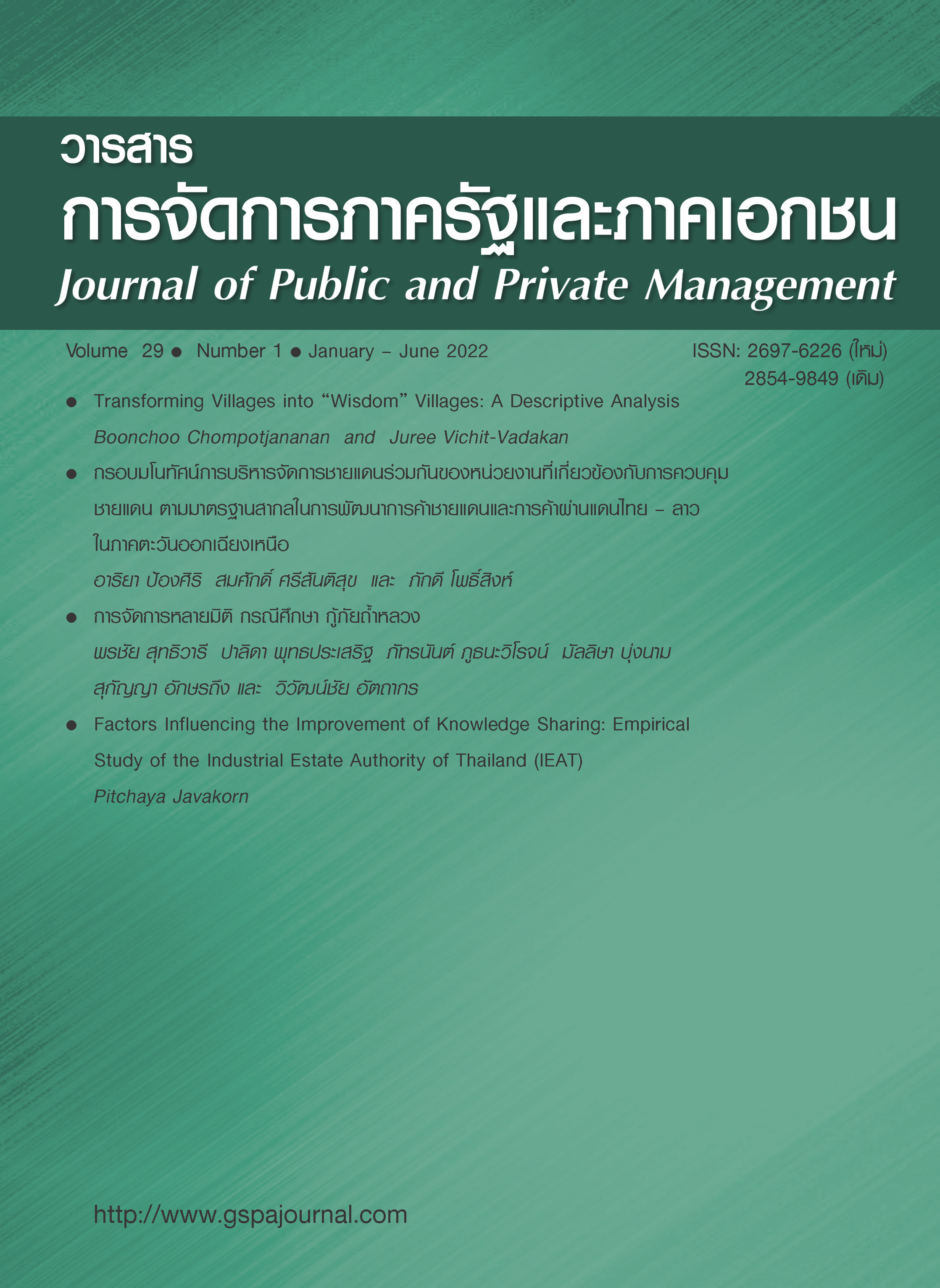
Factor Influencing the Improvement of Knowledge Sharing: Empirical Study of the Industrial Estate Authority of Thailand (IEAT).
คำสำคัญ:
Learning organization culture, Individual’s perceived organizational commitment to knowledge sharing, Organizational citizenship behavior, Extrinsic motivation, Knowledge sharingบทคัดย่อ
การศึกษาครั้งนี้มีวัตถุประสงค์เพื่อศึกษาปัจจัยต่างๆที่ส่งผลต่อการถ่ายทอดความรู้ของบุคลากรในองค์กร กรณีศึกษา การนิคมอุตสาหกรรมแห่งประเทศไทย โดยอ้างอิงตัวแปรทางวัฒนธรรม (วัฒนธรรมองค์กร), ตัวแปรทางจิตวิทยา (พฤติกรรมการเป็นสมาชิกที่ดีขององค์กร), และ ตัวแปรทางพฤติกรรม (ทัศนะของปัจเจกบุคคลที่มีต่อความรับผิดชอบขององค์กรในการถ่ายทอดความรู้), (แรงจูงใจภายนอก) ใช้วิธีวิจัยเชิงปริมาณในการศึกษา การเก็บรวบรวมข้อมูลใช้แบบสอบถาม จากพนักงานประจำของการนิคมอุตสาหกรรมแห่งประเทศไทยจำนวน 247คน ผลการศึกษาพบว่าทุกตัวแปรมีความสัมพันธ์ทางสถิติที่สำคัญกับการถ่ายถอดความรู้ โดยวัฒนธรรมองค์กรมีความสัมพันธ์ทางสถิติทั้งในทางตรงและทางอ้อม ในขณะที่ตัวแปรอื่นๆ; พฤติกรรมการเป็นสมาชิกที่ดีขององค์กร, ทัศนะของปัจเจกบุคคลที่มีต่อความรับผิดชอบขององค์กรในการถ่ายทอดความรู้, และ แรงจูงใจภายนอกมีความสัมพันธ์ทางสถิติทางตรงเพียงทางเดียว นอกจากนั้นประโยชน์ที่ได้รับจากผลการวิจัย ทั้งในทางทฤษฏีและทางปฏิบัติรวมถึงแนวทางการวิจัยในอนาคตและข้อจำกัดของการวิจัยในครั้งนี้ถูกนำเสนอในบทความนี้
Downloads
เอกสารอ้างอิง
Bartol, K. M., & Srivastava, A. (2002). Encouraging knowledge sharing: The role of organizational reward systems. Journal of Leadership & Organizational Studies, 9, 64-76.
Bock, G. W., & Kim, Y. G. (2002). Breaking the myths of rewards: An exploratory study of attitudes about knowledge sharing. Information Resources Management Journal, 15(2), 14-21.
Bock, G., Zmud, R., & Lee, J. N. (2005). Behavioral intention formation in knowledge sharing. MIS Quarterly, 29(1), 87-111.
Björkman, I., Rasmussen, W. B., & Li, L. (2004). Managing knowledge transfer in MNCs: The impact of headquarters control mechanisms. Journal of International Business Studies, 35, 443-455.
Cabrera, W. C. C., & Salgado, J. F. (2006). Determinants of individual engagement in knowledge sharing. The International Journal of Human Resource Management, 17, 245-264.
Chakravarthy, B., Zaheer, A., & Zaheer, S. (1999). Knowledge Sharing in Organizations: A Field Ftudy. St. Paul, MN: Strategic Management Resource Center, University of Minnesota.
Coleman, J. S. (1990). Foundations of Social Theory. Cambridge, MA, and London: The Belknap Press of Harvard University Press.
Confessore, S. J., & Kops, W. J. (1998). Self-directed learning and the learning organization: Examining the connection between the individual and the learning environment. Human Resource Development Quarterly, 9(4), 365-375
De Long, D. W., & Fahey, L. (2000). Diagnosing cultural barriers to knowledge management. The Academy of Management Executive, 14(4), 113-127.
Dyer, J. H., & Nobeoka, K. (2000). Creating and managing a high-performance Knowledge-sharing network: The Toyota case. Strategic Management Journal, 21(3), 345-367.
Earl, M. (2001). Knowledge management strategies: Towards a taxonomy. Journal Management Information Systems, 18, 215-233.
Frey, B. S., & Osterloh, M. (2005). Yes, managers should be paid like bureaucrats. Journal of Management Inquiry, 1 4, 96-111.
Foss, N. J., Minbaeva, D., Pedersen, T., & Reinholt, M. (2009). The impact of autonomy, task identity, and feedback on employee motivation to share knowledge. Human Resource Management, 48, 871-893
Garvin, D. A. (1993). Building a learning organization. Harvard Business Review, 7(1), 78-91.
Gupta, A. K., & Govindarajan, V. (2000). Knowledge management’s social dimension: Lessons from Nucor Steel. Sloan Management Review, 42(1), 71-80.
Hendriks, P. (1999). Why share knowledge? The influence of ICT on the motivation for knowledge sharing. Knowledge and Process Management, 6(2), 91-100.
Hislop, D. (2003). Linking human resource management and knowledge management via commitment: A review and research agenda. Employee Relations, 25, 182-202.
Ipe, M. (2003). Knowledge sharing in organizations: A conceptual framework. Human Resource Development Review, 2, 337-359.
Joo, B., & Lim, T. (2009). The impacts of organizational learning culture and proactive personality on organizational commitment and intrinsic motivation: The mediating role of perceived job complexity. Journal of Leadership & Organizational Studies, 15, 48-60.
Kaiser, H. F. (1974). An index of factorial simplicity. Psychometrika, 39, 31-36.
Krejcie, R. V., & Morgan, D. W. (1970). Determining Sample Size for Research Activities. Educational and Philological Management.
Kuehn, K. W., & Al-Busaidi, Y. (2002). Citizenship behavior in a non-Western context: an examination of the role of satisfaction, commitment and job characteristics on self-reported OCB. International Journal of Commerce & Management, 12(2), 107-125.
Kumari, S. S. S. (2008). Multicollinearity: Estimation and elimination. Journal of Contemporary Research in Management, 3(1), 87-95.
Lam, A. (1997). Embedded firms, embedded knowledge: Problem of collaboration and knowledge transfer in global cooperative ventures. Organization Studies, 18(6), 973-996.
Liebowitz, J. (1999). Key ingredients to the success of an organization’s knowledge management strategy. Knowledge and Process Management, 6(1), 37-40.
Lin, H., & Lee, G. (2004). Perceptions of senior managers toward knowledge-sharing behavior. Management Decision, 42, 108-125.
Mathieu, J. E., & Zajac, D. M. (1990). A review and meta-analysis of the antecedents, correlates, and consequences of organizational commitment. Psychological Bulletin, 108, 171-194.
Milne, P. (2001). Rewards, recognition and knowledge sharing: seeking a causal link. Australian Academic Research Libraries, 32(4), 321-332.
Minbaeva, D. B., Makela, K., & Rabbiosi, L. (2012). Linking HRM and knowledge transfer via individual mechanism. Human Resource Management, May–June 2012, 51(3). 387–405.
Minbaeva, D., & Pedersen, T. (2010). What drives knowledge sharing behavior of individuals? International Journal of Strategic Change Management, 2, 200–222.
Nahapiet, J., & Ghoshal, S. (1998). Social capital, intellectual capital, and the organizational advantage. Academy of Management Review, 23, 242-266.
Nonaka, I., & Takeuchi, H. (1995). The Knowledge-Creating Company: How Japanese Companies Create the Dynamics of Innovation. New York: Oxford University Press.
O’Brien, R. M. (2007). A caution regarding rule of thumb for variance inflation factors. Quality and Quantity, 41, 673-690.
O’Reilly, C., & Pondy, L. (1980). Organizational communication. In Kerr, S. (Ed.). Organizational Behavior. Columbus, OH: Grid.
Organ, D. W. (1988). Organizational Citizenship Behavior: The Good Soldier Syndrome. Lexington, MA: Lexington Books.
Osterloh, M., & Frey, B. S. (2000). Motivation, knowledge transfer, and organizational forms. Organization Science, 11, 538-550.
Osterloh, M., Frost, J., & Frey, B. (2002). The dynamics of motivation in new organizational forms. International Journal of the Economics of Business, 9, 61-77.
Quinn, J. B., Anderson, P., & Finkelstein, S. (1996). Leveraging intellect. Academy of Management Executive, 10, 7-27.
Robertson, M., & Hammersley, G. (2000). Knowledge management practices within a knowledgeintensive firm: The significance of the people management dimension. Journal of European Industrial Training, 24, 241-253.
Sekaran, U. (2003). Research Methods for Business: A Skill Building Approach. New York: John Wiley.
Song, J. H., Joo, B., & Chermack, T. J. (2009). The dimensions of learning organization questionnaire (DLOQ): A validation study in Korean context. Human Resource Development Quarterly, 20, 43-64.
Somech, A., & Drach-Zahavy, A. (2004). Exploring organizational citizenship behavior from an organizational perspective: The relationship between organizational learning and organizational citizenship behavior. Journal of Occupational and Organizational Psychology, 77, 281-298.
Sung, J. J., & Baek, K. J, (2011). Knowledge sharing: The influences of learning organization culture, organizational commitment, and organizational citizenship behavior. Journal of Leadership & Organizational Studies, 18(3) 353-364.
Smith, C. A., Organ, D. W., & Near, J. P. (1983). Organizational citizenship behavior: Its nature and antecedents. Journal of Applied Psychology, 68, 655-663.
Watkins, K. E., & Marsick, V. J. (1997). Dimensions of the Learning Organization. Warwick, RI: Partners for the Learning Organization.
Wayne, S., Shore, L., & Liden, R. (1997). Perceived organizational support and leader-member exchange: A social exchange perspective. Academy of Management Journal, 40, 82-111.
Werner, J. M. (2000). Implications of OCB and contextual performance for human resource management. Human Resource Management Review, 10, 3-24.
Yu, C., & Chu, T. (2007). Exploring knowledge contribution from an OCB perspective. Information & Management, 44, 321-331.
ดาวน์โหลด
เผยแพร่แล้ว
รูปแบบการอ้างอิง
ฉบับ
ประเภทบทความ
สัญญาอนุญาต

อนุญาตภายใต้เงื่อนไข Creative Commons Attribution-NonCommercial-NoDerivatives 4.0 International License.

