
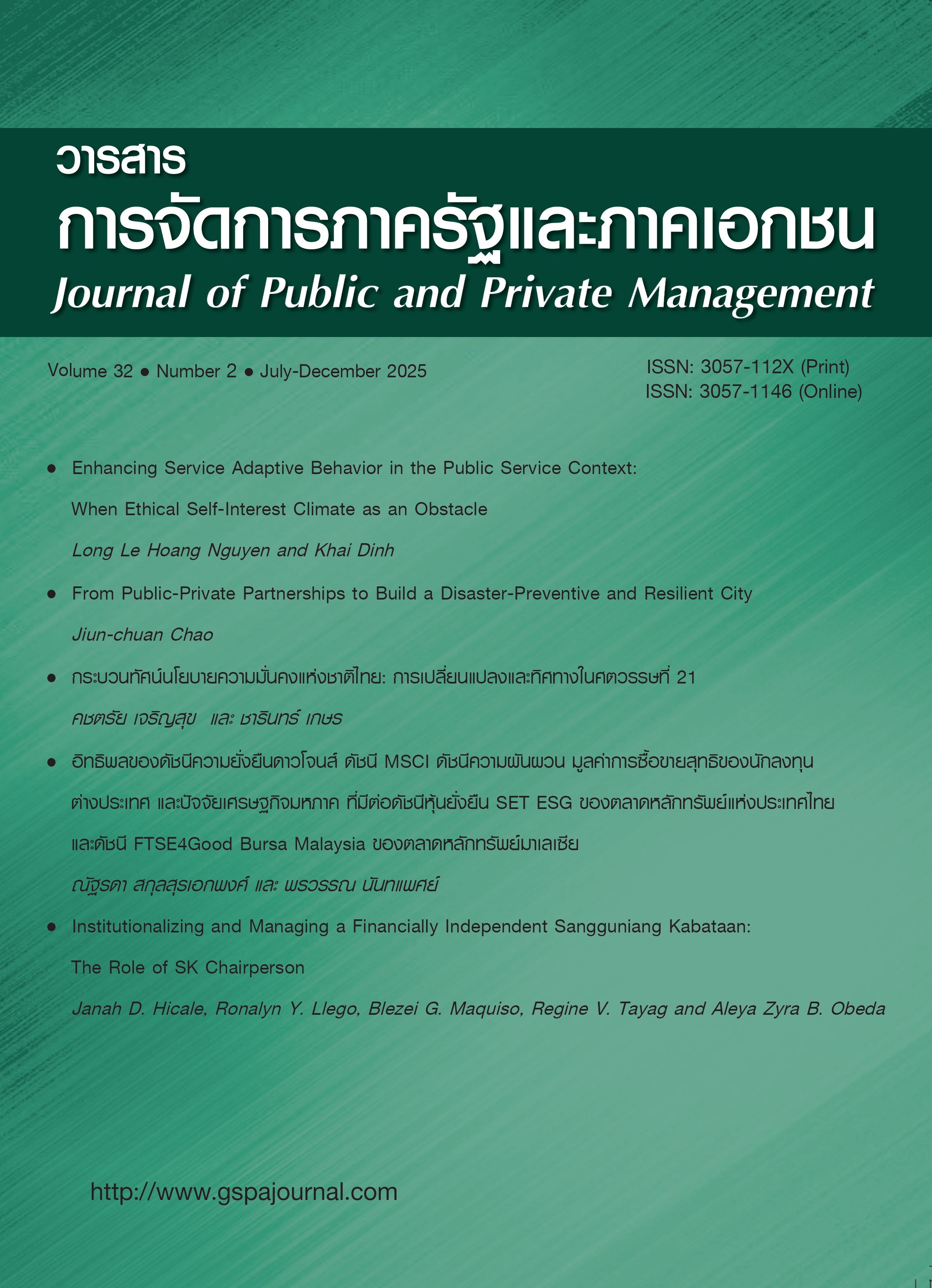
อิทธิพลของดัชนีความยั่งยืนดาวโจนส์ ดัชนี MSCI ดัชนีความผันผวน มูลค่าการซื้อขายสุทธิของนักลงทุนต่างประเทศ และปัจจัยเศรษฐกิจมหภาค ที่มีต่อดัชนีหุ้นยั่งยืน SET ESG ของตลาดหลักทรัพย์แห่งประเทศไทย และดัชนี FTSE4Good Bursa Malaysia ของตลาดหลักทรัพย์มาเลเซีย
คำสำคัญ:
ดัชนีความยั่งยืนดาวโจนส์, ดัชนี MSCI, ดัชนีความผันผวน, ดัชนีหุ้นยั่งยืนของประเทศไทย (SET ESG), ดัชนีหุ้นยั่งยืนของประเทศมาเลเซีย (FTSE4Good Bursa Malaysia)บทคัดย่อ
การศึกษาครั้งนี้มีวัตถุประสงค์เพื่อศึกษาอิทธิพลของดัชนีความยั่งยืนดาวโจนส์ ดัชนี MSCI ดัชนีความผันผวน มูลค่าการซื้อขายสุทธิของนักลงทุนต่างประเทศ และปัจจัยเศรษฐกิจมหภาค ที่มีต่อดัชนีหุ้นยั่งยืน SET ESG ของตลาดหลักทรัพย์แห่งประเทศไทย และดัชนี FTSE4Good Bursa Malaysia ของตลาดหลักทรัพย์มาเลเซีย ตัวแปรอิสระถูกแบ่งออกเป็น ดัชนีความยั่งยืนดาวโจนส์, ดัชนี MSCI, ดัชนีความผันผวน, มูลค่าการซื้อขายสุทธิของนักลงทุนต่างประเทศ, และปัจจัยเศรษฐกิจมหภาค ได้แก่ อัตราแลกเปลี่ยน และราคาน้ำมันดิบ ข้อมูลทุติยภูมิที่ใช้ในงานวิจัยนี้ ถูกเก็บรวบรวมข้อมูลย้อนหลังเป็นรายวัน ระยะเวลาในการศึกษาเริ่มตั้งแต่วันที่ 1 มกราคม 2563 ถึง 31 ธันวาคม 2567 เป็นระยะเวลา 5 ปี โดยใช้การวิเคราะห์ด้วยการถดถอยเชิงเส้นพหุคูณ
ผลการศึกษาพบว่า ดัชนีความยั่งยืนดาวโจนส์มีความสัมพันธ์ในทิศทางเดียวกันกับดัชนี FTSE4Good Bursa Malaysia ของตลาดหลักทรัพย์มาเลเซีย ดัชนี MSCI มีความสัมพันธ์ในทิศทางเดียวกันกับดัชนีหุ้นยั่งยืน SET ESG ของตลาดหลักทรัพย์แห่งประเทศไทยและดัชนี FTSE4Good Bursa Malaysia ของตลาดหลักทรัพย์มาเลเซีย ดัชนีความผันผวนและราคาน้ำมันดิบมีความสัมพันธ์ในทิศทางเดียวกันกับดัชนีหุ้นยั่งยืน SET ESG ของตลาดหลักทรัพย์แห่งประเทศไทย มูลค่าการซื้อขายสุทธิของนักลงทุนต่างประเทศมีความสัมพันธ์ในทิศทางเดียวกันกับดัชนี FTSE4Good Bursa Malaysia ของตลาดหลักทรัพย์มาเลเซีย อัตราแลกเปลี่ยนมีความสัมพันธ์ในทิศทางตรงกันข้ามกับดัชนีหุ้นยั่งยืน SET ESG ของตลาดหลักทรัพย์แห่งประเทศไทย ในขณะที่อัตราแลกเปลี่ยนมีความสัมพันธ์ในทิศทางเดียวกันกับดัชนี FTSE4Good Bursa Malaysia ของตลาดหลักทรัพย์มาเลเซีย อย่างไรก็ตามดัชนีความยั่งยืนดาวโจนส์และมูลค่าการซื้อขายสุทธิของนักลงทุนต่างประเทศไม่มีความสัมพันธ์อย่างมีนัยสำคัญกับดัชนีหุ้นยั่งยืน SET ESG ของตลาดหลักทรัพย์แห่งประเทศไทย ดัชนีความผันผวนและราคาน้ำมันดิบไม่มีความสัมพันธ์อย่างมีนัยสำคัญกับดัชนี FTSE4Good Bursa Malaysia ของตลาดหลักทรัพย์มาเลเซีย
Downloads
เอกสารอ้างอิง
Akbulaev, N., Mammadli, E., & Bayramli, G. (2022). The effect of energy prices on stock indices in the period of COVID-19: Evidence from Russia, Turkey, Brazil, and India. International Journal of Energy Economics and Policy, 12(3), 262–269. https://doi.org/10.32479/ijeep.12919
Angkatawiwat, K. (2014). The Determinants Affecting Stock Market Index in The Stock Exchange of Thailand [Master of Economics thesis, Kasetsart University]. KU E-Thesis.
Atittayaratsakul, N., & Rangkakulnuwat, P. (2018). Volatility Forecasting for MSCI Index of Emerging Markets in Southeast Asia by Generalized Autoregressive Conditional Heteroskedasticity Model. Proceedings of the 13th Graduate Research Conference. (pp. 2685–2691). University of the Thai Chamber of Commerce.
Baker, E., Braga-Alves, M. V., & Morey, M. R. (2022). Exchange rate changes and ESG: Predicting exchange rate changes using country environmental, social, and governance ratings. Journal of Investment Consulting, 21(1), 15–29.
Bagh, T., Azad, T., Razzaq, S., Liaqat, I., & Khan, M. A. (2017). The Impact of Exchange Rate Volatility on Stock Index: Evidence from Pakistan Stock Exchange (PSX). International Journal of Academic Research in Accounting, Finance and Management Sciences, 7(3), 70-86. http://dx.doi.org/10.6007/IJARAFMS/v7-i3/3150
Dyck, A., Lins, K. V., Roth, L., & Wagner, H. F. (2019). Do institutional investors drive corporate social responsibility? International evidence. Journal of Financial Economics, 131(3), 693-714. https://doi.org/10.1016/j.jfineco.2018.08.013
Freeman, R. E. (1984). Strategic management: A stakeholder approach. Pitman.
Friede, G., Busch, T., & Bassen, A. (2015). ESG and financial performance: Aggregated evidence from more than 2000 empirical studies. Journal of Sustainable Finance & Investment, 5(4), 210-233. https://doi.org/10.1080/20430795.2015.1118917
Froot, K. A., & Thaler, R. H. (1990). Anomalies: Foreign exchange. Journal of Economic Perspectives, 4(3), 179-192. https://doi.org/10.1257/jep.4.3.179
Garel, A., & Petit-Romec, A. (2021). Investor rewards to environmental responsibility: Evidence from the COVID-19 crisis. Journal of Corporate Finance, 68, 101948. https://doi.org/10.1016/j.jcorpfin.2021.101948
Guliyeva, S. (2023). Analysis of the effect of energy prices on stock indexes during the epidemic crisis. International Journal of Energy Economics and Policy, 13(2), 526–536. https://doi.org/10.32479/ijeep.14052
Hawn, O., Chatterji, A. K., & Mitchell, W. (2018). Do investors actually value sustainability? New evidence from investor reactions to the Dow Jones Sustainability Index (DJSI). Strategic Management Journal, 39(4), 949-976. https://doi.org/10.1002/smj.2752
Huang, W., Chakrabarti, R., Lee, J., & Jayaraman, N. (2002, June 26-29). The ‘Index Effect’ on Stock Prices and Trading Volumes: International Evidence [Conference Paper]. EFMA 2002 Annual Meetings, London, England. https://doi.org/10.2139/SSRN.313944
Jang, B. H., Cho, S., & Lee, J. (2020). Exchange rate volatility and sustainable investment: Evidence from Asian stock markets. Journal of Sustainable Finance & Investment, 10(3), 295-310. https://doi.org/10.1080/20430795.2020.1728047
López, M. V., Garcia, A., & Rodriguez, L. (2007). Sustainable development and corporate performance: A study based on the Dow Jones Sustainability Index. Journal of Business Ethics, 75(3), 285-300. https://doi.org/10.1007/s10551-006-9253-8
Nguyen, P., Kecskés, A., & Mansi, S. (2020). Does corporate social responsibility create shareholder value? The importance of the institutional environment. Journal of Banking & Finance, 112, 105217. https://doi.org/10.1016/j.jbankfin.2017.09.013
Niemcharoen, N., & Pongsupatt, A. (2023). Factors Affecting the Thailand Sustainability Investment Index. Procedia of Multidisciplinary Research, 1(7), 127.
Pattarasen, W. (2017). Sustainability Index. https://setsustainability.com/download/r86phity9mxkjs1i
Porter, M. E., & Kramer, M. R. (2011). Creating shared value. Harvard Business Review, 89(1/2), 62-77.
Ruan, L. (2018). Research on sustainable development of the stock market based on VIX index. Sustainability, 10(11), 4036. https://doi.org/10.3390/su10114113
Ruxariyatham, N. (2011). Relationships between Economic Factors and Industries Stock Indices [Master’s thesis, Faculty of Commerce and Accountancy, Thammasat University]. TU Digital Collections.
Serbu, R. S., Iancu, A.-N., & Rotar, E. (2022). A possible predictive causality between the new global trend, environmental, social, and governance (ESG) and market sentiment through “gold futures/VIX” ratio. Revista Economic, 74(4), 91-99. https://doi.org/10.56043/reveco-2022-0040
Sparkes, R., & Cowton, C. J. (2004). The maturing of socially responsible investment: A review of the developing link with corporate social responsibility. Journal of Business Ethics, 52(1), 45-57. https://doi.org/10.1023/B:BUSI.0000033106.43260.99
Tanchajchaval, S. (2013). Affect of MSCI Index Addition-Deletion to Stock Return. [Independent study, Faculty of Commerce and Accountancy, Thammasat University]. TU Digital Collections.
Termprasertsakul, S., & Sombatwattana, P. (2017). How does the movement of exchange rate affect listed firms in Thailand?. Research Revenue Project, Faculty of Social Sciences, Srinakharinwirot University. https://hdl.handle.net/20.500.14740/12989
Thanalerskulthon, P., & Punpocha, S. (2020). Study of the volatility of external factors affecting the SET index. Proceedings of the 15th Graduate Research Conference, Academic Year 2020. (pp. 2673–2686). Graduate School of Rangsit University.
The Stock Exchange of Thailand. (2024). SET ESG index profile. SET. https://www.set.or.th/th/market/index/setesg/profile
The Stock Exchange of Thailand. (2024). News of the stock exchange of Thailand SET ESG. SET. https://www.set.or.th/th/market/news-and-alert
The Stock Exchange of Thailand. (2023). Sustainability report 2023. SET. https://www.set.or.th/th/market/news-and-alert
Thongsaichon, N. (2022). ESG investment in the modern world. The Stock Exchange of Thailand. https://www.setinvestnow.com/th/knowledge/article/165-tsi-invest-in-esg-stocks-in-new-investment-era
Treerasahagul, T., & Tuvadaratragoo, S. (2018). The Economic determinants affecting the stock market index in the Stock Exchange of Thailand. Srinakharinwirot Business Journal, 9(2), 12-29.
Wareedee, T. (2016). The Influence of Net Purchase of Foreign Investors and Local Institutions on the SET50 Index. [Independent study, Bangkok University]. BU Research.
ดาวน์โหลด
เผยแพร่แล้ว
รูปแบบการอ้างอิง
ฉบับ
ประเภทบทความ
สัญญาอนุญาต

อนุญาตภายใต้เงื่อนไข Creative Commons Attribution-NonCommercial-NoDerivatives 4.0 International License.

