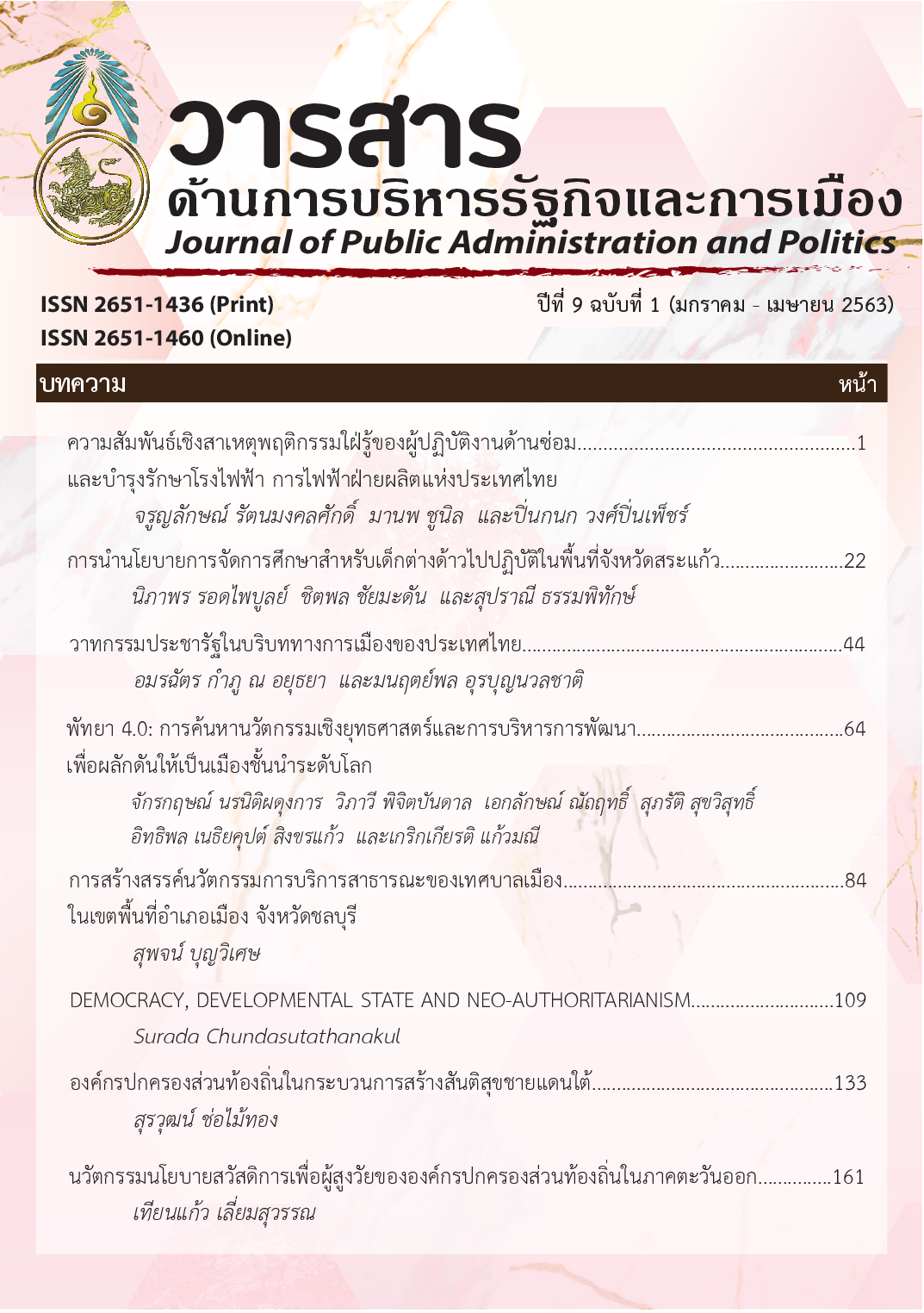
PATTAYA 4.0: A SEARCH FOR INNOVATIVE STRATEGIES AND DEVELOPMENT ADMINISTRATION THEORY TO MAKE IT A WORLD-CLASS TOURIST DESTINY
Article Sidebar
Main Article Content
Abstract
This research had three objectives which were: (1) to study the potentialities of Pattaya City administration and what were the problems and obstacles from the present operation; (2) to study the concepts of knowledgeable and experienced persons and futurists in bring Pattaya City to a world-class city according to Thailand 4.0 policy; and (3) to study guidelines to bring Pattaya City to a world-class city to Thailand 4.0 policy.
This research used the Futuristic Forecast by studying from 7 data sources including observation, document study, interview with staff and important people in the area, inquiry of national and regional experts and academics.
The results of the study found that: (1) Pattaya City has made great progress, the first was caused by the administration of the government and another because the private sector has contributed implemented quality, therefore resulting in Pattaya City being well-prepared in many ways, but still has an important weakness, namely, the administration still used the old style, which was to act according to the capacity, to act according to the pattern of other cities or central has recommended to de, so urban development was slow and not timely for the modern world that highly competitive; (2) Forecasts of the future according to the opinion of national and regional experts, including academics, there were comments that Pattaya City was still a tourist destination that matched the taste of foreigners and Thais, however, due to rapid internal and external changes, it was important to adapt Pattaya City to Pattaya 4.0 as the presentations of thinkers and scholars of this group were very important to Pattaya City development; and (3) Pattaya City needed to improve its vision and strategy to cover all aspects, including using new conceptual framework for urban development, by 9 flagship projects which will drive Pattaya City to be Pattaya 4.0.
Article Details
References
- กรมส่งเสริมการปกครองส่วนท้องถิ่น. (ม.ป.ป.). คู่มือการจัดทำแผนพัฒนาท้องถิ่น แผนยุทธศาสตร์การพัฒนา แผนพัฒนา แผนปฏิบัติการ และการติดตามประเมินผล. กรุงเทพฯ: กรมส่งเสริมการปกครองส่วนท้องถิ่น.
- กรมส่งเสริมการปกครองส่วนท้องถิ่น. (2548). คู่มือการจัดทำแผนพัฒนาท้องถิ่นเทคนิคการจัดทำแผนพัฒนาท้องถิ่น แนวทางการสนับสนุนการจัดทำแผนแม่บทชุมชนเพื่อตนเองสำหรับองค์กรปกครองส่วนท้องถิ่น. กรุงเทพฯ: กรมส่งเสริมการปกครองส่วนท้องถิ่น.
- สำนักโฆษก สำนักเลขาธิการนายกรัฐมนตรี. (2560). นโยบาย Thailand 4.0 คืออะไร. วารสารไทยคู่ฟ้า. เล่มที่ 33 (มกราคม-มีนาคม), หน้า 4-5. สืบค้นจาก https://spm.thaigov.go.th/FILEROOM/spm-thaigov/DRAWER004/
GENERAL/DATA0000/00000368.PDF
- Bass, B. M. and Arolio, B. J. (1993). Transformational leadership: A response to critiques. In M. M. Chemers and R. Ayman (Eds.), Leadership Theory and Research Perspectives and Direction (pp.49-50). Sandiago, CA: Academic Press.
- Burns, J. M. and Arolio, B. J. (1994). Improving organizational electiveness through transformation leadership. Newberg Park, CA: Sage Publication.
- Eigen, Jochen. (1996, February). Sustainable cities and local governance: Briefing for the international workshop on approaches to participatory local governance, 1-2 February 1996. New York: United Nations.
- Gilbert, Richard, Stevenson, Don, Girardet, Herbert and Stren, Richard. (1996). Making cities work: The role of local authorities in the urban environment. London: Earth Scan Publications, Ltd.
- Hill, Charles W. L. and Jones, Gareth R. (2009). Theory of strategic management with cases (8th ed.). Mason, Ohio: South-Western.
- Osborne, Stephen P. (Ed.). (2010). The new public governance: Emerging perspectives on the theory and practice of public governance. New York: Rutledge.
- Pattanaik, B. K. (2016). Introduction to development studies. New Delhi: Sagel Texts.
- Wills, Kenneth G., Turner, R. Kerry, and Bateman, Ian J. (2001). Urban planning and management. Cheltenham: Edward Elgar.
