
Evidence-Based Management Concept for Case Assignment in the Courts of Justice
Article Sidebar
Main Article Content
Abstract
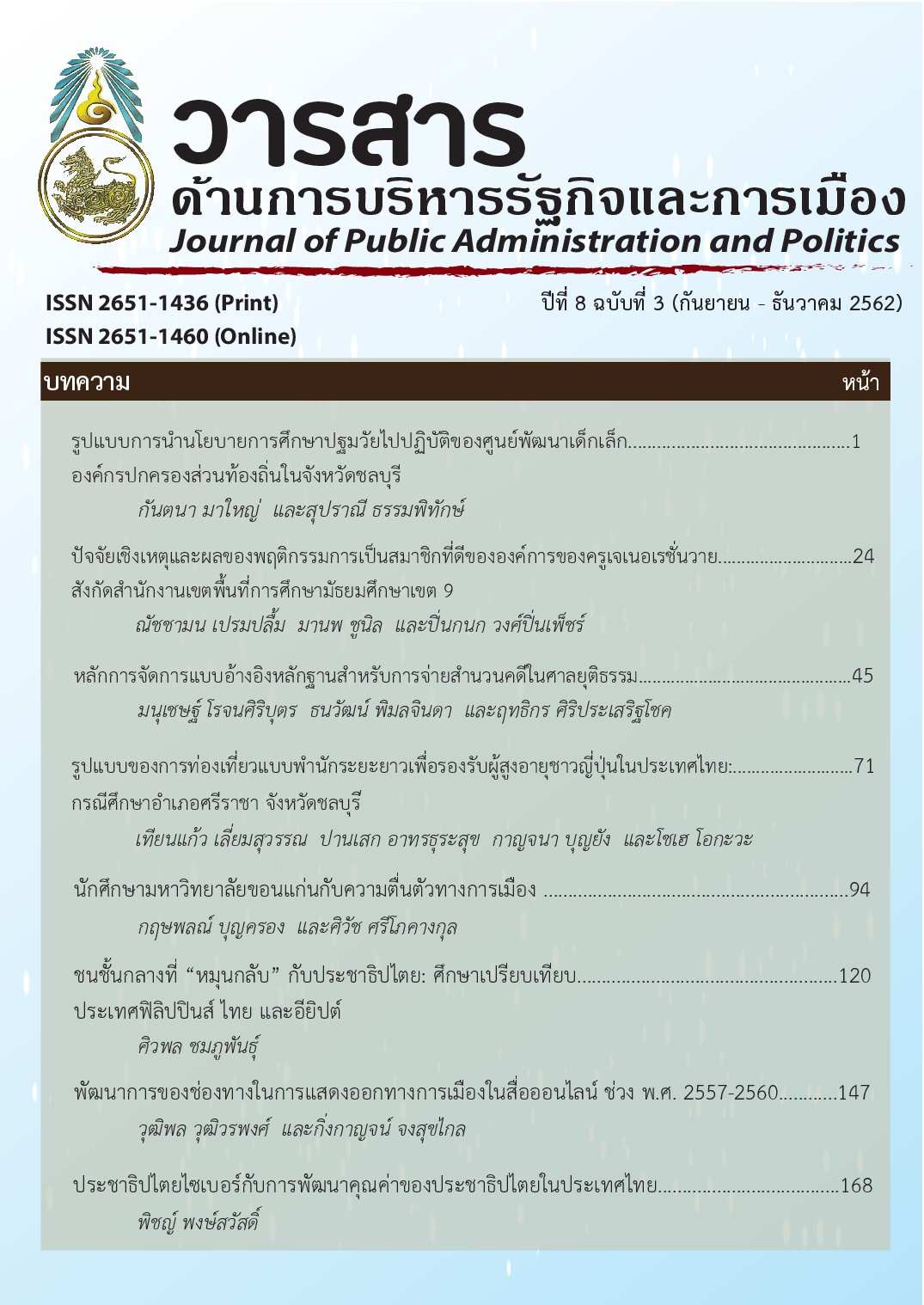
The objective of research was to study the problems be arising from the current regulations of case assignment to a judge in the Courts of Justice. It also was to study the suitability of applying the evidence-based management and human resources management to case assignment. Furthermore, it was to study the format or guidelines of applying the evidence-based management and human resources management to case assignment pursuant to the context of the Courts of Justice. The study used both qualitative and quantitative methods. The qualitative method was conducted by using in-depth interview with Chief Justice, Deputy Chief Justice, Chief Judge, Presiding Judge and Judges, and tool used was structured in-depth interviews. The quantitative method was conducted by collecting opinions and suggestions from 400 the judges of the Courts of Justice across the country. The instrument was a questionnaire. The statistics employed in quantitative data analysis were percentage, mean, standard deviation, and confirmatory factor analysis. The results concluded that there was no clarity in the current of case assignment to a judge in the Courts of Justice, especially the concept of expertise and the number of cases in charge for each judge. Concepts of evidence-based management were appropriate to be used in assignment case lawsuits to judges in the Courts of Justice. Because of it was a tool that was relevant and conducive to the integration of human resources management into the justice system, by using information of technology to help in its decision making. It also could be applied to the management of the assignment of the case to the judge in the Courts of Justice, according to the guidelines in accordance with the Statute of Courts of Justice and the Judicial Regulation of the Judiciary with the Assignment of the Case in 2001.
Article Details
References
- ประเวศ ประภานุกูล. (2553). ศาลยุติธรรม: ยุติอย่างเป็นธรรม หรือยุติความเป็นธรรม; ตอนที่ 5: ระบบศาลไม่สามารถมีใบสั่งจริงหรือ?. สืบค้นจาก http://prachatai.com/journal/2010/12/32278
- วีรยุทธ์ ศรีสุวรรณ. (2558). ทัศนคติของประชาชนในเขตกรุงเทพมหานครที่มีต่อภาพลักษณ์ของศาลยุติธรรม (วิทยานิพนธ์). สาขาวิชาสื่อสารการเมือง วิทยาลัยสื่อสารการเมือง มหาวิทยาลัยเกริก, กรุงเทพฯ.
- อัคญาณ อารยะญาณ. (2545). ทัศนะของผู้พิพากษาต่อกระบวนการพิจารณาพิพากษาคดีภายหลังการแยกศาลออกจากกระทรวงยุติธรรมตามรัฐธรรมนูญแห่งราชอาณาจักรไทย พ.ศ.2540 (วิทยานิพนธ์). สาขาวิชาการบริหารงานยุติธรรม คณะสังคมสงเคราะห์ศาสตร์ มหาวิทยาลัยธรรมศาสตร์, กรุงเทพฯ.
- Brindle, Margaret C. and Steams, Peter N. (2001). Facing up to management faddism. New York: Praeger.
- Durst, A., Tracy D., and Terry B. (2009). Evidence-based management. encyclopedia of public administration and policy. New York: Marcel Dekker.
- Government Accountability Office. (2009). Results-oriented management: Strengthening key practices at FEMA and interior could promote greater use of performance information. GAO-09-676. Washington, DC: Government Accountability Office.
- Hansen, H. and Olaf R. (2009). The evidence movement. Evaluation, 15(2), pp.141-163.
- Learmonth, Mark. (2008). Speaking out: Evidence-based management: A backlash against pluralism in organizational studies? Organization, 15(2), pp.283-291.
- Meier, K., and Laurence J. O’Toole Jr. (2008). The Proverbs of New Public Management: Lessons from an Evidence-Based Research Agenda. American Review of Public Administration, 39(1), pp.4-22.
- Moss, Simon, and Francis, Ronald. (2007). The science of management: Fighting fads and fallacies with evidence-based practice. Queensland: Australia Academic Press.
- Pawson, Ray. (2002). Evidence-based policy: In search of a method. Evaluation, 8(2), pp.157-181.
- Pfeffer, Jeffrey and Sutton, Robert I. (2006). Hard facts, dangerous half truths and total nonsense: Profiting from evidence-based management. Cambridge, MA: Harvard Business School Press.
- Radin, Beryl A.. (2008). The legacy of federal management change. In
- F. Stevens Redburn, Robert J. Shea, and Terry F. Buss. (Eds.), Performance-Based Management and Budgeting: How Governments Can Learn from Experience. Armonk, NY: M.E. Sharpe.
- Rousseau, Denise M. (2006). Keeping an open mind about evidence-based management: A reply to learmonth’s commentary. The Academy of Management Review, 31(4), pp.1091-1093.
- Rousseau, Denise M., and McCarthy, Sharon. (2007). Educating managers from an evidence based perspective. Academy of Management Learning and Education, 6(1), pp.84-101.
- Van, D., Wouter, Geert B., and John H. (2010). Performance Management in the Public Sector. New York: Routlege.
- Watson, D. (2009). Bendable learnings: The wisdom of modern management. Sydney, Australia: Random House.
