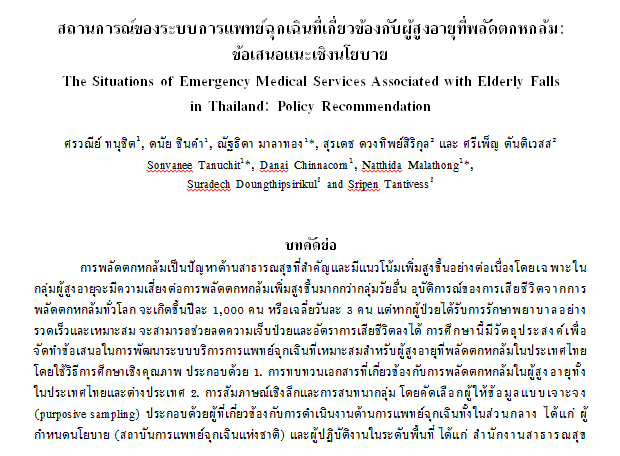
สถานการณ์ของระบบการแพทย์ฉุกเฉินที่เกี่ยวข้องกับผู้สูงอายุที่พลัดตกหกล้ม: ข้อเสนอแนะเชิงนโยบาย
คำสำคัญ:
ระบบบริการการแพทย์ฉุกเฉิน, ผู้สูงอายุ, พลัดตกหกล้มบทคัดย่อ
การพลัดตกหกล้มเป็นปัญหาด้านสาธารณสุขที่สำคัญและมีแนวโน้มเพิ่มสูงขึ้นอย่างต่อเนื่องโดยเฉพาะในกลุ่มผู้สูงอายุจะมีความเสี่ยงต่อการพลัดตกหกล้มเพิ่มสูงขึ้นมากกว่ากลุ่มวัยอื่น อุบัติการณ์ของการเสียชีวิตจากการพลัดตกหกล้มทั่วโลก จะเกิดขึ้นปีละ 1,000 คน หรือเฉลี่ยวันละ 3 คน แต่หากผู้ป่วยได้รับการรักษาพยาบาลอย่างรวดเร็วและเหมาะสม จะสามารถช่วยลดความเจ็บป่วยและอัตราการเสียชีวิตลงได้ การศึกษานี้มีวัตถุประสงค์เพื่อจัดทำข้อเสนอในการพัฒนาระบบบริการการแพทย์ฉุกเฉินที่เหมาะสมสำหรับผู้สูงอายุที่พลัดตกหกล้มในประเทศไทย โดยใช้วิธีการศึกษาเชิงคุณภาพ ประกอบด้วย 1. การทบทวนเอกสารที่เกี่ยวข้องกับการพลัดตกหกล้มในผู้สูงอายุทั้งในประเทศไทยและต่างประเทศ 2. การสัมภาษณ์เชิงลึกและการสนทนากลุ่ม โดยคัดเลือกผู้ให้ข้อมูลแบบเจาะจง (purposive sampling) ประกอบด้วยผู้ที่เกี่ยวข้องกับการดำเนินงานด้านการแพทย์ฉุกเฉินทั้งในส่วนกลาง ได้แก่ ผู้กำหนดนโยบาย (สถาบันการแพทย์ฉุกเฉินแห่งชาติ) และผู้ปฏิบัติงานในระดับพื้นที่ ได้แก่ สำนักงานสาธารณสุขจังหวัด (สสจ.) โรงพยาบาล และโรงพยาบาลส่งเสริมสุขภาพตำบล (รพ.สต.) สำนักงานพัฒนาสังคมและความมั่นคงของมนุษย์จังหวัด (พมจ.) องค์กรปกครองส่วนท้องถิ่น (อปท.) และมูลนิธิที่ปฏิบัติงานเกี่ยวกับการแพทย์ฉุกเฉิน รวมถึงผู้สูงอายุที่ใช้บริการการแพทย์ฉุกเฉินและเข้ารับบริการที่แผนกอุบัติเหตุและฉุกเฉินของโรงพยาบาล และ 3. การจัดประชุมผู้เชี่ยวชาญด้านผู้สูงอายุ ด้านการแพทย์ฉุกเฉิน ด้านเวชศาสตร์ฉุกเฉินสำหรับผู้สูงอายุ และผู้ปฏิบัติงานที่เกี่ยวข้องกับระบบการแพทย์ฉุกเฉินในระดับพื้นที่ ทั้งนี้ผลการศึกษาจากการทบทวนเอกสารทั้งในและต่างประเทศ ไม่พบว่ามีการจัดบริการการแพทย์ฉุกเฉินสำหรับผู้สูงอายุที่พลัดตกหกล้มโดยเฉพาะ แต่ให้ความสำคัญกับการนำเทคโนโลยีมาใช้เพื่ออำนวยความสะดวกในการขอความช่วยเหลือสำหรับผู้สูงอายุที่พลัดตกหกล้มตามความเหมาะสม และจากการสัมภาษณ์เชิงลึกและสนทนากลุ่ม พบว่า ประเทศไทยอาจไม่จำเป็นที่จะต้องมีการจัดบริการการแพทย์ฉุกเฉินสำหรับผู้สูงอายุที่พลัดตกหกล้มโดยเฉพาะ เนื่องจากระบบบริการการแพทย์ฉุกเฉินในปัจจุบันมีการให้บริการครอบคลุมทุกกลุ่มอายุและทุกกลุ่มอาการแล้ว แต่ปัญหาที่สำคัญ คือ การขาดแคลนบุคลากรที่ให้บริการการแพทย์ฉุกเฉิน และบุคลากรยังขาดความรู้และทักษะในการดูแลผู้สูงอายุที่พลัดตกหกล้ม ดังนั้น การศึกษานี้มีข้อเสนอในการพัฒนาระบบบริการการแพทย์ฉุกเฉินที่เหมาะสมสำหรับผู้สูงอายุที่พลัดตกหกล้มในประเทศไทยโดยสถาบันการแพทย์ฉุกเฉินแห่งชาติ และหน่วยงานที่เกี่ยวข้องควรจัดหลักสูตรการพัฒนาบุคลากรในระบบการแพทย์ฉุกเฉินให้มีความรู้และทักษะเกี่ยวกับเวชศาสตร์ฉุกเฉินสำหรับผู้สูงอายุที่พลัดตกหกล้ม และสพฉ. ควรร่วมมือกับหน่วยงานที่เกี่ยวข้องเพื่อสนับสนุนงบประมาณในการพัฒนาศักยภาพบุคลากร เช่น การเพิ่มอัตรากำลัง การจัดสรรวัสดุอุปกรณ์และเทคโนโลยีที่จำเป็นโดยพิจารณาบริบทและความสามารถในการใช้เทคโนโลยีของผู้สูงอายุ เพื่อให้การดำเนินงานมีประสิทธิภาพมากขึ้น
เอกสารอ้างอิง
2. Foundation of thai gerontology research and development institute. Situation of the Thai elderly 2013 [Internet]. 2013 [cited 24 July 2017]. Available from:https://thaitgri.org/?p=
37134 (In Thai).
3. Mortality GBD, Causes of Death C. Global, regional, and national life expectancy, all-cause mortality, and cause-specific mortality for 249 causes of death, 1980-2015: a systematic analysis for the Global Burden of Disease Study 2015. Lancet. 2016;388
(10053):1459-544.
4. Kannus P, Palvanen M, Niemi S, Parkkari J. Alarming rise in the number and incidence of fall-induced cervical spine injuries among older adults. J Gerontol A Biol Sci Med Sci. 2007;62(2):180-3.
5. Nipa sichang and vitra kave. [Internet] [cited 2017 May 28]. Available from: https://
thaincd.com/2016/media-detail.php?id=120
95&tid=1-001-003,38&gid=1-027.
6. World Health Organization. WHO global report on falls prevention in older age [Internet] 2008 [cited 2017 May 28]. Availablefrom:https://www.who.int/iris/handle/10665/43811.
7. National institute for emergency medicine. Guidelines to follow the rules, criteria and procedures to sort and prioritize emergency care at the emergency room, according to the Emergency Medical Board. 3rd ed. Nonthaburi. 2015.[Internet] 2013 [cited2017 June 1. Available from: https://www.niems.
go.th/th/Upload/File/255803301523288185_74OCtOGV0971iG5k.pdf (In Thai).
8. Centers for Disease Control and Prevention. Preventing Falls : A Guide to Implementing Effective Community-Based Fall Prevention Programs. Atlanta, Georgia. 2015.
9. American College of Emergency P, American Geriatrics S, Emergency Nurses A, Society for Academic Emergency M, Geriatric Emergency Department Guidelines Task F. Geriatric emergency department guidelines. Ann Emerg Med. 2014;63(5):e7-25.
10. Gillespie LD, Robertson MC, Gillespie WJ, Sherrington C, Gates S, Clemson LM, et al. Interventions for preventing falls in older people living in the community. Cochrane Database Syst Rev. 2012(9):CD007146.
11. Queensland Health. Queensland How to Stay On Your Feet® Checklist [online]. Queensland Government; 2014 [cited 1 march 2017]. Availablefrom:https://www.health.qld.gov.au/
__data/assets/pdf_file/0028/429814/33381_full.pdf.
12. Peel N, Bell, RAR., Smith, K. . Queensland Stay On Your Feet® Community Good Practice Guidelines – preventing falls, harm from falls and promoting healthy active ageing in older Queenslanders: Queensland Govern-
ment; 2008.
13. Romli MH, Mackenzie L, Lovarini M, Tan MP. Pilot study to investigate the feasibility of the Home Falls and Accidents Screening Tool (HOME FAST) to identify older Malaysian people at risk of falls. BMJ Open. 2016;6(8):e012048.
14. Tang A, Chin-Hao O, Ahmad A. Fall Detection Sensor System for the Elderly. International Journal Of Advanced Computer Research. 2015;5(19):176-83.
15. Han H, Ma X, Oyama K. Flexible Detection of Fall Events Using Bidirectional EMG Sensor. Stud Health Technol Inform. 2017;245:1225.
16. Department of Health & Human Services Falls – services for older people.[Internet] [cited 2017 June 18]. Available from: https://
www.betterhealth.vic.gov.au/health/servicesandsupport/falls-services-for-older-people/
17. Suputtitada A, Boonsinsuk R, Suttanon P. Manual for elderly care: falls prevention. Nonthaburi: Health Systems Research Institute; 2016. (In Thai).
18. Foundation of Thai Gerontology Research and Development institute. A fall prevention manual for elderly. Bangkok: Foundation of Thai Gerontology Research and Development institute; 2015 (In Thai).
19. Department of Health ministry of public health. Elderly Health Handbook [Internet]. 2017 [cited 2017 May 24]. Available from: https://eh.anamai.moph.go.th/main.php?filename=Agingmanual (In Thai).
20. Department of Health, Australia W. Falls Prevention Model of Care: Perth: Health Strategy and Networks, Department of Health, Western Australian; 2014.
21. Takeharu S, Kenji I. Project on Information-support Solution in Emergency Medical Service. Journal Fujitsu Scientific & Technical Journal 2015;51(3):39-49.
22. Department of medical services. Guideline for ER service delivery. [Internet] 2018 [cited 2018 September 30]. Available from: https://
www.dms.moph.go.th/dms2559/download/ERServiceDelivery.pdf (In Thai).
23. Strategy and planning division ministry of public health. Key Performance Indicators of Ministry of Public Health’s: fiscal year 2016. [Internet] 2009 [cited 2017 June 15]. Availablefrom:https://bps.moph.go.th/new_bps
/sites/default/files/KPI_2561_edit3_.pdf (In Thai).
24. Inspection division ministry of public health. Audit Report for Fiscal Year 2018. [Internet] 2018 [cited 2017 July 15]. Available from: https://bie.moph.go.th/e-insreport2/reporttk2
_ch.php?nasubject_id=113&id_regroup=2&id_area=1&around=2&id_group=2&year=2561&fbclid=IwARTTkOGLKuKFqhLCDAnl-QTAVFlt_ZQwx_50ae0KQmW4I (In Thai).
25. National institute for emergency medicine. Interfacility Patient Transfer. Nontraburi: National institute for emergency medicine; 2014. (In Thai).
26. Australian Commission on Safety and Quality in Health Care. Falls best practice guidelines. [Internet] 2009 [cited 2017 June 14]. Availablefrom:https://clinicalexcellence.qld.
gov.au/resources/falls-best-practice-guide
lines.
27. Pagaiya N, Phanthunane P, mandviroj S, Suwatmakin A, Kruesathit O, naramethakul P, et al. Estimation of requrement and human resource planing for Emergency Medical Services. Nonthaburi; 2014. (In Thai).
28. Phadoongsit Chumuanborirak.The compentency development model for personnel working in community emergency medical service : a case study in thailand and lao people's democretic republic: loie rajabhat university; 2009.
29. National institute for emergency medicine. a guideline for budget allocation to support the Emergency Medical Services [Internet]. 2017 [cited 24 May 2017]. Available from: https://ebudget.niems.go.th/ebudget/Upload/File/255711201130391506_y7FOoZVtU1GIQrtw.pdf.
30. Pietrzak E, Cotea C, Pullman S. Does smart home technology prevent falls in community-dwelling older adults: a literature review. Inform Prim Care. 2014;21(3):105-12.
31. Cho SJ, Kwon IH, Jeong J. Application of Telemedicine System to Prehospital Medical Control. Health Inform Res. 2015;21(3):
196-200.
ดาวน์โหลด
เผยแพร่แล้ว
ฉบับ
ประเภทบทความ
สัญญาอนุญาต
บทความทุกบทความที่ตีพิมพ์ในวารสารการพัฒนางานประจำสู่งานวิจัย (JPR2R) ถือว่าเป็นลิขสิทธิ์ของวารสารการพัฒนางานประจำสู่งานวิจัย คณะสิ่งแวดล้อมและทรัพยากรศาสตร์ มหาวิทยาลัยมหิดล