Integrating Public Values into Organizational Resilience: A Case Study of the Bangkok Mass Transit Authority (BMTA)
Article Sidebar
Main Article Content
Abstract
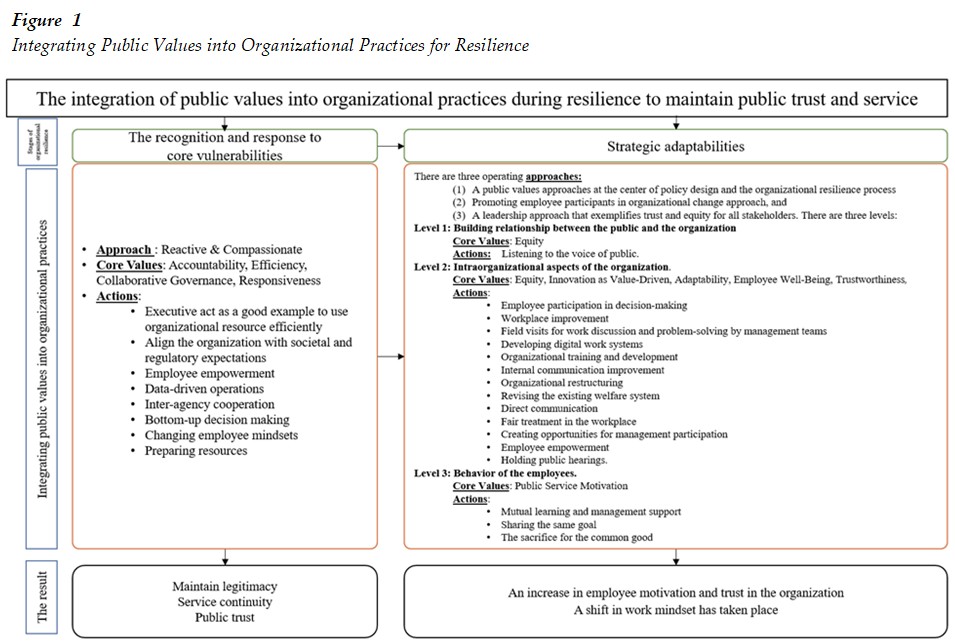
This research aims to explore how public values can be integrated into organizational practices to enhance resilience in public sector organizations, using the Bangkok Mass Transit Authority (BMTA) as a case study. This study employed Strauss and Corbin’s grounded theory methodology, using purposive and snowball sampling to conduct interviews and focus groups with 22 BMTA leaders and staff, complemented by documentary analysis. Data were analyzed through open, axial, and selective coding to develop a substantive theory on the process through which public values shape organizational resilience. Findings reveal that BMTA maintained legitimacy and ensured service continuity by taking a compassionate, reactive approach that was based on efficiency, accountability, and collaborative governance during the recognition and response to core vulnerabilities. In the subsequent stage of strategic adaptability, leadership that promotes employee participation, equity, innovation, adaptability, trustworthiness, employee well-being, and public service motivation facilitated organizational transformation and strengthened public trust. This study offers a substantive theory that connects public values to management strategies, showing that organizational resilience stems not only from structural and procedural capacities, but also from the beliefs, behaviors, and collective commitment of its members.
Article Details

This work is licensed under a Creative Commons Attribution-NonCommercial-NoDerivatives 4.0 International License.
References
Ansell, C., Boin, A., & Keller, A. (2010). Managing transboundary crises: Identifying the building blocks of an effective response system. Journal of Contingencies and Crisis Management, 18(4), 195–207. https://doi.org/10.1111/j.1468-5973.2010.00620.x
Boin, A., Comfort, L. K., & Demchak, C. C. (2010). The rise of resilience. In L. K. Comfort, A. Boin, & C. C. Demchak (Eds.), Designing resilience: Preparing for extreme events (pp.1–12). University of Pittsburgh Press.
Bozeman, B. (2007). Public values and public interest: Counterbalancing economic individualism. Georgetown University Press.
Bozeman, B., & Moulton, S. (2011). Integrative publicness: A framework for public management strategy and performance. Journal of Public Administration Research and Theory, 21(Suppl. 3), i363–i380. https://doi.org/10.1093/jopart/muq078
Burnard, K., & Bhamra, R. (2011). Organisational resilience: Development of a conceptual framework for organisational responses. International Journal of Production Research, 49(18), 5581–5599. https://doi.org/10. 1080/00207543.2011.563827
Cretney, R. (2014). Resilience for whom? Emerging critical geographies of socio-ecological resilience. Geography Compass, 8(9), 627–640. https://doi.org/10.1111/gec3.12154
Duchek, S. (2020). Organizational resilience: A capability-based conceptualization. Business Research, 13(1), 215–246. https://doi.org/10.1007/s40685-019-0085-7
Dudau, A., Masou, R., Murdock, A., & Hunter, P. (2023). Public service resilience post Covid: Introduction to the special issue. Public Management Review, 25(4), 681–689. https://doi.org/10.1080/14719037.2023.2219690
Duit, A. (2016). Resilience thinking: Lessons for public administration. Public Administration, 94(2), 364–380. https://doi.org/10.1111/padm.12182
Fischer, C., Siegel, J., Proeller, I., & Drathschmidt, N. (2023). Resilience through digitalisation: How individual and organisational resources affect public employees working from home during the COVID-19 pandemic. Public Management Review, 25(4), 808–835.
Fukumoto, E., & Bozeman, B. (2019). Public values theory: What is missing? The American Review of Public Administration, 49(6), 635–648. https://doi.org/10.1177/0275074018814244
Gittell, J. H., Cameron, K., Lim, S., & Rivas, V. (2006). Relationships, layoffs, and organizational resilience: Airline industry responses to September 11. The Journal of Applied Behavioral Science, 42(3), 300–329. https://doi.org/10.1177/0021886306286466
Jørgensen, T. B., & Bozeman, B. (2007). Public values: An inventory. Administration & Society, 39(3), 354–381. https://doi.org/10.1177/009539970 7300703
Kim, K., Andrew, S. A., & Jung, K. (2021). Building resilient organizations: Organizational resilience as a network outcome. International Journal of Public Administration, 44(15), 1319–1328. https://doi.org/10.1080/01900692. 2020.1758720
Lengnick-Hall, C. A., Beck, T. E., & Lengnick-Hall, M. L. (2011). Developing a capacity for organizational resilience through strategic human resource management. Human Resource Management Review, 21(3), 243–255. https://doi.org/10.1016/j.hrmr.2011.03.001
Linnenluecke, M. K., Griffiths, A., & Winn, M. (2012). Extreme weather events and the critical importance of anticipatory adaptation and organizational resilience in responding to impacts. Business Strategy and the Environment, 21(1), 17–32. https://doi.org/10.1002/bse.708
McManus, S., Seville, E., Vargo, J., & Brunsdon, D. (2008). Facilitated process for improving organizational resilience. Natural Hazards Review, 9(2), 81–90. https://doi.org/10.1061/(ASCE)1527-6988(2008)9:2(81)
Meynhardt, T., Brieger, S. A., Strathoff, P., Anderer, S., Bäro, A., Hermann, C., Kollat, J., Neumann, P., Bartholomes, S., & Gomez, P. (2017). Public value performance: What does it mean to create value in the public sector? In T. Anderer, J. Neumann, & P. Gomez (Eds.), Public sector management in a globalized world (pp. 135–160). Springer.
Moore, M. H. (1995). Creating public value: Strategic management in government. Harvard University Press.
Moore, M. H. (2021). Creating public value: The core idea of strategic management in government. International Journal of Professional Business Review, 6(1), e01040. https://doi.org/10.26668/businessreview/2021. v6i1.219
Raetze, S., Duchek, S., Maynard, M. T., & Wohlgemuth, M. (2022). Resilience in organization-related research: An integrative conceptual review across disciplines and levels of analysis. Journal of Applied Psychology, 107(6), 867–889. https://doi.org/10.1037/apl0000952
Rogers, P., Bohland, J. J., & Lawrence, J. (2020). Resilience and values: Global perspectives on the values and worldviews underpinning the resilience concept. Political Geography, 83, 102280. https://doi.org/10.1016/j.polgeo.2020.102280
Stark, A. (2014). Bureaucratic values and resilience: An exploration of crisis management adaptation. Public Administration, 92(3), 692–706. https://doi.org/10.1111/padm.12085
Stokes, P., Smith, S., Wall, T., Moore, N., Rowland, C., Ward, T., & Cronshaw, S. (2019). Resilience and the (micro) dynamics of organizational ambidexterity: Implications for strategic HRM. The International Journal of Human Resource Management, 30(8), 1287–1322. https://doi.org/10.1002/hrm.21690
