ความท้าทายของมาตรการป้องกันการหลีกเลี่ยงภาษีอากรสำหรับประเทศไทยในบริบทของเศรษฐกิจดิจิทัล
Article Sidebar
Main Article Content
บทคัดย่อ
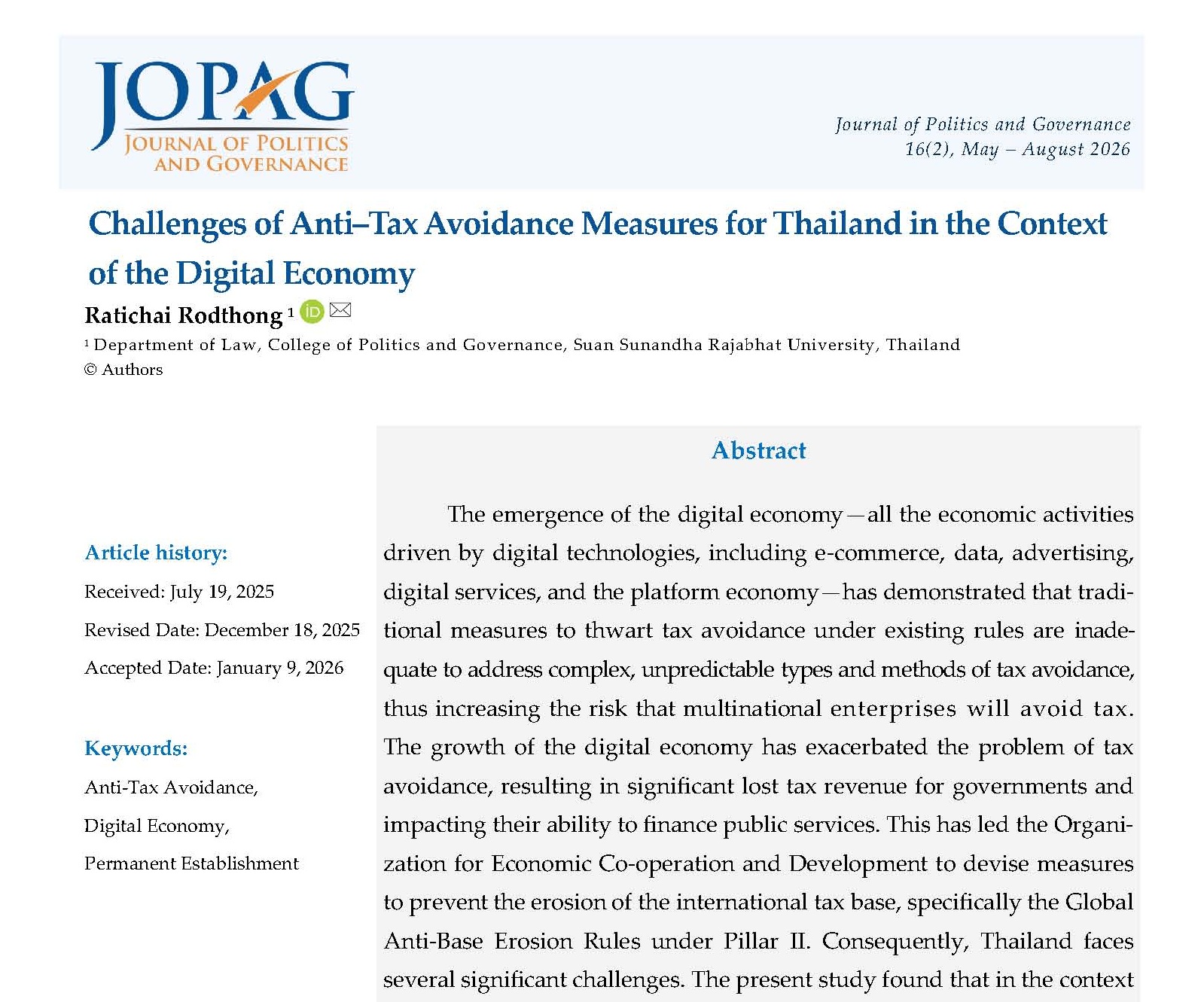
การเข้าสู่ยุคเศรษฐกิจดิจิทัลส่งผลให้มาตรการป้องกันการหลีกเลี่ยงภาษีอากรภายใต้กติกาภาษีรูปแบบเดิมไม่เพียงพอในการจัดการกับรูปแบบ และวิธีการหลีกเลี่ยงภาษีที่มีความซับซ้อนและยากที่จะคาดหมายได้ ซึ่งก่อให้เกิดความเสี่ยงในการหลีกเลี่ยงภาษีอากรของบรรดาบริษัทข้ามชาติมากยิ่งขึ้น องค์กรเพื่อความร่วมมือทางเศรษฐกิจและการพัฒนาจึงออกมาตรการป้องกันการกัดกร่อนฐานภาษีระหว่างประเทศต่าง ๆ มาใช้ โดยเฉพาะอย่างยิ่งกฏ Pillar II GloBE ประเทศไทยจึงจำเป็นต้องเผชิญกับปัญหาความท้าทายที่สำคัญหลายประการ พบว่ามาตรการป้องกันการหลีกเลี่ยงภาษีที่เหมาะสมสำหรับประเทศไทยในบริบทของเศรษฐกิจดิจิทัล คือการนำเอาหลักที่ใช้ในการป้องกันการหลีกเลี่ยงภาษีอากร เช่นหลักเจตนารมณ์ของกฎหมายมีความสำคัญกว่ารูปแบบ มาใช้เพื่อให้ศาลตีความเนื่องจากมีความยืดหยุ่นสูงเสมือนเป็นมาตรการทั่วไป ส่วนมาตรการเฉพาะอย่างนั้น ให้เร่งออกกฎระเบียบมารองรับพระราชกำหนดการเก็บภาษีเพิ่มเติมให้มีความชัดเจน รวมทั้ง เร่งออกกฎหมายเฉพาะเพื่อจัดเก็บภาษีทางตรงจากรายได้อันเนื่องมาจากการให้บริการดิจิทัล หรือควรได้แก้ไขมาตรา 76 ทวิ หรือมาตรา 70 แห่งประมวลรัษฎากรอย่างหนึ่งอย่างใดเพื่อเก็บภาษีเงินได้บริษัทเทคข้ามชาติ ส่วนมาตรการสุดท้ายควรเร่งนำมาตรการแลกเปลี่ยนข้อมูล และมาตรการการแลกเปลี่ยนข้อมูลทางภาษีอากรตามข้อตกลงระหว่างประเทศมาใช้โดยนำเอาเทคโนโลยีบล็อกเชนมาช่วยเพื่อให้เกิดความโปร่งใสและตรวจสอบได้
Article Details

อนุญาตภายใต้เงื่อนไข Creative Commons Attribution-NonCommercial-NoDerivatives 4.0 International License.
เอกสารอ้างอิง
Arnold, B. J. (2016). International tax primer. Kluwer Law International.
Aslam, A., & Shah, A. (2021). Taxing the digital economy. In M. D. Ruud, A. Klemm, & V. Perry (Eds.), Corporate income taxes under pressure: Why reform is needed and how it could be designed (pp. 189–226). International Monetary Fund.
Bekkers, E., Koopman, R., Sabbadini, G., & The, R. (2024). The impact of digital technologies on developing countries. In WTO (Ed.), The digital trade era: Challenges and opportunities for developing countries (pp. 38–51). https://www.wto.org/english/res_e/booksp_e/05_ adtera_chapter_01_e.pdf
Brincker, E. (2014). What is simulation really? Tax Alert. https://www.cliffedekkerhofmeyr. com/export/sites/cdh/news/publications/ 2014/tax/downloads/Tax-Alert-21-November-2014.pdf
Bukht, R., & Heeks, R. (2017). Defining, conceptualizing and measuring the digital economy. International Organizations Research Journal, 13, 143–172. https://doi.org/10.17323/1996-7845-2018-02-07
Bukht, R., & Heeks, R. (2018). Defining, conceptualizing and measuring the digital economy (Development Informatics Working Paper No. 68). https://hummedia.manchester.ac.uk/institutes/gdi/publications/workingpapers/di/di_wp68.pdf
Crown, M. T. (1944). The moral obligation of paying just taxes. The Catholic University of America Press.
DiCarlo, D. P. (2010). What estate planners need to know about the step transaction doctrine. Real Property, Trust and Estate Law Journal, 45(2), 355–368. http://www.jstor.org/stable/20785705
Flynn, M. (1995). Substance versus form in tax disputes: An analysis of recent developments. Australian Tax Review, 24(3), 171–189. https://search.informit.org/doi/10.3316/agispt.19954583
Freedman, J. (2008). Is tax avoidance fair? In C. Wales (Ed.), Fair tax: Towards a modern tax system (pp. 86–95). Smith Institute.
HM Revenue & Customs. (2013). General anti-abuse rule. https://assets.publishing.service. gov.uk/media/5a7b6975e5274a34770eb850/general_anti_abuse_rule.pdf
IBFD. (2024). International tax planning and prevention of abuse: A study under domestic tax law, tax treaties and EC law in relation to conduit and base companies. https://www.bing.com/search?q=Stepping1
International Institute of Tax and Finance. (2025). Tax avoidance. https://academyoftaxlaw. com/glossary/tax-avoidance/
Ismail, Y. (2020). Digital economy: State of play and implications for developing countries. CUTS International Geneva.
Kansra, D. (2020). Rethinking the maxim ignorantia juris non excusat. Academia Letters, 1–4. https://doi.org/10.20935/AL43
Lokanan, M. (2023). The morality and tax avoidance: A sentiment and position-taking analysis. PLOS ONE, 18(7), Article e0287327. https://doi.org/10.1371/journal.pone.0287327
OECD. (1987). International tax avoidance and evasion: Four related studies (Issues in International Taxation No. 1). OECD Publishing. https://doi.org/10.1787/g2ghgbf6-en
OECD. (2014). Addressing the tax challenges of the digital economy: OECD/G20 base erosion and profit shifting project. OECD Publishing. https://doi.org/10.1787/9789264218789-en
OECD. (2015a). Addressing the tax challenges of the digital economy, Action 1: Final report. OECD Publishing. https://doi.org/10.1787/9789264241046-en
OECD. (2015b). Designing effective controlled foreign company rules, Action 3: Final report. OECD Publishing. https://doi.org/10.1787/9789264 241152-en
OECD. (2020a). OECD digital economy outlook 2020. OECD Publishing. https://doi.org/10.1787/bb167041-en
OECD. (2020b). Tax challenges arising from digitalization: Report on Pillar Two blueprint. OECD Publishing. https://doi.org/10.1787/abb4c3d1-en
OECD. (2023). Minimum tax implementation handbook (Pillar Two). OECD Publishing. https://www.oecd.org/tax/beps/minimum-tax-implementation-handbook-pillar-two.pdf
OECD. (2024). Members of the OECD/G20 Inclusive Framework on BEPS. OECD Publishing. https://www.oecd.org/content/dam/oecd/en/topics/policy-issues/beps/inclusive-framework-on-beps-composition.pdf
Perillo, J. M. (1995). Abuse of rights: A pervasive legal concept. Pacific Law Journal, 27, 38–97. https://scholarlycommons.pacific.edu/mlr/vol27/iss1/6
Postlewaite, P. F. (2005). The status of the judicial sham doctrine in the United States. Revenue Law Journal, 15(1), 140–149. https://doi.org/ 10.53300/001c.6686
Revenue Department. (2024). Tax code study and development project. https://www.rd.go.th/fileadmin/download/PramualProj/cont05.html
Rohatgi, R. (2007). Basic international taxation: Volume two: Practice of international taxation. Taxmann Allied Services.
Schreiher, U. (2023). International company taxation: An introduction to the legal and economic principles. Springer.
Smith, J. D., & Herman, J. D. (2020). Developing open-source software using version control systems: An introduction to the Git language for documenting your computational research. https://core.ac.uk/download/334990832.pdf
Tapscott, D. (1997). The digital economy: Promise and peril in the age of networked intelligence. McGraw-Hill.
Thuronyi, V., Brooks, K., & Kolozs, B. (2016). Comparative tax law. Kluwer Law International.
Troup, E. (1992). Unacceptable discretion: Countering tax avoidance and preserving the rights of the individual. Fiscal Studies, 13(4), 128–138. http://www.jstor.org/stable/24437268
Vanistendael, F. (1996). Legal framework for taxation. In V. Thuronyi (Ed.), Tax law design and drafting (Vol. 1, pp. 15–70). International Monetary Fund. https://doi.org/10.5089/ 9781557755872.071
World Economic Forum. (2022). What is the digital economy and how is it transforming business? https://www.weforum.org/stories/2022/05/digital-economy-transforming-business/
