Knowledge Integration and Spatial Context: A Pathway to an Education and Innovation Hub for Betong as a Model City of Sustainable Self-Reliance
Article Sidebar
Main Article Content
Abstract
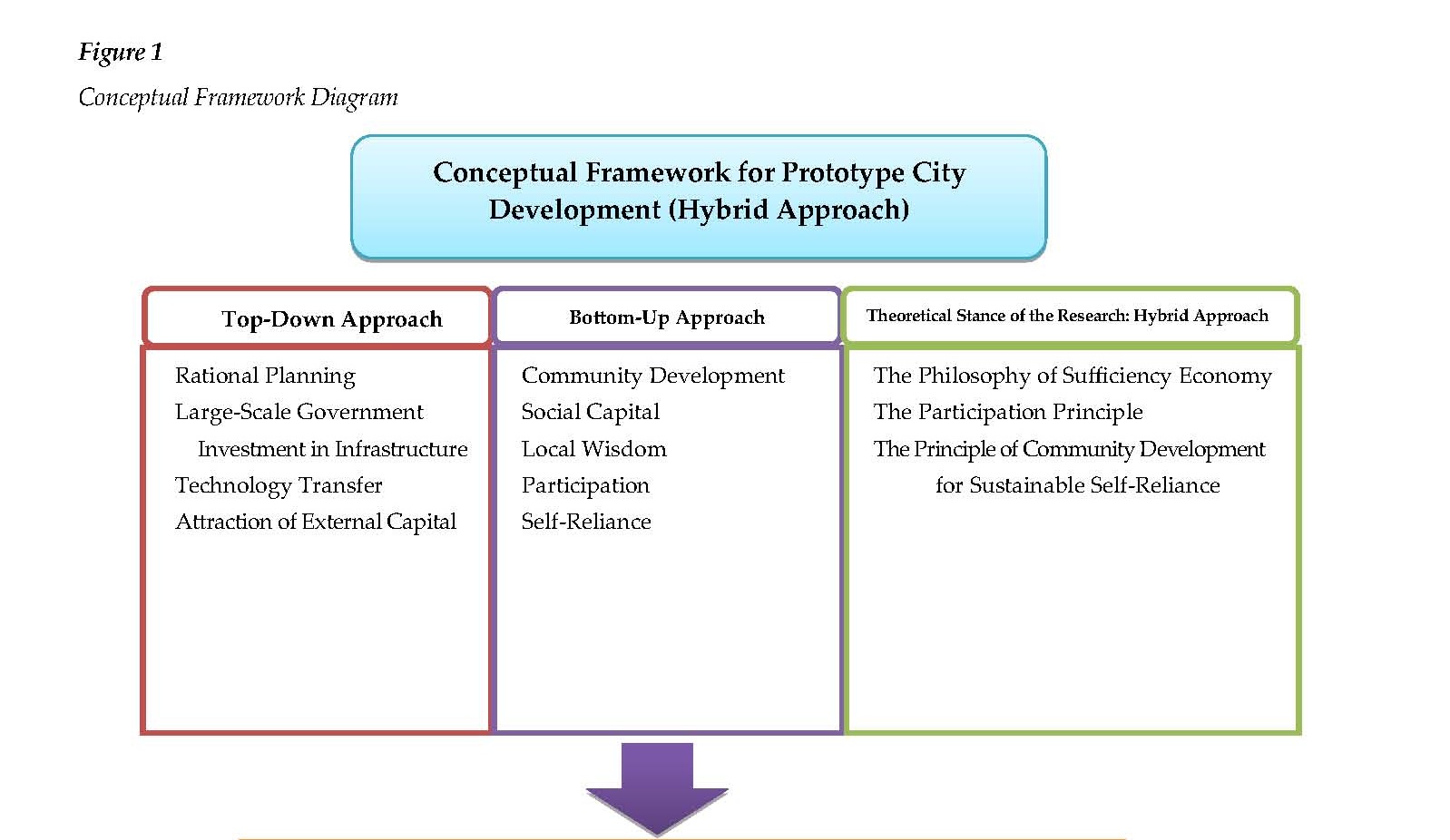
This research article aims to present a synthesis and analysis of the knowledge landscape concerning the development of Betong District, Yala Province, as a model city. The study seeks to support the initiative to establish an Education, Research, and Service Innovation Center for the security, prosperity, and sustainability of a model city within the southern border economic triangle. This research employs a descriptive analytical methodology through the synthesis of research and project implementation outcomes in Betong District over a five-year period (2016–2020). The findings reveal that the knowledge landscape is categorized into five main areas: (1) tourism, (2) product development, (3) commerce and business, (4) drug-related problems, and (5) environmental management. These bodies of knowledge are interconnected with the core conceptual frameworks for model city development, namely the Sufficiency Economy Philosophy, the principle of participation, and the principle of community development for sustainable self-reliance. The study also identifies knowledge gaps that require further exploration across multiple dimensions to ensure comprehensive and tangible development. Consequently, this article proposes the establishment of an integrated Education, Research, and Service Innovation Center. This center should function as a knowledge hub, a repository for the historical background of the Malay Peninsula border region, and a comprehensive community management center to drive Betong District toward becoming a sustainably self-reliant model city.
Article Details

This work is licensed under a Creative Commons Attribution-NonCommercial-NoDerivatives 4.0 International License.
References
Anusornprasert, Y., & Chinfuk, N. (2019). A study of community leaders’ opinion on drug problems: A case study of Yarom Subdistrict, Betong District, Yala Province. In Proceedings of the 11th Hatyai National and International Conference.
Arnstein, S. R. (1969). A ladder of citizen participation. Journal of the American Institute of Planners, 35(4), 216–224.
Belur, J., Tompson, L., Thornton, A., & McDonald, M. (2021). Interrater reliability in systematic review methodology: Exploring variation in coder decision-making. Sociological Methods & Research, 50(2), 837–865.
Bergvall-Kåreborn, B., & Ståhlbröst, A. (2009). Living lab: An open and citizen-centric approach for innovation. International Journal of Innovation and Regional Development, 1(4), 356–370.
Braun, V., & Clarke, V. (2006). Using thematic analysis in psychology. Qualitative Research in Psychology, 3(2), 77–101.
Chambers, R. (1997). Whose reality counts? Putting the first last. Intermediate Technology Publications.
Chitkesorn, A., & Layraman, T. (2020). Research synthesis of the area Nan Province during 2006–2016 for problem solving management and local development. FEU Academic Review, 14(1–4), 41–58.
Cohen, J. (1960). A coefficient of agreement for nominal scales. Educational and Psychological Measurement, 20(1), 37–46.
Comejina, P. (2019). Information system for smart city in Muangkaen Pattana Municipality Area, Chiangmai. National Research Council of Thailand.
Cooper, H. (2007). Evaluating and interpreting research syntheses in adult learning and literacy. National Center for the Study of Adult Learning and Literacy.
Cooper, H. (2017). Research synthesis and meta-analysis: A step-by-step approach (5th ed.). SAGE.
Costanza, R., Kubiszewski, I., Giovannini, E., Lovins, H., McGlade, J., Pickett, K. E., Ragnarsdóttir, K. V., Roberts, D., De Vogli, R., & Wilkinson, R. (2014). Development: Time to leave GDP behind. Nature, 505(7483), 283–285.
Damrongkadee, J. (2015). Approaches for tourism business management of the Betong temperate zone flower production group in Yala Province. School of Agriculture and Cooperatives, Sukhothai Thammathirat Open University.
Etzkowitz, H., & Leydesdorff, L. (2000). The dynamics of innovation: From national systems and “Mode 2” to a triple helix of university–industry–government relations. Research Policy, 29(2), 109–123.
Finlay, L. (2002). “Outing” the researcher: The provenance, process, and practice of reflexivity. Qualitative Health Research, 12(4), 531–545.
Giddens, A. (1984). The constitution of society: Outline of the theory of structuration. University of California Press.
Gilson, L. (2014). Qualitative research synthesis for health policy analysis: What does it entail and what does it offer? Health Policy and Planning, 29(Suppl. 3), iii1–iii5.
Gössling, S., Scott, D., & Hall, C. M. (2012). Tourism and water. Channel View Publications.
Harvey, D. (2005). A brief history of neoliberalism. Oxford University Press.
Higgins, J. P. T., Thomas, J., Chandler, J., Cumpston, M., Li, T., Page, M. J., & Welch, V. A. (Eds.). (2019). Cochrane handbook for systematic reviews of interventions (2nd ed.). John Wiley & Sons.
Hollands, R. G. (2008). Will the real smart city please stand up? City, 12(3), 303–320.
Isranews Agency. (2016). The Betong model project: Triangle model for security, prosperity, and sustainability.
Jasanoff, S. (Ed.). (2004). States of knowledge: The co-production of science and social order. Routledge.
Jussapalo, C., Urairat, U., Prommai, P., Jussapalo, S., Noisengiam, N., & Boonrasme, B. (2018). Development strategy for the city of Betong for sustainable tourism. The Thailand Research Fund.
Kaewngam, K. (2018). Betong: Strategies of tourism communication under the violence crisis in the three southern border provinces [Master’s thesis, Thammasat University].
Kaewngam, K., & Jongwilaikasaem, W. (2019). Betong: Strategies of tourism communication under the violence crisis in the three southern border provinces. Journal of Communication Arts, 37(3), 40–50.
Kaewyai, N. (2016). Learning resources center: The sustainable development of higher education institutions. Southeast Bangkok Journal, 2(2).
Korstjens, I., & Moser, A. (2018). Series: Practical guidance to qualitative research. Part 4: Trustworthiness and publishing. European Journal of General Practice, 24(1), 120–124.
Kretzmann, J. P., & McKnight, J. L. (1993). Building communities from the inside out: A path toward finding and mobilizing a community’s assets. ACTA Publications.
Landis, J. R., & Koch, G. G. (1977). The measurement of observer agreement for categorical data. Biometrics, 33(1), 159–174.
Leelakriangkrai, M., Kasikamphaibool, P., Chantasuban, T., Jariyaboon, R., Khuncharn, U., Thongroy, P., Mahathanphitak, P., Rungwichanivat, J., Makmanee, T., & Jariyaboon, T. (2019). Environmental management for accommodating the growth of Betong municipality. Thailand Science Research and Innovation.
Lincoln, Y. S., & Guba, E. G. (1985). Naturalistic inquiry. SAGE.
McFarlane, C. (2011). Learning the city: Knowledge and translocal assemblage. Wiley-Blackwell.
Mirowski, P., & Sent, E. M. (2008). The commercialization of science and the response of STS. In E. J. Hackett, O. Amsterdamska, M. Lynch, & J. Wajcman (Eds.), The handbook of science and technology studies (3rd ed., pp. 635–689). MIT Press.
Moher, D., Liberati, A., Tetzlaff, J., Altman, D. G., & PRISMA Group. (2009). Preferred reporting items for systematic reviews and meta-analyses: The PRISMA statement. PLoS Medicine, 6(7), e1000097.
National Security Council Office. (2017). National administrative plan for the Southern Border Provinces, 2017–2021. National Security Council Office.
Nature. (2023). Tools such as ChatGPT threaten transparent science; here are our ground rules for their use. Nature, 613, 612.
Office of Civil Society Politics Promotion, King Prajadhipok’s Institute. (2018). Knowledge synthesis report for the Citizen Empowerment in Action Project, Roi Et Province.
Office of Royal Development Projects Board. (n.d.). Royal development research center: Integrated management. http://km.rdpb.go.th/Knowledge/View/81
Patton, M. Q. (2015). Qualitative research & evaluation methods (4th ed.). SAGE Publications.
Peck, J., & Theodore, N. (2015). Fast policy: Experimental statecraft at the thresholds of neoliberalism. University of Minnesota Press.
Porter, M. E. (1990). The competitive advantage of nations. Free Press.
Pretty, J. N. (1995). Participatory learning for sustainable agriculture. World Development, 23(8), 1247–1263.
Pujinda, P., & Boonsom, Y. (2016). Urban design guideline for specific purposed towns. Journal of Environmental Design, 3(1), 21–43.
Puntasen, A. (2007). Buddhist economics as a new paradigm towards happiness. Society and Economy, 29(1), 81–200.
Putnam, R. D. (2000). Bowling alone: The collapse and revival of American community. Simon & Schuster.
Rovinelli, R. J., & Hambleton, R. K. (1977). On the use of content specialists in the assessment of criterion-referenced test item validity. Dutch Journal of Educational Research, 2, 49–60.
Rungrut, S., Maso, Z., Udomlamun, S., Salah, N., Salah, M., & Mintrasak, N. (2018). The participatory action research for the development of Kopi manufacturer (ancient coffee), Betong District, Yala Province. Thailand Science Research and Innovation.
Sandelowski, M. (2000). Whatever happened to qualitative description? Research in Nursing & Health, 23(4), 334–340.
Sandelowski, M., & Barroso, J. (2007). Handbook for synthesizing qualitative research. Springer Publishing.
Sawaain, R., Wilairat, W., & Mad-adam, S. (2016). Factors affecting Thai tourists’ satisfaction on ecotourism in Betong District, Yala Province. In Proceedings of the 9th SCT Conference.
Scott, J. C. (1998). Seeing like a state: How certain schemes to improve the human condition have failed. Yale University Press.
Singhalert, R., & Jongwutiwes, N. (2018). A model of community development for sustainable self-sufficiency: A case study of Dondang Village, Kantharawichai District, Maha Sarakham Province. Journal of Information Technology and Innovation Management, 5(1), 133–144.
Sitawan. (2011). Research synthesis process. http://sitawan112.blogspot.com/2011/04/blog-post_7910.html
Southernreports. (2019). Industrial development for model cities under the slogan “Stable, affluent and sustainable triangle”. https://multi.dopa. go.th/inspector/assets/modules/news/uploads/6c0e420d8cc48f28f5c06635355d5 8b859199ef8e3220554388842300268570.pdf
Southernreports. (2019). The prototype city project “Stable, prosperous, sustainable triangle” in Betong District, Yala Province. https://multi. dopa.go.th/inspector/assets/modules/news/uploads/6c0e420d8cc48f28f5c06635355d58 b859199ef8e3220554388842300268570.pdf
Tayeh, N. (2018). Development of tea product from Betong watercress. Faculty of Science, Technology and Agriculture, Yala Rajabhat University.
Thomas, D. R. (2006). A general inductive approach for analyzing qualitative evaluation data. American Journal of Evaluation, 27(2), 237–246.
Tungseng, T., Chaiyakot, P., Suwanvong, D., Buakwan, N., Ditta-apichai, M., Sripornngam, T., Chaiyakhet, W., Petlamul, W., Buathong, S., & Pattano, D. (2020). The driving force for community-based tourism research in the three Southern Border Provinces: Betong District, Yala Province. Thailand Science Research and Innovation.
Visessung, S. (2019). Behaviours of Malaysian tourists and potentials of ecotourism in Betong District, Yala Province [Master’s thesis, Hatyai University].
Waepa, W. (2017). The external environment and border trade entrepreneurs’ expectations: A case study of Betong, Yala [Master’s thesis, Yala Rajabhat University].
Yunrat, S. (2018). Knowledge synthesis report from university and externally funded research, academic years 2015–2017. Center for Research and Development Support, Sripatum University.
