Integrated Framework for Digital-Era Public Administration Curricula: Insights from Thai and International Universities
Article Sidebar
Main Article Content
Abstract
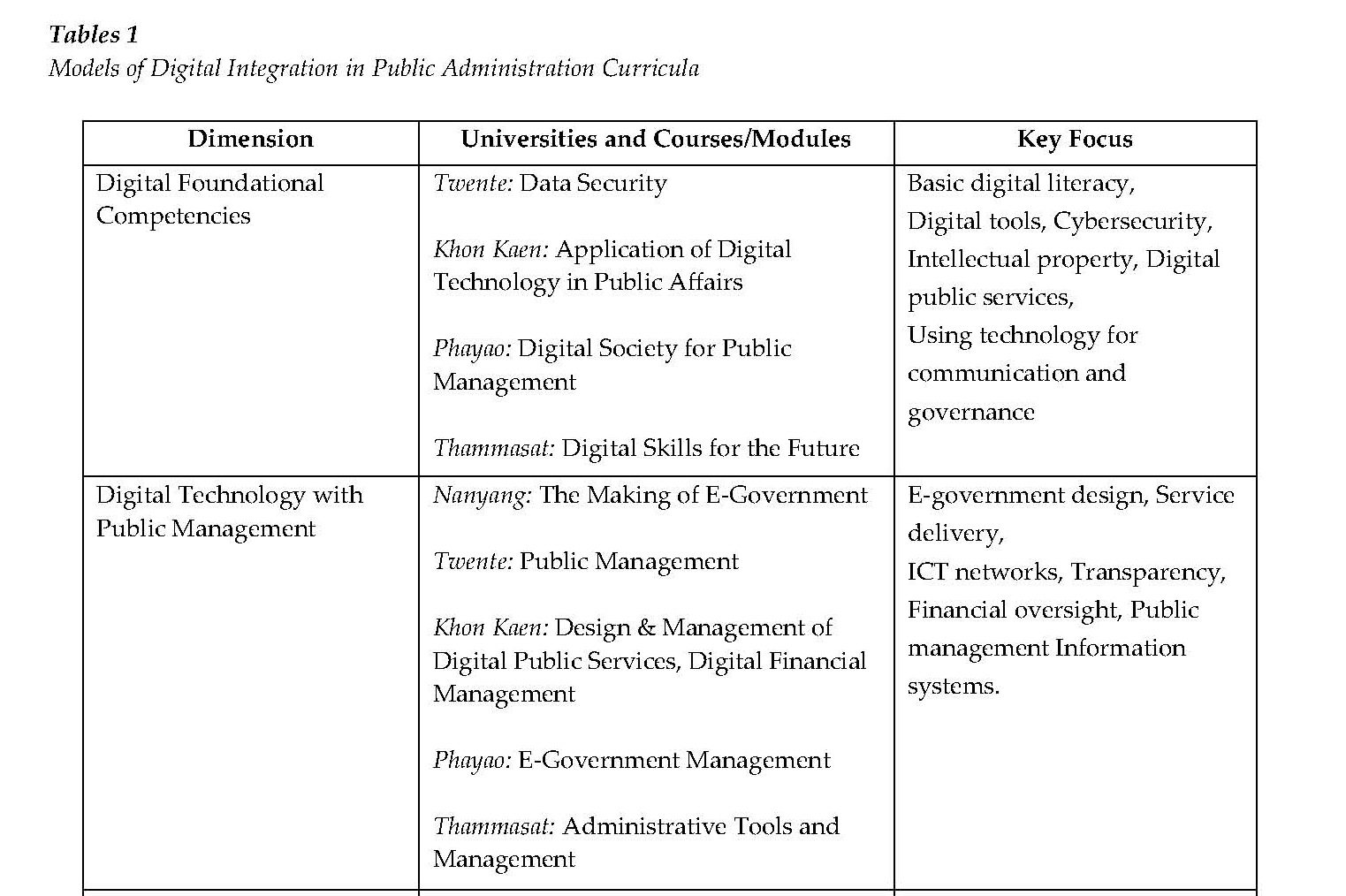
This paper examines the policy directions in relation to developing digital personnel, generalizes the aspects of incorporating digital subjects in the curriculum of public administration, and recommends a conceptual framework for designing a curriculum in public administration in the digital era. The documentary analysis of international and national policy papers, six public administration curricula, and academic literature was conducted through the use of qualitative research. These findings suggest that the national and international policy of developing personnel focuses on artificial intelligence, data analytics, cybersecurity, digital citizenship, lifelong learning, and university-government collaboration to support the development of digital competency. There are five dimensions under which the curriculums were explored: digital foundational competencies; digital technology and public management; data use and policy analysis; legal, ethical, and digital citizenship; and integrating innovation, technology, and public development. The study also recommends an integrated conceptual framework of digital public administration curricula, which encompasses policy inputs, curriculum design processes, and learning outcomes. This work contributes to the further empowerment of digital education within the field of public administration by providing a model of policy-to-curriculum integration that would help universities and policymakers to synchronize the policy intent and the curriculum in practice.
Article Details

This work is licensed under a Creative Commons Attribution-NonCommercial-NoDerivatives 4.0 International License.
References
Ansell, C., & Gash, A. (2008). Collaborative governance in theory and practice. Journal of Public Administration Research and Theory, 18(4), 543–571. https://doi.org/10.1093/jopart/mum032
Cen, X. (2024). Data-driven governance in the digital era: Opportunities and challenges. Journal of Public Administration Research and Theory, 34(1), 45–62. https://doi.org/10.1093/jopart/muae001
Council of Europe. (2019). Digital citizenship education handbook. Council of Europe Publishing. https://rm.coe.int/digital-citizenship-education-handbook/16809382f9
Damar, M., Aydın, Ö., Cagle, M. N., Özoğuz, E., Köse, H. Ö., & Özen, A. (2024). Navigating the digital frontier: Transformative technologies reshaping public administration. EDPACS, 2024(0), 1–29. https://doi.org/ 10.1080/07366981.2024.2376792
Dunleavy, P., Margetts, H., Bastow, S., & Tinkler, J. (2006). New public management is dead—Long live digital-era governance. Journal of Public Administration Research and Theory, 16(3), 467–494. https://doi.org/ 10.1093/jopart/mui057
Electronic Government Agency (Public Organization). (2023). (Draft) Thailand Digital Government Development Plan, B.E. 2023–2030 (1st printing). Bolliger & Company (Thailand) Co., Ltd.
European Commission, Joint Research Centre. (2022). DigComp 2.2: The digital competence framework for citizens – With new examples of knowledge, skills and attitudes. Publications Office of the European Union. https://doi. org/10.2760/115376
Fung, M., Taal, R., & Sim, W. (2021). SkillsFuture: The roles of public and private sectors in developing a learning society in Singapore. In S. Ra, J. Jung, & H. Lee (Eds.), Powering a learning society during an age of disruption (pp. 195–208). Springer. https://doi.org/ 10.1007/978-981-16-0983-1_14
Hu, Q. (2018). Preparing public managers for the digital era: incorporating information management, use, and technology into public affairs graduate curricula. Public Management Review, 20(5), 766–787. https://doi.org/10.1080/14719037.2017.1327180
Jennings, E. T. (2019). E-Government and Public Affairs Education. Chinese Public Administration Review, 10(2), 79-83. https://doi. org/10.22140/cpar.v10i2.208
Kim, S., & Lee, J. (2012). E-Participation, transparency, and trust in local government. Public Administration Review, 72(6). https://doi. org/10.1111/j.1540-6210.2012.02593.x
Khon Kaen University. (2022). Bachelor of Public Administration program curriculum (Revised Edition B.E. 2565). College of Local Administration, Khon Kaen University. Retrieved from https://cola.kku.ac.th/bachelor-of-public-administration-program-revised-curriculum-2022/
Malaysia Digital Economy Corporation (MDEC). (2021). Malaysia Digital. https://mdec.my/malaysiadigital
Marketech APAC. (2025, January 16). MDEC rolls out nationwide initiative to accelerate digital transformation amongst SMEs. https://marketech-apac.com/mdec-rolls-out-nationwide-initiative-to-accelerate-digital-transformation-amongst-smes/
Mergel, I., Edelmann, N., & Haug, N. (2019). Defining digital transformation: Results from expert interviews. Government Information Quarterly, 36(4), 101385. https://doi.org/10.1016/j.giq.2019.06.002
Nanyang Technological University. (2025). BSocSci in PPGA. Nanyang Technological University. https://www.ntu.edu.sg/sss/about-us/public-policy-and-global-affairs/public-policy-and-global-affairs-curriculum/BSocSci-in-PPGA/4#Content_C010_Col00
OECD. (2019). Recommendation of the Council on Artificial Intelligence. OECD/LEGAL/0449. https://legalinstruments.oecd.org/en/instruments/OECD-LEGAL-0449
OECD. (2020). The OECD digital government policy framework: Six dimensions of a digital government. OECD Publishing. https://doi.org/10.1787/f64fed2a-en
OECD. (2021). Digital talent and skills for the future public sector. OECD Publishing. https://doi. org/10.1787/digital-skills-2021
Office of the National Economic and Social Development Council. (2018). Thailand's 20-year national strategy (2018–2037) summary. https://bic.moe.go.th/images/stories/pdf/National_Strategy_Summary.pdf
Provan, K. G., & Kenis, P. (2008). Modes of network governance: Structure, management, and effectiveness. Journal of Public Administration Research and Theory, 18(2), 229–252. https://doi.org/10.1093/jopart/mum015
Sharmin, S., & Chowdhury, R. H. (2025). Digital transformation in governance: The impact of e-governance on public administration and transparency. Journal of Computer Science and Technology Studies, 7(1), 362–379. https://doi.org/10.32996/jcsts
Thammasat University. (2023). Bachelor of Political Science curriculum (Revised Edition B.E. 2566). Faculty of Political Science, Thammasat University.
UNESCO. (2018). UNESCO ICT competency framework for teachers. UNESCO. https://unesdoc. unesco.org/ark:/48223/pf0000265721
UNESCO. (2021). Recommendation on the ethics of artificial intelligence. UNESCO. https://unesdoc.unesco.org/ark:/48223/pf0000381137
UNESCO. (2023). Guidance for generative AI in education and research. UNESCO. https://unesdoc.unesco.org/ark:/48223/pf0000386693
University College London. (2025). Master of Public Administration (MPA)-Digital Technologies and Policy. https://www.ucl.ac.uk/prospective-students/graduate/taught-degrees/digital-technologies-and-policy-mpa/2025
University College London. (2025, August 18). Emerging dilemmas in digital technology policy (STEP0012). Module Catalogue. https://www.ucl.ac.uk/module-catalogue/modules/emerging-dilemmas-in-digital-technology-policy-STEP0012
University College London. (2025, August 21). Digital rights (STEP0057). Module Catalogue. https://www.ucl.ac.uk/module-catalogue/modules/digital-rights-STEP0057
University of Phayao. (2022). Bachelor of Public Administration program in Public Innovation Management (Revised Curriculum B.E. 2565). Faculty of Political and Social Sciences, University of Phayao.
University of Twente. (2025). Bachelor of Public Administration (Management, Society & Technology). https://www.utwente.nl/en/mst/bachelor-mst/
University of Twente. (2025). Contents of the modules | Management, Society & Technology. https://www.utwente.nl/en/education/bachelor/programmes/management-society-technology/study-programme/
Valle-Cruz, D., & García-Contreras, R. (2023). Towards AI-driven transformation and smart data management: Emerging technological change in the public sector value chain. Public Policy and Administration, 40(2), 254–275. https://doi.org/10.1177/095207672 31188401
