Migrants Versus Minorities: Sons of the Soil Conflicts in the Southern Philippines
Article Sidebar
Main Article Content
Abstract
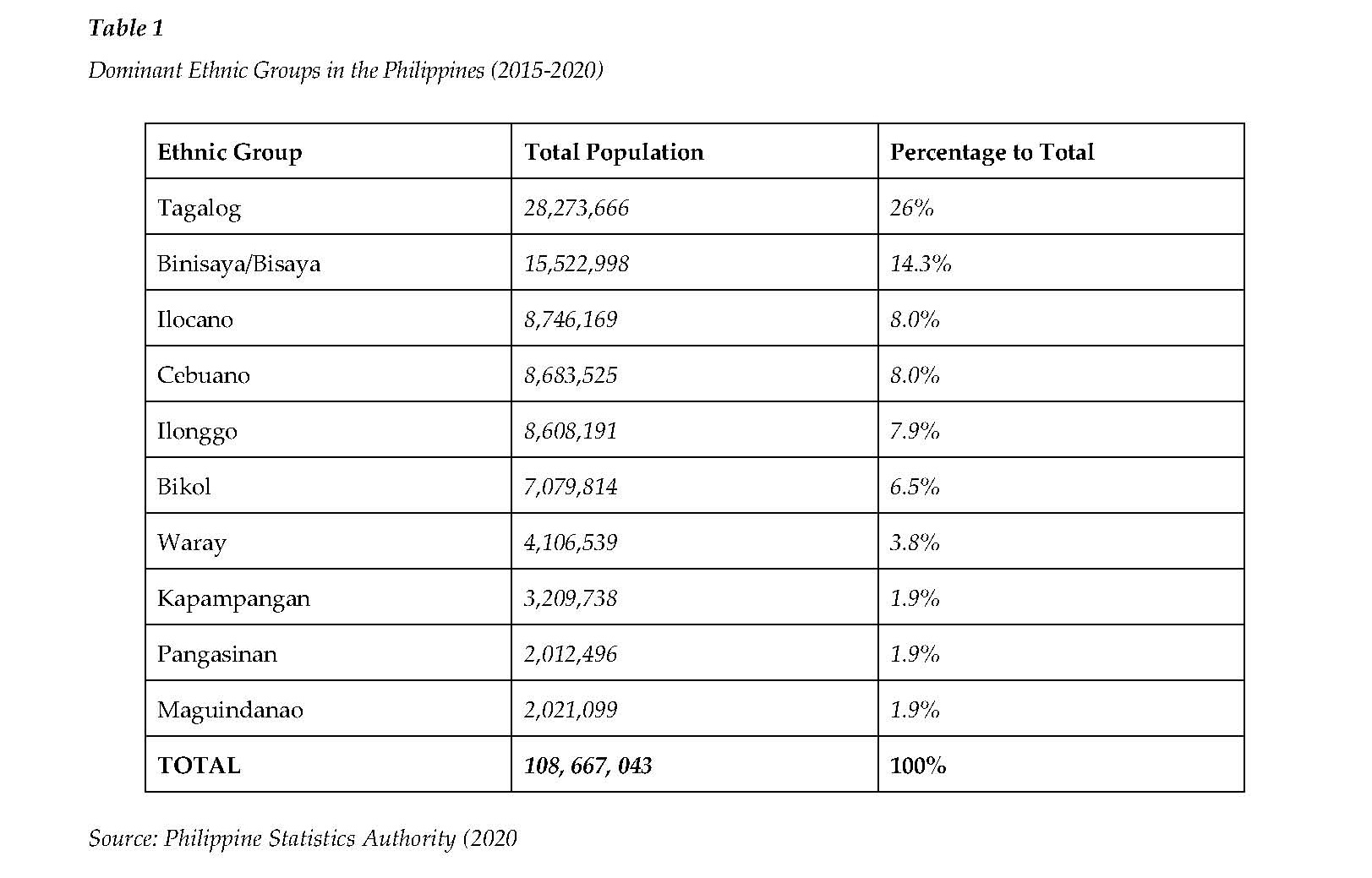
By the end of the Cold War, the study of international relations has experienced a reinvigoration of academic debate on intrastate conflicts as one of the greatest threats to international peace and security. A distinct form of these conflicts, also known as sons of the soil (SOS) conflicts, take place when migrants of a dominant ethnic group in a nation-state migrate to peripheral communities inhabited by indigenous minorities, triggering interethnic violence that eventually become highly intractable over time. Drawing census data from the Philippine Statistics Authority (PSA) on ethnolinguistic groups in the Philippines, this paper attempts to build a historical account of conflicts in the southern Philippines as a compelling case of an SOS conflict. The paper concludes by generating explanations why Mindanao has continued to experience SOS conflicts despite the cessation of conflict activities in the past decades.
Article Details

This work is licensed under a Creative Commons Attribution-NonCommercial-NoDerivatives 4.0 International License.
References
Abato, M. (2018). The 2018 Bangsamoro Organic Law in the Philippines: Solving the Mindanao conflict with autonomy plus compensatory justice. Saniata Publications.
Abinales, P. (2000). Making Mindanao: Cotabato and Davao in the formation of the Philippine nation-state. Ateneo de Manila University Press.
Adam, J. (2010). Post-conflict Ambon: Forced migration and the ethno-territorial effects of customary tenure. Development and Change, 41(3), 401–419. https://doi.org/10.1111/j.1467-7660.2010.01645.x
Alamon, A. (2017). Wars on extinction: Discrimination and the Lumad struggle in Mindanao. Rural Missionaries of the Philippines.
Anderson, B. (1988). Cacique democracy in the Philippines: Origins and dreams. New Left Review, 169, 3–33. https://doi.org/10.64590/xqs
Arellano, B. (2022). The history of migration settlement of Ilonggo people in Tacurong, Cotabato (1930s–1970s). UP Los Baños Journal, 20(1), 23–53. https://www.ukdr.uplb. edu.ph/journal-articles/5751
Aspinall, E. (2007). The construction of grievance: Natural resources and identity in a separatist conflict. Journal of Conflict Resolution, 51(6), 950–972. http://www.jstor.org/stable/ 27638587
Canuday, J. (2011). Bakwit: The power of the displaced. Ateneo de Manila University Press.
Collier, P., Hegre, H., Hoeffler, A., Reynal-Querol, M., & Sambanis, N. (2003). Breaking the conflict trap: Civil war and development policy: A World Bank policy research report. World Bank Publications.
Collier, P., & Hoeffler, A. (2004). Greed and grievance in civil war. Oxford Economic Papers, 56(4), 563–595. https://doi.org/10.1093/oep/gpf064
Core, P. (2009). Burma/Myanmar: Challenges of a ceasefire accord in the Karen State. Journal of Current Southeast Asian Affairs, 28(3), 95–105. https://doi.org/10.1177/186810340902800304
Coronel-Ferrer, M. (2012). To share or divide power? Minorities in autonomous regions, the case of the autonomous region in Muslim Mindanao. Ethnic and Racial Studies, 35(12), 2097–2115. https://doi.org/10.1080/01419870. 2011.605901
Coronel-Ferrer, M. (2013). Costly wars, elusive peace: Collected articles on the peace processes in the Philippines, 1990–2007. University of the Philippines Press.
Coté, I., & Mitchell, A. (2015). Deciphering “sons of the soil” conflicts: A critical survey of the literature. Ethnopolitics, 16(4), 333–351. https://doi.org/10.1080/17449057.2015. 1089050
Croissant, A. (2007). Muslim insurgency, political violence, and democracy in Thailand. Terrorism and Political Violence, 19(1), 1–18. https://doi.org/10.1080/09546550601054485
Dacudao, P. (2010). Pioneer migrants in the land of promise. Philippine Population Review, 9(1), 109–124. https://pssc.org.ph/wp-content/pssc-archives/Philippine%20Population%20Review/2010/09_Pioneer%20Migrants%20In%20The%20Land%20Of%20Promise.pdf
Dizon, M. (2014). Oona Paredes, A mountain of difference: The Lumad in early colonial Mindanao. Philippine Studies: Historical and Ethnographic Viewpoints, 62(2). https://doi.org/10.13185/ 2244-1638.4040
Elmhirst, R. (1999). Space, identity politics and resource control in Indonesia’s transmigration programme. Political Geography, 18(7), 813–835. https://doi.org/10.1016/S0962-6298(99)00029-3
Fearon, J., & Laitin, D. (2011). Sons of the soil, migrants, and civil war. World Development, 39(2), 199–211. https://doi.org/10.1016/j.worlddev.2009.11.031
Fernandes, C. (2021). Indonesia’s war against East Timor: How it ended. Small Wars & Insurgencies, 32(6), 867–886. https://doi.org/ 10.1080/09592318.2021.1911103
Gowing, P. (1977). Of different minds: Muslim and Christian perceptions of the Mindanao problem. Philippine Quarterly of Culture and Society, 5(4), 243–252. https://www.jstor.org/stable/29791565
Gravers, M. (2015). Disorder as order: The ethno-nationalist struggle of the Karen in Burma/Myanmar—A discussion of the dynamics of an ethnicized civil war and its historical roots. Journal of Burma Studies, 19(1), 27–78. https://doi.org/10.1353/jbs.2015.0005
Hannum, H. (2001). Nationalism and international law. In A. Motyl (Ed.), Encyclopedia of nationalism. Academic Press.
Heger, M. P., & Neumayer, E. (2021). Economic legacy effects of armed conflict: Insights from the civil war in Aceh, Indonesia. Conflict Management and Peace Science, 39(4), 394–421. https://doi.org/10.1177/0738894221994503
Hutchcroft, P. (1991). Oligarchs and cronies in the Philippine state: The politics of patrimonial plunder. World Politics, 43(3), 414–450. https://doi.org/10.2307/2010401
Juliano, H., Ordoñez, D., & La Viña, E. A. (2020). Dealing with diversity: State strategies of economic minority management in Southeast Asia. Asian Review, 32(1), 85–108. https://so01.tci-thaijo.org/index.php/arv/article/view/240211
Kaldor, M. (2013). In defence of new wars. Stability: International Journal of Security and Development, 2(1), 1–16. https://doi.org/10.5334/sta.at
Kusakabe, K., & Oo, Z. (2007). Relational places of ethnic Burman women migrants in the borderland town of Tachilek, Myanmar. Singapore Journal of Tropical Geography, 28(3), 300–313. https://doi.org/10.1111/j.1467-9493. 2007.00303.x
Lara, F. (2014). Insurgents, clans, and states: Political legitimacy and resurgent conflict in Muslim Mindanao. Ateneo de Manila University Press.
Lara, F., & dela Rosa, N. P. (2023). Conflict’s long game: A decade of violence in the Bangsamoro. Ateneo de Manila University Press.
Lara, F., & Schoofs, S. (2009). Out of the shadows: Violence and the real economy of Mindanao. International Alert.
Levinson, D. (1994). Ethnic conflict. Peace Review, 6(1), 3–8. https://doi.org/10.1080/ 10402659408425768
Madrigal, L., Cuesta, J., & Somerville, S. (2025). Indigenous peoples, land, and conflict in Mindanao, Philippines. Asian Development Review, 42(2), 221–248. https://doi.org/ 10.1142/S0116110525500106
Majul, C. (1973). Muslims in the Philippines. University of the Philippines Press.
Manning, P., & Keo, D. (2025). Indigeneity, precarity, and peace: Lessons from Cambodia. International Review of Sociology, 1(1), 1–26. https://doi.org/10.1080/03906701.2025. 2497966
Paredes, O. (2015). Indigenous vs. native: Negotiating the place of the Lumads in the Bangsamoro homeland. Asian Ethnicity, 16(2), 168–185. https://doi.org/10.1080/14631369.2015. 1003690
Philippine Statistics Authority. (2020, July 4). Census of population and housing. https://psa.gov.ph/content/2020-census-population-and-housing-2020-cph-population-counts-declared-official-president
Republic Act No. 8371. (1997). The Indigenous Peoples’ Rights Act of the Philippines.
Rodil, B. R. (1993). The Lumad and Moro of Mindanao. Minority Rights International.
Sambanis, N. (2004). What is civil war? Conceptual and empirical complexities of an operational definition. Journal of Conflict Resolution, 46(8), 814–858. https://doi.org/10.1177/ 002200270426935
Tadem, T. (2019). Philippine politics and the Marcos technocrats: The emergence and evolution of a power elite. Ateneo de Manila University Press.
Thiers, R. (2023). Tales of the post-plantation: Unlikely protagonists of modern Philippine banana history. Ateneo de Manila University Press.
Tigno, J. (2006). Migration and conflict in Mindanao. Population Review, 45(1), 23–47. https://doi.org/10.1353/prv.2006.0013
Uppsala Conflict Data Program. (2013). The Philippines. UCDP Encyclopedia. https://web.archive. org/web/20130603132459/http://www. ucdp.uu.se/gpdatabase/gpcountry.php?id=127®ionSelect=11-Oceania
Vandekerckhove, N. (2009). “We are sons of this soil”: The endless battle over indigenous homelands in Assam, India. Critical Asian Studies, 41(4), 523–548. https://doi.org/ 10.1080/14672710903328013
Walton, M. (2012). The “wages of Burma-ness”: Ethnicity and Burman privilege in contemporary Myanmar. Journal of Contemporary Asia, 43(1), 1–27. https://doi.org/10.1080/00472336.2012.730892
Wolff, S. (2011). Managing ethno-national conflict: Towards an analytical framework. Commonwealth & Comparative Politics, 49(2), 162–195. https://doi.org/10.1080/14662043. 2011.564471
