Proactive Management: Strategic Frameworks for Success and Sustainability in an Era of Change
Article Sidebar
Main Article Content
Abstract
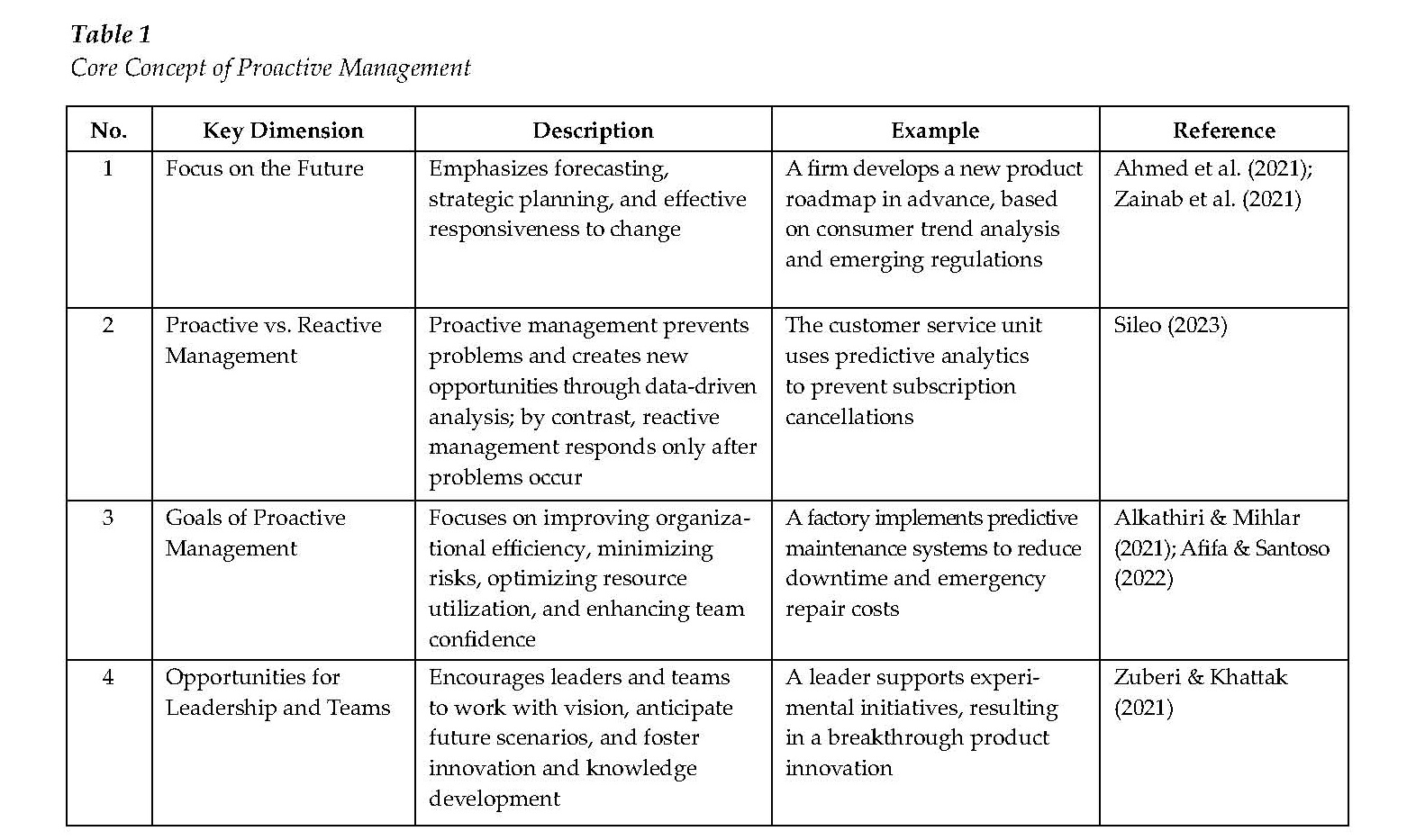
Proactive management has gained increasing attention in both academic and organizational contexts due to its strategic role in enhancing adaptability and competitiveness in volatile and uncertain environments. This study aims to synthesize a conceptual framework of proactive management through documentary analysis guided by Snyder’s (2019) model. A total of 134 scholarly articles published between 2020 and 2025, inclusive, were initially identified from reputable academic databases, including Scopus, ScienceDirect, SCImago Journal Rank (SJR), and Google Scholar. Following systematic selection criteria, 41 articles were selected for in-depth synthesis. The analysis focused on five key dimensions: core concepts, foundational elements, strategic outcomes, the role of proactive leadership, and practical applications. The findings reveal that proactive management comprises five interconnected components: anticipation, strategic planning, proactive problem-solving, team development, and data-driven decision-making. Collectively, these elements contribute to improved risk mitigation, enhanced organizational efficiency, increased team confidence, greater resilience, and sustained competitiveness. The resulting integrated framework offers both theoretical insights and practical implications, serving as a foundation for strategic design, leadership development, and policy formulation in rapidly evolving environments.
Article Details

This work is licensed under a Creative Commons Attribution-NonCommercial-NoDerivatives 4.0 International License.
References
Afifa, Y. N., & Santoso, I. (2022). Proactive risk mitigation strategies and building strategic resilience in the food supply chain: a review. Food Research, 6(2), 9-17. https://doi.org/10.26656/fr.2017.6(2).257
Agbaji, A. (2021). Leadership and managerial decision-making in an AI-enabled oil and gas industry. Day 3 Wed, November 17, 2021. https://doi.org/10.2118/207613-ms
Ahmed, R. R., Streimikiene, D., & Zheng, X. (2021). The impact of proactive environmental strategy on competitive and sustainable development of organizations. Journal of Competitiveness. https://doi.org/10.7441/joc.2021.04.01
Alkathiri, K. G. M., & Mihlar, M. (2021). The Organizational Performance Dimensions on Achieving Organizational Goals: A Case Study of the Minister’s Office of Dhofar State, Oman. Journal of Almaarif University College, 32(3). https://doi.org/10.51345/.v32i3.449.g235
Allam, K., & Rodwal, A. (2023). AI-DRIVEN BIG DATA ANALYTICS: UNVEILING INSIGHTS FOR BUSINESS ADVANCEMENT. EPH - International Journal of Science and Engineering. https://doi.org/10.53555/ephijse.v9i3.219
Asaul, A., Asaul, M., Levin, J., Shcherbina, G., & Trushkovskaya, E. (2021). Proactive mechanisms for response to risks of business entities engaged in investment and construction activities. SSRN Electronic Journal. https://doi.org/10.2139/ssrn.3873189
Bhima, B., Zahra, A., & Nurtino, T. (2023). Enhancing organizational efficiency through the integration of artificial intelligence in management information systems. APTISI Transactions on Management (ATM, 7)(3), Article 2146. https://doi.org/10.33050/atm.v7i3.2146
Bohashko, O., & Bohashko, I. (2023). The culture of business communication is a decisive factor of leadership in the management of organizations. Economies' Horizons, 26(4), 91–99. https://doi.org/10.31499/2616-5236.4(26).2023.291789
Bushuyev, S., & Pilyugina, K. (2023). Value-oriented proactive management in high-tech project teams. Management of Development of Complex Systems, 53, 5–15. https://doi.org/10.32347/2412-9933.2023.53.5-15
Crant, J. M. (2000). Proactive behavior in organizations. Journal of Management, 26(3), 435–462. https://doi.org/10.1177/014920630002600304
Daher, A. (2023). Proactive leadership and its relationship to managing the organizational error of the Iraqi Handball Federation from the point of view of the clubs participating in the Iraqi Elite League for the season 2023–2024. Journal of Physical Education, 35(4). https://doi.org/10.37359/jope.v35(4)2023.1981
Dba, C., & Mallillin, L. (2023). Organizational leadership skills theory and practice: A guide to management system. International Journal of Social Science and Human Research, 6(10), 5152–5160. https://doi.org/10.47191/ijsshr/v6-i10-69
Faisal, M., & Mahmoud, M. (2023). The role of proactive behavior in achieving strategic decision quality. International Journal of Research in Social Sciences & Humanities, 13(2). https://doi.org/10.37648/ijrssh.v13i02.048
Fatima, A., & Tufail, M. (2021). Improving efficiency of apparel manufacturing through the principles of resource management. Clothing and Textiles Research Journal, 41(3), 225–235. https://doi.org/10.1177/0887302X211005432
Fazli, H., Farooq, S., Yang, C., & Wæhrens, B. V. (2023). Proactive and reactive approaches towards sustainable practices in manufacturing companies: Emerging economies perspective. Sustainability, 15(17), Article 12796. https://doi.org/10.3390/su151712796
Fitria, N., Wijayanti, I., Santoso, A., Romadon, S., & Kraugusteeliana, K. (2023). The role of management information systems in human resource competency development. Jurnal Minfo Polgan, 12(1), Article 12764. https://doi.org/10.33395/jmp.v12i1.12764
Gitelman, L., Isaev, A., Kozhevnikov, M., & Gavrilova, T. (2023). Proactive management education for a technological breakthrough. Strategic Decisions and Risk Management, 13(4), 290–303. https://doi.org/10.17747/2618-947x-2022-4-290-303
Grove, H., Clouse, M., & Xu, T. (2023). Strategic foresight for companies. Corporate Board: Role, Duties and Composition, 19(2), 1–10. https://doi.org/10.22495/cbv19i2art1
Haessler, P. (2020). Strategic decisions between short-term profit and sustainability. Administrative Sciences, 10(3), 63. https://doi.org/10.3390/admsci10030063
Hashim, Z., & Hussein, A. (2022). The effect of proactive leadership in the quality of insurance decisions: A field study on a sample of managers of Iraqi insurance companies. International Academic Journal of Business Management, 9(2), 1–14. https://doi.org/10.9756/iajbm/v9i2/iajbm0915
Hidayat, S., Febrianto, Z., Eliyana, A., Purwohedi, U., Anggraini, R., Emur, A., & Zahar, M. (2023). Proactive personality and organizational support in television industry: Their roles in creativity. PLOS ONE, 18(1), Article e0280003. https://doi.org/10.1371/journal.pone.0280003
Hong, Y., Liao, H., Raub, S., & Han, J. (2016). What it takes to get proactive: An integrative multilevel model of the antecedents of personal initiative. The Journal of Applied Psychology, 101(5), 687–701. https://doi.org/10.1037/apl0000064
Ionescu, S., & Diaconita, V. (2023). Transforming Financial Decision-Making: The Interplay of AI, Cloud Computing and Advanced Data Management Technologies. INTERNATIONAL JOURNAL OF COMPUTERS COMMUNICATIONS & CONTROL. https://doi.org/10.15837/ijccc.2023.6.5735
Klomim, K., & Kuayngern, B. (2023). Development in designing competency-based learning management according to the guidelines for driving the economy (BCG model) by using the concept of proactive learning management for students’ practice teaching professional experience. Journal of Education and Learning, 12(5), 208–217. https://doi.org/10.5539/jel.v12n5p208
Kostarev, D., Tevyashev, A., Sizova, N., & Tkachenko, V. (2023). System analysis of the problem of proactive management of an industrial enterprise. InterConf. https://doi.org/10.51582/interconf.19-20.08.2023.031
Kumar, H. (2023). A study on strategic human resource management and organizational performance. TEST Engineering & Management, 83, Article 14611. https://doi.org/10.52783/testmagzine.v83.14611
Kvasha, T. (2022). Foresight research as a strategic planning component. University Scientific Notes, 85–86. https://doi.org/10.37491/unz.85-86.15
Lazarenko, Y., Garafonova, O., Marhasova, V., & Grigashkina, S. (2021). Gaining a competitive advantage through sustainability strategy: Managerial applications for the mining sector. E3S Web of Conferences, 278, Article 03036. https://doi.org/10.1051/e3sconf/202127803036
Leung, B. (2023). The effects of green management practice on organizational performance success: An empirical study in HK building industry. Natural Resources Conservation and Research, 6(1), Article 1859. https://doi.org/10.24294/nrcr.v6i1.1859
Linkova, О. (2021). Personnel training as an effective tool of organizational development. Scientific Journal of Kherson State University. Series "Economic Sciences", 2021(1). https://doi.org/10.32782/2415-8801/2021-1.17
Lunde, T., Sjusdal, A., & Pappas, I. (2019). Organizational culture challenges of adopting big data: A systematic literature review. In Proceedings of the IFIP Advances in Information and Communication Technology (Vol. 558, pp. 164–176). Springer. https://doi.org/10.1007/978-3-030-29374-1_14
Luo, B. N., Tang, Y., Chen, E. W., Li, S., & Luo, D. (2020). Corporate sustainability paradox management: A systematic review and future agenda. Frontiers in psychology, 11, 579272. https://doi.org/10.3389/fpsyg.2020.579272
Mahler-Rogers, D. (2017). Infusing complex problem-solving and systems thinking in college leadership development programs. Doctoral Dissertation, Old Dominion University. https://doi.org/10.25777/qvbz-m677
Meng, X. (2020). Proactive management in the context of construction supply chains. Production Planning & Control, 31(6), 527–539. https://doi.org/10.1080/09537287.2019.1657977
Meza, R., Triplett, N., Woodard, G., Martin, P., Khairuzzaman, A., Jamora, G., & Dorsey, S. (2021). The relationship between first-level leadership and inner-context and implementation outcomes in behavioral health: A scoping review. Implementation Science, 16(1), Article 104. https://doi.org/10.1186/s13012-021-01104-4
Mujtaba, B., Cavico, F., & Senathip, T. (2020). Strategies for personal, organizational and professional leadership success. Scientific Journal of Research & Reviews, 2(1). https://doi.org/10.33552/sjrr.2020.02.000538
Ongaro, E., & Ferlie, E. (2020). Strategic Management in public organizations: Profiling the public entrepreneur as strategist. The American Review of Public Administration, 50(4-5), 360-374. https://doi.org/10.1177/0275074020909514
Park, J. H. (2025). How did South Korean multiplexes survive the pandemic?: A dynamic capabilities perspective. foresight, 27(3), 507-523. https://doi.org/10.1108/fs-10-2023-0205
Parker, S. K., Bindl, U. K., & Strauss, K. (2010). Making things happen: A model of proactive motivation. Journal of Management, 36(4), 827–856. https://doi.org/10.1177/0149206310363732
Parker, S. K. (2000). From passive to proactive motivation: The importance of flexible role orientations and role breadth self‐efficacy. Applied Psychology, 49(3), 447–469. https://doi.org/10.1111/1464-0597.00025
Psychogios, A. (2022). Re-conceptualising total quality leadership: A framework development and future research agenda. The TQM Journal, 34(6), 1–23. https://doi.org/10.1108/tqm-01-2022-0030
Rakova, B., Yang, J., Cramer, H., & Chowdhury, R. (2020). Where responsible AI meets reality. Proceedings of the ACM on Human-Computer Interaction, 5, 1–23. https://doi.org/10.1145/3449081
Roy, V., Silvestre, B. S., & Singh, S. (2020). Reactive and proactive pathways to sustainable apparel supply chains: Manufacturer's perspective on stakeholder salience and organizational learning toward responsible management. International Journal of Production Economics, 227, 107672. https://doi.org/10.1016/j.ijpe.2020.107672
Serra, F., Scafuto, I., Da Costa, P., Nassif, V., & Pigola, A. (2023). Organizing 'contributions to practice' in research articles on innovation. International Journal of Innovation, 11(1), Article 25629. https://doi.org/10.5585/2023.25629
Shafiabady, N., Hadjinicolaou, N., Din, F., Bhandari, B., Wu, R., & Vakilian, J. (2023). Using artificial intelligence (AI) to predict organizational agility. PLOS ONE, 18(1), Article e0283066. https://doi.org/10.1371/journal.pone.0283066
Sileo, G. (2023). Proactive and reactive infrastructure investment. Available at SSRN 4274528. https://doi.org/10.2139/ssrn.4274528
Snyder, H. (2019). Literature review as a research methodology: An overview and guidelines. Journal of Business Research, 104, 333–339. https://doi.org/10.1016/j.jbusres.2019.07.039
Szabo, Z., Körtesi, P., Guncaga, J., Szabo, D., & Neag, R. (2020). Examples of problem-solving strategies in mathematics education supporting the sustainability of 21st-century skills. Sustainability, 12(23), Article 10113. https://doi.org/10.3390/su122310113
Usman, M. (2020). Transformational leadership and organizational change: In the context of today’s leader. International Business Education Journal, 13(1), 85–98. https://doi.org/10.37134/IBEJ.VOL13.1.8.2020
Wood, J., & Ventura, H. (2021). Development of a single-factor scale to measure leader accountability. In Advances in Human Resources Management and Organizational Development (Chapter 10). IGI Global. https://doi.org/10.4018/978-1-7998-7665-6.ch010
Wu, C., & Wang, Y. (2011). Understanding proactive leadership. Research in Personnel and Human Resources Management, 30, 299–314. https://doi.org/10.1108/S1535-1203(2011)0000006015
Zainab, S. R., Khawaja, K. F., & Asghar, S. A. (2021). The impact of Proactive Sustainability Strategy and Sustainable Leadership on Corporate Sustainability performance. NICE Research Journal, 30-47. https://doi.org/10.51239/nrjss.vi.272
Zhu, Y., How, K., Wu, H., & Cao, Q. (2023). AI-based proactive storage failure management in software-defined data centres. Proceedings of the 2023 6th International Conference on Information Science and Systems. https://doi.org/10.1145/3625156.3625190
Zuberi, M., & Khattak, A. (2021). Impact of proactive personality and leader-member exchange on innovative work behavior: A job design perspective. International Journal of Innovation Science, 13(3), 329–345. https://doi.org/10.1108/IJIS-11-2020-0251
