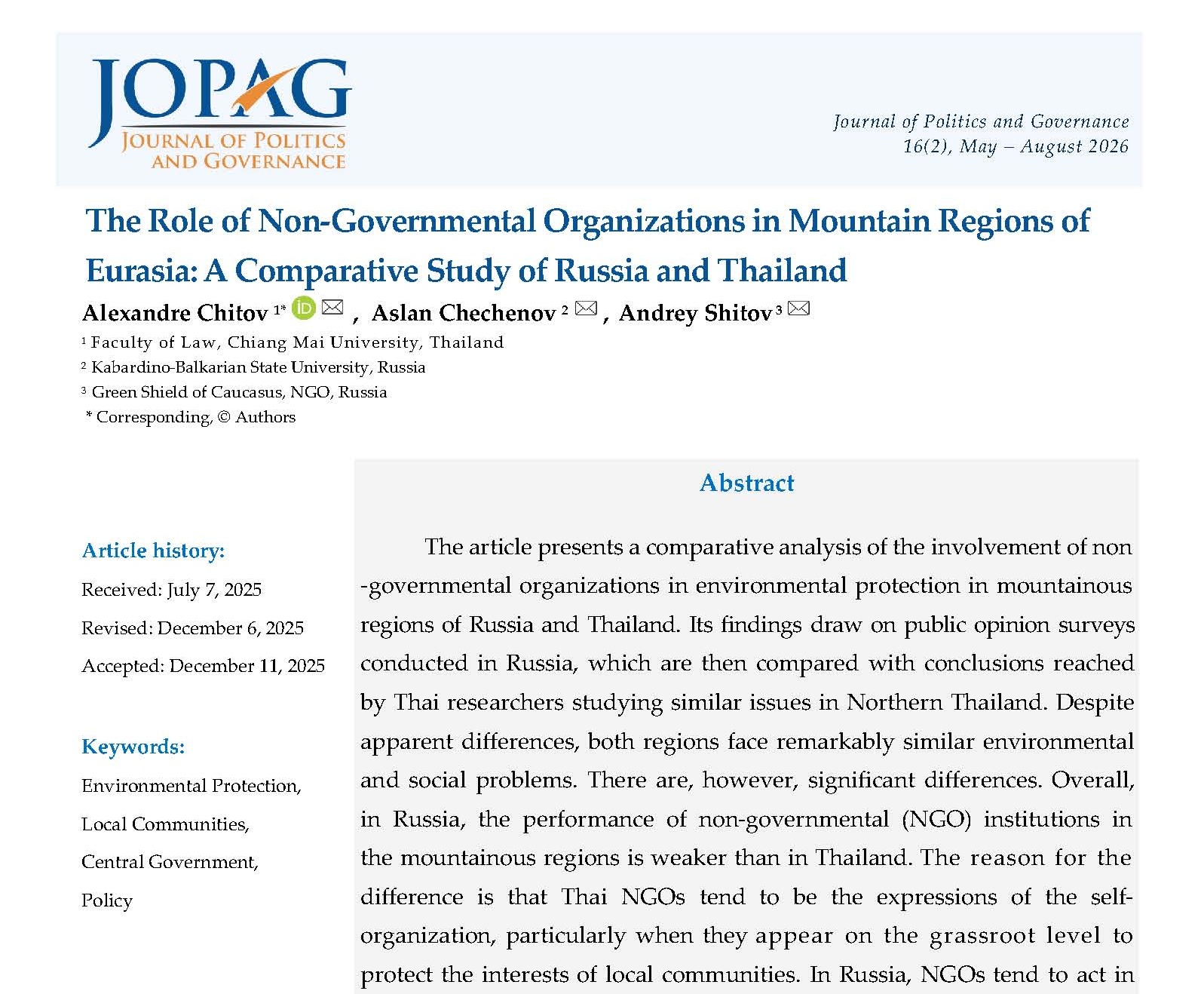
The Role of Non-Governmental Organizations in Mountain Regions of Eurasia: A Comparative Study of Russia and Thailand
Article Sidebar
Main Article Content
Abstract
The article presents a comparative analysis of the involvement of non-governmental organizations in environmental protection in mountainous regions of Russia and Thailand. Its findings draw on public opinion surveys conducted in Russia, which are then compared with conclusions reached by Thai researchers studying similar issues in Northern Thailand. Despite apparent differences, both regions face remarkably similar environmental and social problems. There are, however, significant differences. Overall, in Russia, the performance of non-governmental (NGO) institutions in the mountainous regions is weaker than in Thailand. The reason for the difference is that Thai NGOs tend to be the expressions of the self-organization, particularly when they appear on the grassroot level to protect the interests of local communities. In Russia, NGOs tend to act in accordance with the governmental policies and in close interaction with the central government authorities. A stronger state leaves less room for the successful work of non-governmental organizations.
Article Details

This work is licensed under a Creative Commons Attribution-NonCommercial-NoDerivatives 4.0 International License.
References
Aim Sinpeng. (2020). From the Yellow Shirts to the whistle rebels: Comparative analysis of the People’s Alliance for Democracy (PAD) and the People’s Democratic Reform Committee (PDRC). In P. Chachavalpongpun (Ed.), The Routledge handbook of contemporary Thailand (pp. 145–155). Routledge.
Altaiprirod. (2020, August 20). Joint work between community activists and state inspectors continues in specially protected natural areas of the Altai Krai. https://altpriroda.ru/novosti/?/n132-sovmestnaya-rabota-obschestvennikov-i-gosudarstvennyih-inspektorov-prodoljaetsya-na-osobo-ohranyaemyih-prirodnyih-territoriyah-altayskogo-kraya/
Badenkov, Y. P. (2017). Life in the mountains: Natural and cultural diversity – Diversity of development models. GEOS.
Betsill, M. M., Corell, E., & Dodds, F. (Eds.). (2007). NGO diplomacy: The influence of nongovernmental organizations in international environmental negotiations. MIT Press.
Bronfenbrenner, U. (1979). The ecology of human development: Experiments by nature and design. Harvard University Press.
Buasuwan, P. (2018). Rethinking Thai higher education for Thailand 4.0. Asian Education and Development Studies, 7(2), 157–173.
Chaithongkam, S. (2020). Criminal prosecution by people and private organizations in environmental cases. Interdisciplinary Sripatum Chonburi Journal, 6(3), 92–101.
Chechenov, A. M., Shogenov, M. Z., Azamatova, G. K., Atabieva, Z. A., & Reshetnikova, N. N. (2020). Self-administration and development of local communities of North Caucasus: By the example of Kabardino-Balkar Republic and Karachay-Cherkess Republic. In T. Kolmykova & E. V. Kharchenko (Eds.), Digital future economic growth, social adaptation, and technological perspectives (pp. 59–69).
Cheskin, A., & March, L. (2015). State–society relations in contemporary Russia: New forms of political and social contention. East European Politics, 31(3), 261–273.
Credit Suisse. (2022). Global wealth databook 2022. https://www.credit-suisse.com/media/assets/corporate/docs/about-us/research/publications/global-wealth-databook-2022.pdf
Crotty, J., & Ljubownikow, S. (2023). Environmental governance in the Russian Federation: Firms and regulator perception of environmental NGOs. East European Politics, 39(1), 39–56.
Dutta, K., & Khongkachonkiet, P. (2008). Reclaiming rights in forests: Struggles of indigenous peoples in Thailand. International Work Group for Indigenous Affairs & Highland Peoples Taskforce. https://crcfthailand.org/wp-content/uploads/2010/01/reclaiming_ rights_in_forests_struggles_of_ips_in_thailand.pdf
Golosov, G. V., Gushchina, K., & Kononenko, P. (2016). Russia’s local government in the process of authoritarian regime transformation: Incentives for the survival of local democracy. Local Government Studies, 42(4), 507–526.
Gunya, A., Daksner, M., Köhler, J., Tenov, T., Chechenov, A., & Shogenov, M. (2013). Konflikty i razvitiya: Vvedenie v metodologii i metody izucheniya [Conflicts and development: Introduction to methodology and methods of study]. Publishing House of Kabardino-Balkarian State University.
Gunya, A. N. (Ed.). (2019). North Caucasian complex expedition: Collection of works (Issue 1). Chechen State University.
Hares, M. (2009). Forest conflict in Thailand: Northern minorities in focus. Environmental Management, 43(3), 381–395.
Ives, J. (2004). Himalayan perceptions: Environmental change and the well-being of mountain peoples. Routledge.
Kendall, D. (2019, June 1). Human rights defenders face risk of “jail, death.” Bangkok Post. https://www.bangkokpost.com/thailand/general/1687468/human-rights-defenders-face-risk-of-jail-death
Klausner, W. J. (1987). Reflections on Thai culture. Siam Society.
Kommersant. (2017, July 25). ANO “Far Eastern Leopards.” https://www.kommersant.ru/doc/3361311
Kommersant. (2023, June 21). What is the World Wildlife Fund known for? https://www.kommersant.ru/doc/6055938
Leungaramsri, P., & Rajesh, N. (1992). The future of people and forests in Thailand after the logging ban. Project for Ecological Recovery.
Levitsky, S., & Way, L. A. (2002). The rise of competitive authoritarianism. Journal of Democracy, 13(2), 51–65.
Mae Omki. (2015). The life of the forest and ideals of the justice process. Human Rights Lawyers Association.
Manorom, K. (2020). NGOs and civil society in Thailand. In P. Chachavalpongpun (Ed.), The Routledge handbook of contemporary Thailand (pp. 366–378). Routledge.
Manushya Foundation, Cross Cultural Foundation, ENLAWTHAI Foundation, Human Rights and Development Foundation, Human Rights Lawyers Association, Northern Development Foundation, & Union for Civil Liberty. (2021, March 6). Joint statement: Thai authorities must release 22 Bang Kloi Karen and drop all forest encroachment charges. https://a9e7bfc1-cab8-4cb9-9c9e-c0cee58a 9bd.filesusr.com/ugd/a0db76_220e3ccbf 96c41b4bd5ecbcb1c46ccbf.pdf
Martin, T. (2001). The affirmative action empire: Nations and nationalism in the Soviet Union, 1923–1939. Cornell University Press.
Munger, F. (2012). Global funder, grassroots litigator–Judicialization of the environmental movement in Thailand. NYLS Legal Studies Research Paper, 12/13, 1–38.
Munger, F. (2015). Thailand’s cause lawyers and twenty-first century military coups: Nation, identity, and conflicting visions of the rule of law. Asian Journal of Law and Society, 2, 301–322.
Nature and People. (2025). Projects. https://naturepeople.ru/news?rubric=projects&t=1
Pongboonjun, S. (2023). Creating rights from the bottom up: Public interest environmental lawyers in Thailand (Doctoral dissertation, Victoria University).
Presidential Grant Fund. (2025). https://xn--80afcdbalict6afooklqi5o.xn--p1ai/public/application/cards
Russian Government. (1993). Constitution of the Russian Federation. http://www.constitution. ru/en/10003000-09.htm
Russian Government. (2003). Federal Law No. 131-FZ “On the general principles of the organization of local self-government in the Russian Federation” (October 6, 2003). http://www.kremlin.ru/acts/bank/20035
Russian Government. (2012). Federal Law No. 121-FZ “On amendments to certain legislative acts of the Russian Federation in terms of regulating the activities of non-commercial organizations performing the functions of a foreign agent”. https://rg.ru/documents/2012/07/23/nko-dok.html
Russian Government. (2022). Federal Law No. 255-FZ “On control over the activities of persons under foreign influence”. https://rg.ru/documents/2022/07/19/document-inoagent.html
Russian Government. (2025). Decree of the President of the Russian Federation of 07.02.2025 No. 69 “On the establishment of the Presidential Fund for environmental and nature conservation projects”. https://www.consultant.ru/document/cons_doc_LAW_498156/
Rybakov, S. (2024). Фонду «Природа и Люди» исполнился 1 год. https://naturepeople.ru/news/tpost/5hio9p7331-fondu-priroda-i-lyudi-ispolnilsya-1-god
Saichol Sattayanurak. (2020). Thai identity and nationalism. In P. Chachavalpongpun (Ed.), The Routledge handbook of contemporary Thailand (pp. 241–252). Routledge.
Shogenov, M. Z., Gunya, A. N., Chechenov, A. M., & Chemaev, N. A. (2018). Local civil society and its contribution to stability in the North Caucasus: The example of Kabardino-Balkaria and Karachay-Cherkessia. Caucasian Science Bridge, 1(1), 103–121.
Shytov, A., Siriwittayakorn, T., Nunthagowat, S., & Longsida, T. (2007). Thai local youth and environmental offences. Chiang Mai University.
Simpson, A. (2005). Green NGOs and authoritarian regimes: The perils of environmental activism in Thaksin’s Thailand. Griffith Journal of the Environment, 1, 1–34.
Sutton, M. Q., & Anderson, E. N. (2014). Introduction to cultural ecology (3rd ed.). AltaMira Press.
Talesh, S. (2022). Public law and regulatory theory. In C. Ansell & J. Torfing (Eds.), Handbook on theories of governance (pp. 104–117). Edward Elgar Publishing.
Thai Government. (1992). The National Environmental Quality Enhancement and Conservation Act B.E. 2535. https://faolex.fao.org/docs/pdf/tha19415.pdf
Tysiachniouk, M. S., Tulaeva, S. A., Kotilainen, J., & Henry, L. A. (2025). Liberal spaces in an illiberal regime: Environmental NGOs, state sovereignty and the struggle for nature. Territory, Politics, Governance, 13(6), 773–792.
Ungsuchaval, T. (2016). Civil society and nongovernmental organizations (NGOs) in Thailand. GRIN Verlag.
United Nations. (2022). Sustainable development: Sustainable mountain development. Resolution adopted by the General Assembly on 14 December 2022. https://documents.un.org/doc/undoc/gen/n22/756/81/pdf/n2275681.pdf
World Rainforest Movement. (2021). Karen indigenous communities face danger after returning to their ancestral territory in Thailand. https://www.wrm.org.uy/action-alerts/alert-karen-indigenous-communities-face-danger-after-returning-to-their-ancestral-territory-in-thailand
Zuzin, S. (2025, February 20). In the Altai region, it was not possible to stop barbaric gold mining. Rossiiskaya Gazeta. https://rg.ru/2025/02/20/reg-sibfo/v-altajskom-krae-ne-udalos-prekratit-varvarskuiu-zolotodobychu.html
