Policy Network Management and Community Enterprise Potential: The Mediating Role of Promoting Community Enterprise Management in Northeastern Thailand
Article Sidebar
Main Article Content
Abstract
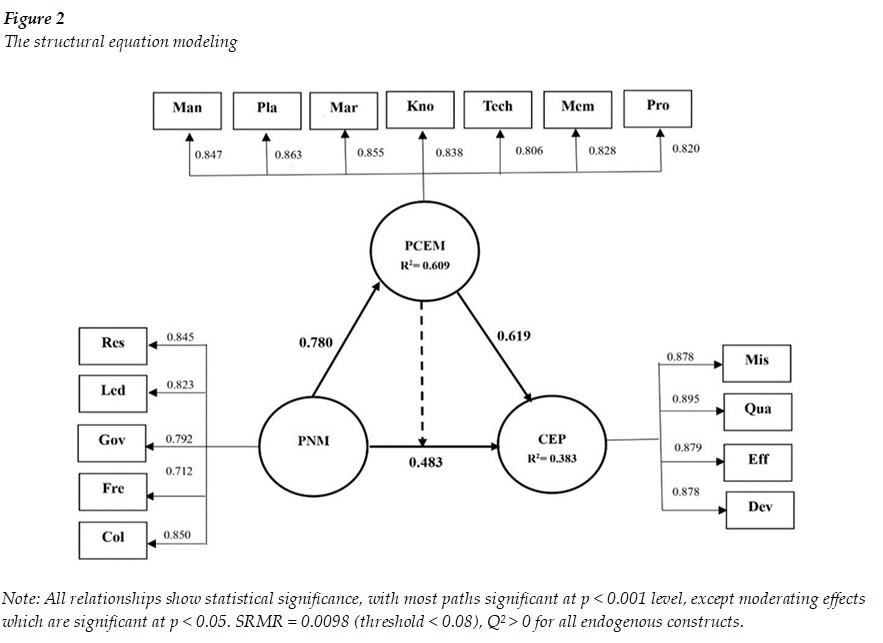
This study examines the complex relationships between policy network management, community enterprise management promotion, and community enterprise potential in Thailand's Northeastern region. Despite significant policy support for community enterprises, questions remain about how policy networks effectively enhance enterprise potential. Using a quantitative approach with data from 443 community enterprises, this research employs PLS-SEM to test a theoretical model linking these constructs. Findings reveal that promoting community enterprise management significantly mediates the relationship between policy network management and community enterprise potential. A well-coordinated policy network enhances enterprise potential primarily by strengthening management capabilities across multiple dimensions, including planning, knowledge management, and technology integration. This study contributes to policy network theory by demonstrating concrete implementation mechanisms and offers practical guidance for policymakers to design integrated support systems that recognize management capacity development as a critical pathway for community enterprise enhancement.
Article Details

This work is licensed under a Creative Commons Attribution-NonCommercial-NoDerivatives 4.0 International License.
References
Anusonphat, N. (2024). Driving community enterprises to create a sustainable grassroots economy in Thailand. Asian Political Science Review, 8(1).
ASEAN Foundation. (2025). Calling social enterprises from 10 ASEAN countries to apply! Join us in ASEAN SEDP 4.0. https://www.aseanfoundation.org/calling_social_ enterprises_from_10_ asean_countries_to _apply
Baruch, Y., & Holtom, B. C. (2008). Survey response rate levels and trends in organizational research. Human Relations, 61(8), 1139–1160.
Bentler, P. M., & Chou, C. P. (1987). Practical issues in structural modeling. Sociological Methods & Research, 16(1), 78–117.
Board of Investment of Thailand. (2022). Encouraging business operators to be involved in local community and society development. https://www.boi.go.th/en/grassroot
Boonnual, C., & Boonnual, T. (2024). Social capital and corporate social responsibility: Pathways to the sustainability of community enterprises in Chumphon Province. International Journal of Professional Business Review, 9(1), 15.
Boossabong, P., & Chamchong, P. (2018). The importance of network in public policy and governance: Critical perspectives and an analytical framework for going beyond an empty signifier. Journal of Social Sciences, Naresuan University, 14(2), 113–136.
Brown, J. D. (2000). What is construct validity? http://jalt.org/test/bro_8.htm
Cavite, H. J. M., Kerdsriserm, C., & Suwanmaneepong, S. (2023). Strategic guidelines for community enterprise development: A case in rural Thailand. Journal of Enterprising Communities: People and Places in the Global Economy, 17(2), 284–304.
Chaiyo, S., Pongsiri, P., & Wattanakomol, S. (2024). Strategy for developing the potential of community enterprises in product production groups towards sustainable growth. International Journal of eBusiness and eGovernment Studies, 16(1), 145–161.
Cohen, J. (1992). Statistical power analysis. Current Directions in Psychological Science, 1(3), 98–101.
Department of Community Enterprise Promotion. (2022). Community enterprise database. Ministry of Agriculture and Cooperatives.
Dillman, D. A., Smyth, J. D., & Christian, L. M. (2014). Internet, phone, mail, and mixed-mode surveys: The tailored design method (4th ed.). Wiley.
Gomes, A. (2024). Understanding the shapers of sustainability in small businesses. International Journal of Science and Research Archive, 13(2), 3040–3054. https://doi.org/10.30574/ijsra.2024.13.2.2500
Hadi, A., Bedasari, H., & Zebua, B. H. (2025). Policy network in improving the quality of Meranti slum area effort to realize sustainable cities and settlements in Pekanbaru. In Proceedings of the 1st International Conference on Social Environment Diversity (ICOSEND 2024) (pp. 903–912). Atlantis Press.
Hair, J. F., & Alamer, A. (2022). Partial least squares structural equation modeling (PLS-SEM) in second language and education research: Guidelines using an applied example. Research Methods in Applied Linguistics, 1(3), Article 100027.
Hair, J. F., Risher, J. J., Sarstedt, M., & Ringle, C. M. (2019). When to use and how to report the results of PLS-SEM. European Business Review, 31(1), 2–24.
Henseler, J., Ringle, C. M., & Sarstedt, M. (2015). A new criterion for assessing discriminant validity in variance-based structural equation modeling. Journal of the Academy of Marketing Science, 43, 115–135.
IFAD. (2023). Coastal community development project. https://www.ifad.org/en/w/projects/1100001621
Jarusen, J., & Cheunkamon, E. (2024). Measurement model for community enterprise management strategies. Heliyon, 10(19).
Kickert, W. J., Klijn, E. H., & Koppenjan, J. F. (1997). Introduction: A management perspective on policy networks. In W. J. Kickert, E. H. Klijn, & J. F. Koppenjan (Eds.), Managing complex networks: Strategies for the public sector (pp. 1–13). SAGE Publications.
Klijn, E. H., Koppenjan, J., Warsen, R., & Spekkink, W. (2015). Governance networks in the public sector. Routledge.
Kock, N., & Hadaya, P. (2018). Minimum sample size estimation in PLS-SEM: The inverse square root and gamma-exponential methods. Information Systems Journal, 28(1), 227–261.
Mandell, M. P., & Keast, R. (2008). Evaluating the effectiveness of interorganizational relations through networks. Public Management Review, 10(6), 715–731.
Manfreda, K. L., Bosnjak, M., Berzelak, J., Haas, I., & Vehovar, V. (2008). Web surveys versus other survey modes: A meta-analysis comparing response rates. International Journal of Market Research, 50(1), 79–104.
Mitchell, V. (1996). Assessing the reliability and validity of questionnaires. Journal of Applied Management Studies, 5, 199–207.
Moran, M., Rein, M., & Goodin, R. E. (Eds.). (2008). The Oxford handbook of public policy. Oxford University Press.
Muangnam, P. (2021, October 6). Driving community enterprises in Nong Bua Lamphu province: Cooperation in promoting community enterprises among partner agencies [Personal interview].
Nunnally, J. C., & Bernstein, I. H. (1994). Psychometric theory (3rd ed.). McGraw-Hill.
Podsakoff, P. M., MacKenzie, S. B., Lee, J. Y., & Podsakoff, N. P. (2003). Common method biases in behavioral research: A critical review of the literature and recommended remedies. Journal of Applied Psychology, 88(5), 879–903.
Provan, K. G., & Kenis, P. (2008). Modes of network governance: Structure, management, and effectiveness. Journal of Public Administration Research and Theory, 18(2), 229–252.
Rhodes, R. A. W. (2006). Policy networks. In M. Moran, M. Rein, & R. E. Goodin (Eds.), The Oxford handbook of public policy (pp. 425–447). Oxford University Press.
Rigdon, E. E. (2016). Choosing PLS path modeling as an analytical method in European management research: A realist perspective. European Management Journal, 34(6), 598–605.
Sarstedt, M., Hair, J. F., Pick, M., Liengaard, B. D., Radomir, L., & Ringle, C. M. (2022). Progress in partial least squares structural equation modeling use in marketing research in the last decade. Psychology & Marketing, 39(5), 1035–1064.
Tung, D. T., Hung, N. T., Phuong, N. T. C., Loan, N. T. T., & Chong, S.-C. (2020). Enterprise development from students: The case of universities in Vietnam and the Philippines. The International Journal of Management Education, 18(3), 100333. https://doi.org/10.1016/j.ijme.2020.100333
Voorhees, C. M., Brady, M. K., Calantone, R., & Ramirez, E. (2016). Discriminant validity testing in marketing: An analysis, causes for concern, and proposed remedies. Journal of the Academy of Marketing Science, 44, 119–134.
World Bank. (2014). Community driven development in Indonesia. https://www.worldbank.org/en/country/indonesia/brief/community-driven-development-in-indonesia
