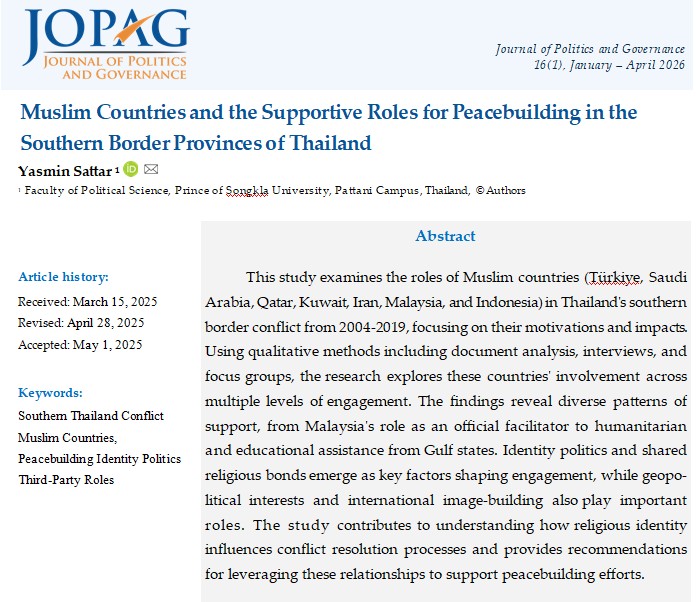
Muslim Countries and the Supportive Roles for Peacebuilding in the Southern Border Provinces of Thailand
Article Sidebar
Main Article Content
Abstract
This study examines the roles of Muslim countries (Türkiye, Saudi Arabia, Qatar, Kuwait, Iran, Malaysia, and Indonesia) in Thailand's southern border conflict from 2004-2019, focusing on their motivations and impacts. Using qualitative methods including document analysis, interviews, and focus groups, the research explores these countries' involvement across multiple levels of engagement. The findings reveal diverse patterns of support, from Malaysia's role as an official facilitator to humanitarian and educational assistance from Gulf states. Identity politics and shared religious bonds emerge as key factors shaping engagement, while geopolitical interests and international image-building also play important roles. The study contributes to understanding how religious identity influences conflict resolution processes and provides recommendations for leveraging these relationships to support peacebuilding efforts.
Article Details

This work is licensed under a Creative Commons Attribution-NonCommercial-NoDerivatives 4.0 International License.
References
Anderson, M. B. (1999). Do no harm: How aid can support peace—or war. Lynne Rienner Publishers.
Barakat, S., & Zyck, S. (2010). Gulf state assistance to conflict-affected environments (Kuwait Programme on Development, Governance and Globalisation in the Gulf States). The Centre for the Study of Global Governance, London School of Economics and Political Science.
Daoreuang, P. (2024, August 28). Botbat khong Malaysia nai khwam khatyaeng chaidan tai khong Thai [Malaysia's role in Thailand's southern border conflict]. The 101 World. https://www.the101.world/malaysia-roles-in-thailand-deep-south-conflict/
De Lauri, A. (2018). Humanitarian diplomacy: Practices, politics, and power (CMI Brief No. 2018:4). Chr. Michelsen Institute.
Lederach, J. P. (1998). Building peace: Sustainable reconciliation in divided societies. United States Institute of Peace Press.
Maluleem, J. (2012). Ongkan Nana Chat Islam (OIC) kap kan kaipan ha khwam khatyaeng nai phak tai khong Thai [The Organization of Islamic Cooperation (OIC) and the resolution of conflicts in southern Thailand]. Chulalongkorn University.
McCargo, D. (2014). Southern Thailand: From conflict to negotiations? Lowy Institute. https://www.lowyinstitute.org/publications/southern-thailand-conflict-negotiations
Milton, S., Elkahlout, G., & Tariq, S. (2023). Qatar's evolving role in conflict mediation. Mediterranean Politics, 30(1), 53–77. https://doi.org/10.1080/13629395.2023. 2266665
Muna, R. A. A., Ras, A. R., Rudiyanto, R., Widodo, P., Saragih, H. J. R., & Suwarno, P. (2023). Indonesian diplomacy in resolving the Southern Thailand conflict in maintaining regional security stability. International Journal of Humanities Education and Social Sciences, 2(6), 1898–1904.
Nakaurairat, P., et al. (2019). Botbat khong nana chat to krabuankan sang santiphap nai chaidan tai khong Thai lae bang mummong to phap anakhot [The role of international actors in the peace process in southern Thailand and some perspectives on the future]. Institute of Human Rights and Peace Studies, Mahidol University.
Salae, H. (2008). Ongkon Muslim kham chat kap khwam mankhong khong manut: Chak Saudi Arabia su prathet Thai [Transnational Muslim organizations and human security: From Saudi Arabia to Thailand]. Paper presented at the 9th National Conference of Political Science and Public Administration.
Sattar, Y. (2018). Güney Doğu Asya'nin Çatişma Bölgelerinde Türkiye'nin Varliği ve Etkisi (Doctoral dissertation, Istanbul University, School of Social Sciences).
Sattar, Y., Koma, A., & Plaiyaphol, M. (2023). Okat lae kho thathai nai khwam samphan Thai–Turki [Opportunities and challenges in Thai–Turkish relations]. International Studies Center (ISC), Ministry of Foreign Affairs.
Strategic Nonviolence Working Group. (2016). Tua sadeng rawang prathet nai khwam khatyaeng thueng tai thi chaidan tai [International actors in the southern border deadly conflict]. Parbpim.
Wigmore-Shepherd, D. (2013). Ethnic identity, political identity and ethnic conflict: Simulating the effect of congruence between the two identities on ethnic violence and conflict (Doctoral dissertation, Durham University).
Yusof, A., & Jaes, L. (2020). Malaysia–Thailand relation in the security perspective. Journal of Social Transformation and Regional Development, 2(2), 20–28.
Yusuf, I. (2007). The Southern Thailand conflict and the Muslim world. Journal of Muslim Minority Affairs, 27(2), 319–339.
