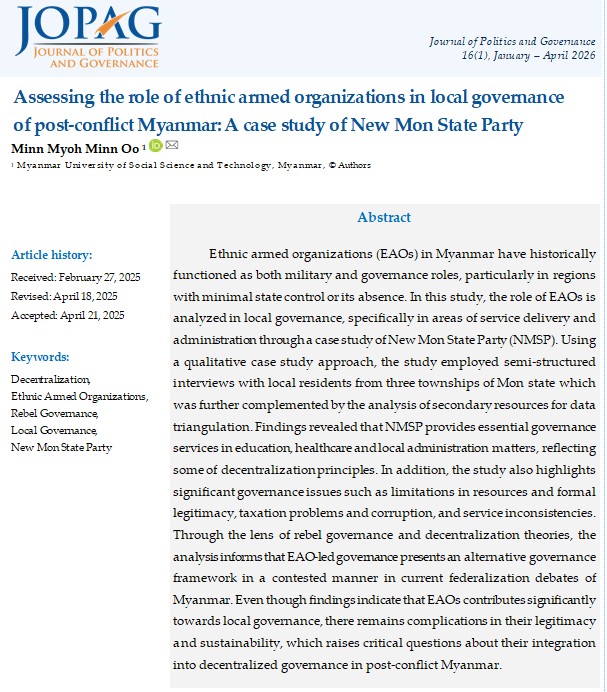
Assessing the role of ethnic armed organizations in local governance of post-conflict Myanmar: A case study of New Mon State Party
Article Sidebar
Main Article Content
Abstract
Ethnic armed organizations (EAOs) in Myanmar have historically functioned as both military and governance roles, particularly in regions with minimal state control or its absence. In this study, the role of EAOs is analyzed in local governance, specifically in areas of service delivery and administration through a case study of New Mon State Party (NMSP). Using a qualitative case study approach, the study employed semi-structured interviews with local residents from three townships of Mon state which was further complemented by the analysis of secondary resources for data triangulation. Findings revealed that NMSP provides essential governance services in education, healthcare and local administration matters, reflecting some of decentralization principles. In addition, the study also highlights significant governance issues such as limitations in resources and formal legitimacy, taxation problems and corruption, and service inconsistencies. Through the lens of rebel governance and decentralization theories, the analysis informs that EAO-led governance presents an alternative governance framework in a contested manner in current federalization debates of Myanmar. Even though findings indicate that EAOs contributes significantly towards local governance, there remains complications in their legitimacy and sustainability, which raises critical questions about their integration into decentralized governance in post-conflict Myanmar.
Article Details

This work is licensed under a Creative Commons Attribution-NonCommercial-NoDerivatives 4.0 International License.
References
Arraiza, J. M., & Davies, S. E. (2020). Enduring peace: A case study of the opportunities and the challenges for engaging in Myanmar’s peace process. Global Responsibility to Protect, 12(1), 115–136. https://doi.org/10.1163/ 1875984X-01201007
Arnold, M., Aung, Y. T., Kempel, S., & Saw, K. P. C. (2015). Municipal governance in Myanmar: An overview of development affairs organizations (Discussion Paper No. 7). Myanmar Development Resource Center for Economic and Social Development & The Asia Foundation.
Aung, S. M. T. (2016). The politics of policymaking in transitional government: A case study of the ethnic peace process in Myanmar. In N. Cheesman & N. Farrelly (Eds.), Conflict in Myanmar: War, politics, religion (pp. 25–46). ISEAS–Yusof Ishak Institute.
Breslawski, J. (2022). Can rebels bolster trust in the government? Evidence from the Philippines. Journal of Conflict Resolution, 67(4), 728–751. https://doi.org/10.1177/00220027221123319
Bünte, M., Köllner, P., & Roewer, R. (2019). Taking stock of Myanmar’s political transformation since 2011. Journal of Current Southeast Asian Affairs, 38(3), 249–264. https://doi.org/ 10.1177/1868103420905140
Center for Operational Analysis and Research. (2023, September 27). A governance tapestry: Layered administrations and revolutionary service delivery in Western Myanmar.
Coffey, D. K. (2022). The drafting of the Constitution of the Union of Burma in 1947: Dominion status, Indo–Burmese relations, and the Irish example. Law and History Review, 41(2), 253–272. https://doi.org/10.1017/S0738248022000487
Crouch, M. (2019). The constitution of Myanmar: A contextual analysis. Hart Publishing.
Crumpton, C. D., Cifuentes, M., & Roche, J. (2023). Rural grassroots governance-building in Myanmar. In J. Ockey & N. S. Talib (Eds.), Democratic recession, autocratization, and democratic backlash in Southeast Asia (pp. 167–197). Palgrave Macmillan.
Florea, A., & Malejacq, R. (2023). The supply and demand of rebel governance. International Studies Review, 26(1), 1–27. https://doi.org/ 10.1093/isr/viae004
Furnivall, J. S. (1949). Twilight in Burma: Independence and after. Pacific Affairs, 22(2), 155–172. https://doi.org/10.2307/2751593
Gleis, J. L., & Berti, B. (2012). Hezbollah and Hamas: A comparative study. Johns Hopkins University Press.
Grindle, M. S. (2007). Going local: Decentralization, democratization and the promise of good governance. Princeton University Press.
Harrisson, A. P., & Kyed, H. M. (2019). Ceasefire state-making and justice provision by ethnic armed groups in Southeast Myanmar. Sojourn, 34(2), 290–326. https://doi.org/10.1355/SJ34-2C
Ibrahim, M. G., & Victoria, D. M. (2022). Reflections on the use of qualitative case study design in education policy research: Contributing to the debate of generalisation in research. International Journal of Social Sciences and Humanities Invention, 9(9), 7250–7258. https://doi.org/10.18535/ijsshi/v9i09.09
Jagger, S. (2018). Developing civil society in the non-state sphere: Welfare and rights-based organisations associated with ethnic armed groups in Myanmar. Small Wars & Insurgencies, 29(2), 316–343. https://doi.org/10.1080/ 09592318.2018.1433511
Jolliffe, K. (2014). Ethnic conflict and social services in Myanmar’s contested regions. The Asia Foundation.
Jolliffe, K. (2015). Ethnic armed conflicts and territorial administration in Myanmar. The Asia Foundation.
Joshi, A., Barnes, K., Chaimite, E., Loureiro, M., & Shankland, A. (2024). Local governance networks as public authority: Insights from Mozambique, Myanmar and Pakistan. Global Policy. https://doi.org/10.1111/1758-5899.13363
Khan, N. I. (2022). Case study as a method of qualitative research. In Information Resources Management Association (Ed.), Research anthology on innovative research methodologies and utilization across multiple disciplines (pp. 452–472). IGI Global. https://doi.org/10.4018/978-1-6684-3881-7.ch023
Kyed, H. M., & Engberg-Pedersen, L. (2008). Local governance in fragile states (DIIS Policy Brief). Danish Institute for International Studies.
Loong, S. (2022). The Karen National Union in post-coup Myanmar. The Henry L. Stimson Center.
Mon, P. N. (2014). Education reform and national reconciliation in Burma. Paper presented at the Western Conference Association for Asian Studies.
Ninh, K. N. B., & Kosuta, M. (2016). Decentralization in Myanmar: A nascent and evolving process. Journal of Southeast Asian Economies, 33(2), 224–241. https://doi.org/10.1355/AE33-2G
Nixon, H., Joelene, C., Saw, K. P. C., Lynn, T. A., & Arnold, M. (2013). State and region governments in Myanmar (Policy Dialogue Brief Series No. 1). Myanmar Development Resource Center for Economic and Social Development & The Asia Foundation.
Norton, A. R. (2007). Hezbollah: A short history. Princeton University Press.
Oates, W. E. (1972). Fiscal federalism. Harcourt Brace Jovanovich.
Provost, R. (2018). FARC justice: Rebel rule of law. UC Irvine Law Review, 8(2), 227–273.
Rodden, J. (2004). Comparative federalism and decentralization: On meaning and measurement. Comparative Politics, 36(4), 481–500. https://doi.org/10.2307/4150172
Saab, B. Y., & Ranstorp, M. (2007). Securing Lebanon from the threat of Salafist jihadism. Studies in Conflict & Terrorism, 30(10), 825–855. https://doi.org/10.1080/10576100701561236
Schneider, A. (2003). Decentralization: Conceptualization and measurement. Studies in Comparative International Development, 38, 32–56.
Schultze-Kraft, M., Valencia, O., & Alzate, D. (2016). Decentralisation, security consolidation and territorial peacebuilding: Is Colombia about to close the loop? Third World Thematics, 1(6), 837–856. https://doi.org/10.1080/ 23802014.2016.1338922
Sharma, S. K., Mudgal, S. K., Gaur, R., Chaturvedi, J., Rulaniya, S., & Sharma, P. (2024). Navigating sample size estimation for qualitative research. Journal of Medical Evidence, 5(2), 133–139. https://doi.org/10.4103/jme. jme_59_24
South, A. (2022). Towards “emergent federalism” in post-coup Myanmar. Contemporary Southeast Asia, 43(3), 439–460. https://doi.org/10.1355/cs43-3a
Spadaro, A. (2022). From outlaws to judges: Armed groups and the administration of justice. Journal of International Humanitarian Legal Studies, 13, 362–377. https://doi.org/ 10.1163/18781527-bja10052
Stokke, K., Kham, K. K. M., Nge, N. K. L., & Kvanvik, S. H. (2022). Illiberal peacebuilding in a hybrid regime: Authoritarian strategies for conflict containment in Myanmar. Political Geography, 93. https://doi.org/10.1016/j.polgeo.2021.102551
Swe, Y. L. W., & Lim, S. (2019). Associations between the mixture of governance modes and the performance of local public service delivery. Politics and Governance, 7(4), 301–314. https://doi.org/10.17645/PAG.V7I4.2218
Tuminez, A. S. (2007). This land is our land: Moro ancestral domain and its implications for peace and development in the Southern Philippines. SAIS Review of International Affairs, 27(2), 77–91. https://doi.org/10.1353/SAIS.2007.0044
UNDP Myanmar. (2015). Local governance mapping: The state of local governance-Trends in Myanmar.
Williams, B. (2017). Excess of love: An oral history of the Kachin Independence Organization (Bachelor’s thesis). As College.
Young, D. S., & Casey, E. A. (2018). An examination of the sufficiency of small qualitative samples. Social Work Research, 43(1), 53–58. https://doi.org/10.1093/swr/svy026
