The Development of Curriculum on South Korean Foreign Policy Studies: Analysis of Outsiders and Insiders Perspectives on Korean Studies
Article Sidebar
Main Article Content
Abstract
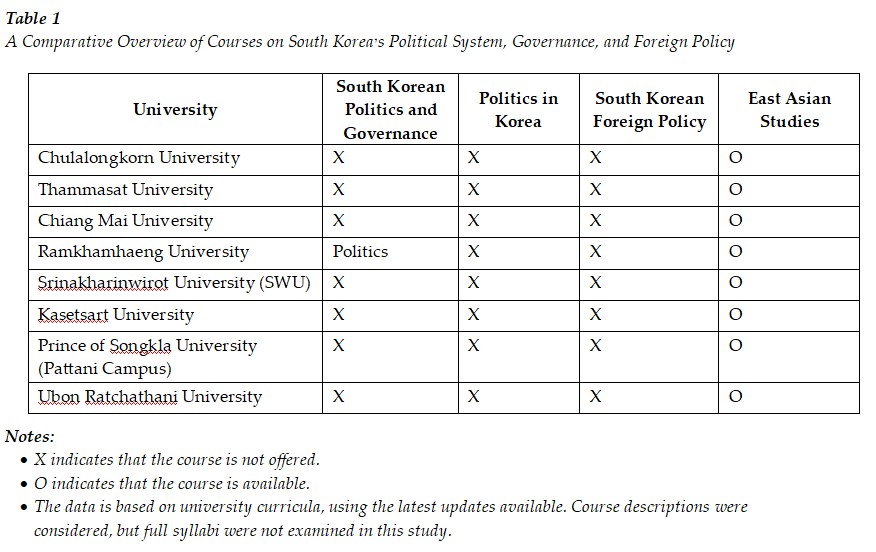
This article aims to assess the current status of South Korean foreign policy studies in undergraduate political science curricula, particularly in International Relations programs, and to analyze the perspectives of “insiders” (South Korean scholars) and “outsiders” (Thai or foreign scholars specializing in Korean Studies) regarding the key topics that should be incorporated into South Korea’s foreign policy courses. The objective is to contribute to the development of elective courses on South Korean foreign policy within the International Relations program under the Faculty of Political Science and Public Administration at Chiang Mai University. The central argument of this study posits that the development of knowledge on South Korea’s foreign policy should encompass three fundamental dimensions: (1) historical perspectives, (2) political institutions and interest groups, and (3) contemporary issues. These components are essential for understanding the internal transformations of South Korea, including its historical interactions with neighboring countries, relations with major powers, and shifts in the international system that influence South Korea’s strategic positioning within global political and economic structures. From a theoretical standpoint, the study of South Korean foreign policy should be approached through the lens of three major International Relations theories: structural realism, neoliberal institutionalism, and social constructivism. This theoretical framework enables a dual analysis of South Korea’s national interests—both from an empirical perspective, focusing on tangible geopolitical and economic factors, and from a constructivist perspective, emphasizing the role of evolving values, beliefs, and ideas shaped by South Korea’s unique sociopolitical context.
Article Details

This work is licensed under a Creative Commons Attribution-NonCommercial-NoDerivatives 4.0 International License.
References
Chutidet, M. (2024). “Restricted zones” of the military: Democracy and the process of civilian control over the South Korean armed forces. Phitsanulok: Crackers Books. (In Thai)
Damrong, T. (1987). South Korea: The role of the state in national development. Pathum Thani: Korean Studies Project, East Asian Studies Institute, Thammasat University. (In Thai)
Halper, A. M. (1973). Japan’s economic giant’s quiet diplomacy. International Affairs, 49(4), 584–599.
Kasemsuk, N. (2025). Koreans on course to be No. 1 visitors to Chiang Mai in 2025. Bangkok Post. Retrieved February 2, 2025, from https://www.bangkokpost.com/business/general/2948907/koreans-on-course-to-be-no-1-visitors-to-chiang-mai-in-2025
Kim, H. K., Kim, A. E., & Connolly, D. (2016). Catching up with Hallyu? The Japanese and Chinese response to South Korean soft power. Korea Observer, 47(3), 527–558.
Kim, T. (2017). Creative economy of the developmental state: A case study of South Korea’s creative economy initiatives. The Journal of Arts, Management, Law, and Society, 47(5), 322–332.
Lertarit, C., & Ministry of Patriots and Veterans Affairs. (2010). Eternal partners: Thailand and South Korea—A history of Thai soldiers in the Korean War. Publisher unknown. (In Thai)
Meephokee, C. (2000). Economic relations between Thailand–South Korea: Past and future trends. Thai Journal of East Asian Studies, 11(1), 39–54. (In Thai)
Nimmontra, S. (2019). The movement of Thai workers and illegal status in South Korea. Journal of Social Sciences, 31(1), 145–170. (In Thai)
Orapan, C. (2022). Contemporary South Korea. Pattani: Office of Learning Technology and Innovation, Prince of Songkla University, Pattani Campus. (In Thai)
Pasuk, P., Worawit, C., & The Center for Energy Conservation of Thailand. (1998). Industrial and economic development: Experiences of South Korea, Brazil, and Thailand. Bangkok: Faculty of Economics, Chulalongkorn University. (In Thai)
Prachachat Business. (2019). Chiang Mai’s growing popularity: South Koreans flocking to buy condos and open restaurants. Prachachat Business. Retrieved February 4, 2025, from https://www.prachachat.net/local-economy/news-406708 (In Thai)
Supitchaya, L., Wiphat, M., Pensri, C., & Waradej, C. (2024). The trade landscape between Thailand and South Korea: Trade patterns, opportunities, and challenges in Thai exports to South Korea. Lampang Rajabhat University Humanities and Social Sciences Review Journal, 12(1), 12–26. (In Thai)
Thanuth, P., Suwicha, P., & Surasit, W. (2022). The struggle for survival of Thai illegal workers in South Korea during the COVID-19 pandemic: A case study of Udon Thani Province. Journal of Social Development, 24(1), 119–136. (In Thai)
Wichian, I. (2021). North Korea and South Korea: Perspectives on reunification. Phitsanulok: Naresuan University Press. (In Thai)
