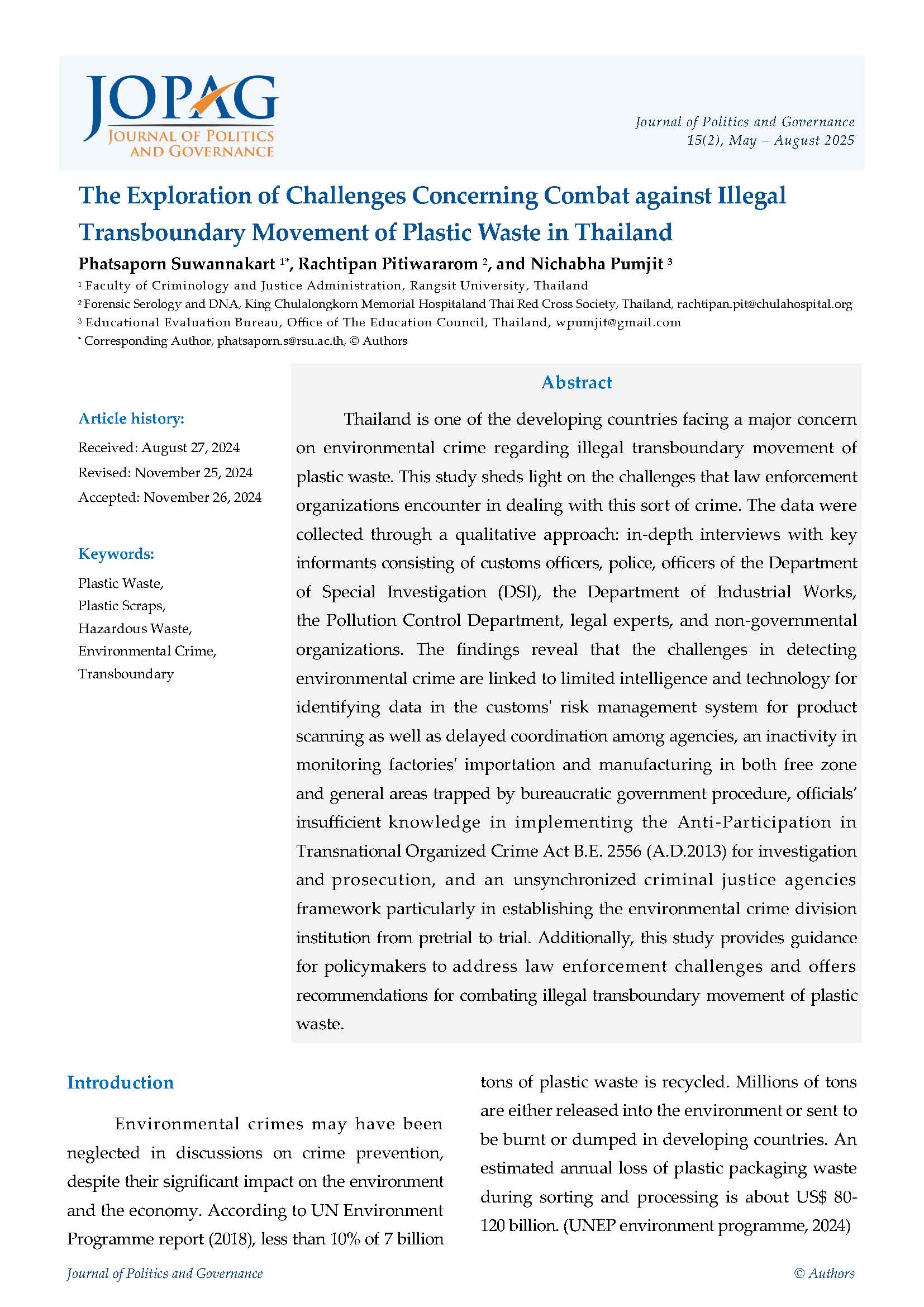
The Exploration of Challenges Concerning Combat against Illegal Transboundary Movement of Plastic Waste in Thailand
Article Sidebar
Main Article Content
Abstract
Thailand is one of the developing countries facing a major concern on environmental crime regarding illegal transboundary movement of plastic waste. This study sheds light on the challenges that law enforcement organizations encounter in dealing with this sort of crime. The data were collected through a qualitative approach: in-depth interviews with key informants consisting of customs officers, police, officers of the Department of Special Investigation (DSI), the Department of Industrial Works, the Pollution Control Department, legal experts, and non-governmental organizations. The findings reveal that the challenges in detecting environmental crime are linked to limited intelligence and technology for identifying data in the customs' risk management system for product scanning as well as delayed coordination among agencies, an inactivity in monitoring factories' importation and manufacturing in both free zone and general areas trapped by bureaucratic government procedure, officials’ insufficient knowledge in implementing the Anti-Participation in Transnational Organized Crime Act B.E. 2556 (A.D.2013) for investigation and prosecution, and an unsynchronized criminal justice agencies framework particularly in establishing the environmental crime division institution from pretrial to trial. Additionally, this study provides guidance for policymakers to address law enforcement challenges and offers recommendations for combating illegal transboundary movement of plastic waste.
Article Details

This work is licensed under a Creative Commons Attribution-NonCommercial-NoDerivatives 4.0 International License.
References
Anti-Participation in Transnational Organized Crime Act B.E. 2556. (2013). Anti-Participation in Transnational Organized Crime Act B.E. 2556. Thai Government Gazette.
Beirne, P., & South, N. (2007). Issues in green criminology (1st ed.). Willan. https://doi.org/10.4324/9781843926344
Chaondee, N. (2023). Greennews. https://greennews.agency/?p=33297
Chitsawang, S., Chitsawang, N., & Kor-Udom, S. (2022). A guideline for improving efficiency in enforcing the Anti-Participation in Transnational Organized Crimes Act B.E. 2556. Journal of Social Sciences, 52(2), 33–54. http://www.library.polsci.chula.ac.th/journal2
Chokcharatsakun, K. (2021). Krungthep Turakij. https://www.bangkokbiznews.com/social/954268
CUSTOMS ACT B.E. 2560. (2017). CUSTOMS ACT B.E. 2560 (2017). Thai Government Gazette.
Department of Industrial Works. (2024). Meeting to consider guidelines for granting permission to import plastic scraps (outside the duty free zone) in 2024, ready to accept the import ban policy in 2025. https://www.diw.go.th/webdiw/pr67-113
Europol. (2022). Environmental crime. https://www.europol.europa.eu/crime-areas/environmental-crime
Europol, & EnviCrimeNet. (2015). Report on environmental crime in Europe. Europol.
Greennews. (2023). Cabinet resolution prohibits the importation of waste. Greennews. https://greennews.agency/?p=33297
Interpol. (2020). Interpol strategic analysis report: Emerging criminal trends in the global plastic waste market since January 2018. INTERPOL General Secretariat.
Liddick, D. (2010). The traffic in garbage and hazardous wastes: An overview. Trends in Organized Crime, 13(2–3), 134–146. https://doi.org/10.1007/s12117-009-9089-6
Lieselot, B. (2012). Is it all going to waste? Illegal transports of e-waste in a European trade hub. Crime, Law and Social Change, 58(3), 221–249. https://doi.org/10.1007/s10611-012-9383-0
Matichon Online. (2018). 35 countries send electronic waste to Thailand. Matichon Online. https://www.matichon.co.th/local/crime/news_980047
Ministry of Commerce's Public Data. (2023). Summary of exports, imports, trade balance. Information and Communication Technology Center, Office of the Permanent Secretary, Ministry of Commerce.
Ministry of Foreign Affairs. (2013). Thailand ratifies UN Convention against Transnational Organized Crime (UNTOC) and protocol to prevent, suppress and punish trafficking in persons, especially women and children. https://www.mfa.go.th/en/content/5d5bcd2515e39c306000f543?cate=5d5bcb4e15e39c3060006834
Ministry of Industry. (2006). Announcement of the Ministry of Industry regarding criteria for consideration and approval regarding permission to bring scraps, cuttings, and unusable items. which is plastic Whether used or not Entered the Kingdom in 2006. Legislative Institutional Repository of Thailand.
Ministry of Natural Resources and Environment. (2023). Action plan on plastic waste management phase II (2023–2027). Pollution Control Department and Ministry of Natural Resources and Environment.
Ministry of Natural Resources and Environment. (2024). Policy for regulating the import of plastic scraps. Ministry of Natural Resources and Environment.
Nellemann, C., Henriksen, R., Kreilhuber, A., Stewart, D., Kotsovou, M., Raxter, P., … Barrat, S. (2016). The rise of environmental crime: A growing threat to natural resources, peace, development and security. United Nations Environment Programme (UNEP).
Piachan, N. (2023). The smuggling of electronic waste is an environment crime. Journal of Social Sciences and Humanities, 491(1), 13–32. https://so04.tci-thaijo.org/index.php/socku/article/view/257860
Rujivanarom, P. (2021). Thailand’s plastic waste conundrum. Heinrich-Böll-Stiftung. https://th.boell.org/en/2021/10/26/thailands-plastic-waste-conundrum
Sarkulworawit, C. (2021). A study on illegal transboundary movement of waste in Thailand [Master’s thesis, Chulalongkorn University]. https://doi.org/10.58837/CHULA.THE.2021.1119
Sasaki, S. (2021). The effects on Thailand of China’s import restrictions on waste: Measures and challenges related to the international recycling of waste plastic and e-waste. Journal of Material Cycles and Waste Management, 23, 77–83. https://doi.org/10.1007/s10163-020-01113-3
Secretariat of the Basel Convention. (2011). UN environment programme. Milestones since its adoption. https://www.basel.int/TheConvention/Overview/Milestones/tabid/2270/Default.aspx
Secretariat of the Basel Convention. (2011). UN environmental programme. https://www.basel.int/TheConvention/Overview/tabid/1271/Default.aspx
Siegel, L. (2015). Criminology: Theories, patterns, and typologies (12th ed.). Cengage Learning.
Thai Customs. (2024). Statistics report. Innovation and System Analysis Division, Information and Communication Technology Center, Customs Department.
Thai PBS. (2018). Smuggling factory imports 20,000 tonnes of plastic waste. Thai Public Broadcasting Service (Thai PBS). https://www.thaipbs.or.th/news/content/272551
Tonry, M., & Farrington, D. P. (1995). Strategic approaches to crime prevention. Crime & Justice, 19, 1. https://scholarship. law.umn.edu/faculty_articles/483
UNEP. (2012). Transnational environmental crime – A common crime in need of better enforcement. UNEP Global Environmental Alert Service (GEAS).
UNEP Environment Programme. (2024). 2024 UNEP. https://www.unep.org/interactives/beat-plastic-pollution/
UNICRI. (2024). United Nations Interregional Crime and Justice Research Institute (UNICRI). https://unicri.it/topics/environmental
White, R. (2018). Transnational environmental crime: Toward an eco-global criminology. Willan.
