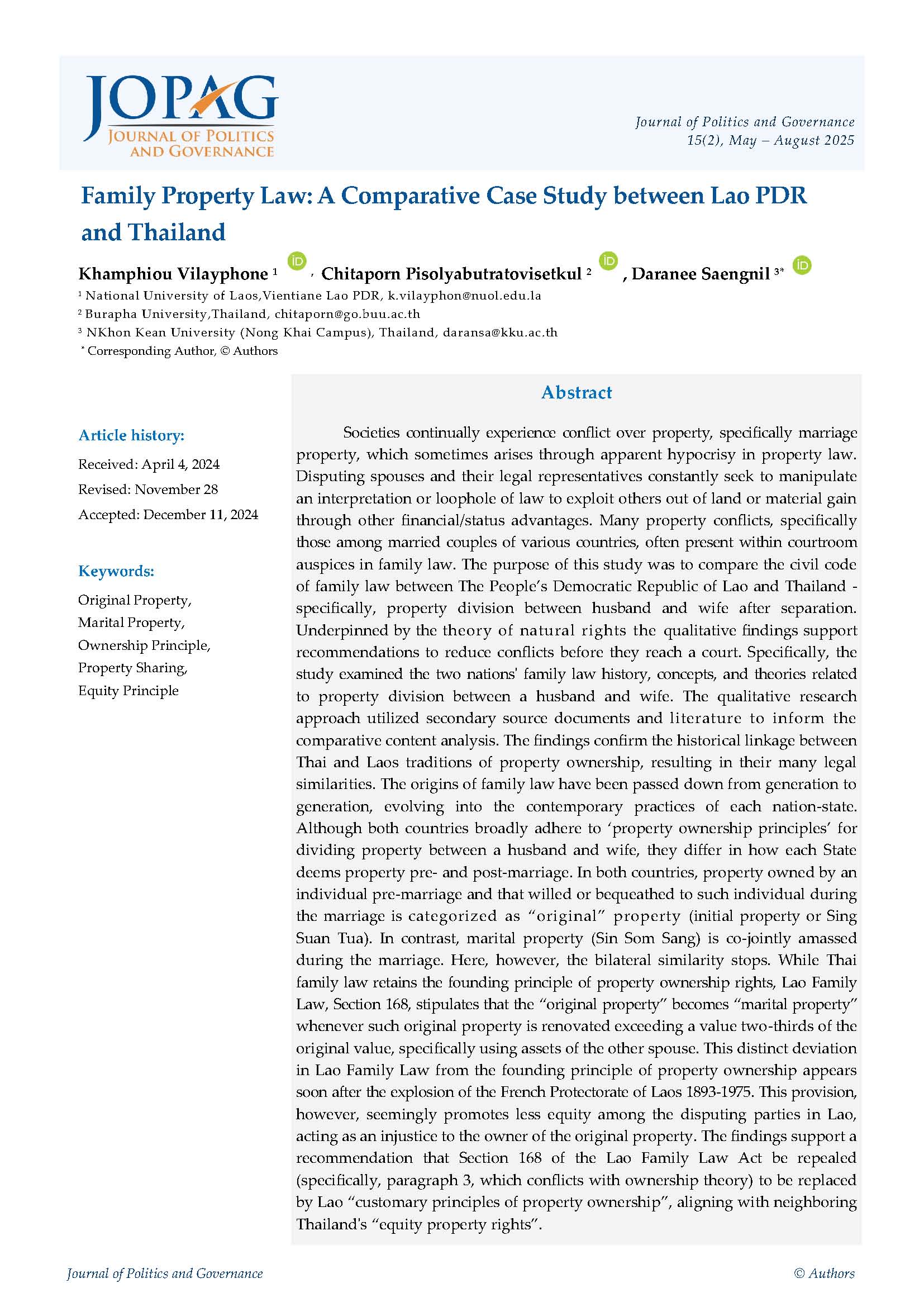
Family Property Law: A Comparative Case Study between Lao PDR and Thailand
Article Sidebar
Main Article Content
Abstract
Societies continually experience conflict over property, specifically marriage property, which sometimes arises through apparent hypocrisy in property law. Disputing spouses and their legal representatives constantly seek to manipulate an interpretation or loophole of law to exploit others out of land or material gain through other financial/status advantages. Many property conflicts, specifically those among married couples of various countries, often present within courtroom auspices in family law. The purpose of this study was to compare the civil code of family law between The People’s Democratic Republic of Lao and Thailand - specifically, property division between husband and wife after separation. Underpinned by the theory of natural rights the qualitative findings support recommendations to reduce conflicts before they reach a court. Specifically, the study examined the two nations' family law history, concepts, and theories related to property division between a husband and wife. The qualitative research approach utilized secondary source documents and literature to inform the comparative content analysis. The findings confirm the historical linkage between Thai and Laos traditions of property ownership, resulting in their many legal similarities. The origins of family law have been passed down from generation to generation, evolving into the contemporary practices of each nation-state. Although both countries broadly adhere to ‘property ownership principles’ for dividing property between a husband and wife, they differ in how each State deems property pre- and post-marriage. In both countries, property owned by an individual pre-marriage and that willed or bequeathed to such individual during the marriage is categorized as “original” property (initial property or Sing Suan Tua). In contrast, marital property (Sin Som Sang) is co-jointly amassed during the marriage. Here, however, the bilateral similarity stops. While Thai family law retains the founding principle of property ownership rights, Lao Family Law, Section 168, stipulates that the “original property” becomes “marital property” whenever such original property is renovated exceeding a value two-thirds of the original value, specifically using assets of the other spouse. This distinct deviation in Lao Family Law from the founding principle of property ownership appears soon after the explosion of the French Protectorate of Laos 1893-1975. This provision, however, seemingly promotes less equity among the disputing parties in Lao, acting as an injustice to the owner of the original property. The findings support a recommendation that Section 168 of the Lao Family Law Act be repealed (specifically, paragraph 3, which conflicts with ownership theory) to be replaced by Lao “customary principles of property ownership”, aligning with neighboring Thailand's “equity property rights”.
Article Details

This work is licensed under a Creative Commons Attribution-NonCommercial-NoDerivatives 4.0 International License.
References
Apirat Petchsiri. (2016). The research of legal system and legal information related to social, culture, political and security of Lao People’s Democratic Republic Office of the Council of State of Thailand and Khon Kean University. Research Project. Office of the Council of State. https://www.lawforasean.krisdika.go.th/
Arendt, H. (1998). The human condition (2nd ed.). University of Chicago Press. https://pensarelespaciopublico.wordpress.com/wp-content/uploads/2012/02/arendt-hanna-the-human-condition.pdf
Caldicott, R. W., Scherrer, P., & Harris, A. (2022). The RV camping framework for understanding modern camping practices. Tourism Management Perspectives, 43, 100990. https://doi.org/10.1016/j.tmp.2022.100990
Cole, D., & Whiting, B. (2024). Natural rights: Definition, theory & applications. Study.com. https://study.com/academy/lesson/natural-rights-definition-theory-examples.html
David, R., & Brierly, J. E. C. (1978). Major legal systems in the world today: An introduction to the comparative study of law (2nd ed.). The Free Press. https://openlibrary.org/books/OL4748432M/Major_legal_systems_in_the_ world_today
Hunt, B. A. (2016). Locke on equality. Political Research Quarterly, 69(3), 546–556. https://doi.org/10.1177/1065912916652239
Janyarak Suvapan. (n.d.). Gender recognition and marriage under the Civil and Commercial Code, Book 5. https://so04.tci-thaijo.org/index.php/lawnujournal/article/download/261182/181807/1076026
Khaowichit, N. (1976). Sin Suan Tua - continuation level on personal property. Chulalongkorn University. http://cuir.car.chula.ac.th/handle/123456789/39430
Locke, J. (1689). Two treatises of government. https://www.yorku.ca/comninel/courses/3025pdf/Locke.pdf
Locke, J. (1690). Second treatise of government. Project Gutenberg. https://www.gutenberg. org/files/7370/7370-h/7370-h.htm
Maffesoli, M. (1995). The time of the tribes: The decline of individualism in mass society. Sage. https://www.adlibris.com/se/e-bok/time-of-the-tribes-9781848609532
Malee Pruekphongsawali. (2014). Tracing women's human rights (3rd ed.). Office of the National Human Rights Commission and the Women’s and Youth Studies Project, Thammasat University. https://www.ohchr.org/sites/default/files/Documents/Events/WHRD/WomenRightsAreHR.pdf
McKerron, M. A. (2003). Neo-tribes and traditional tribes: Identity construction and interaction of tourists and highland people in a village in Northern Thailand. Graduate School, Chiang Mai University. http://cmuir.cmu.ac.th/jspui/handle/6653943832/35477
Ministry of Justice, Lao PDR. (2021). JICA and JICA Rule of Law Project on February 2021. https://www.jica.go.jp/Resource/english/our_work/thematic_issues/governance/portal/laos.html
Ojha, A. (2024). Locke: Natural rights. IGNOU the People's University. https://egyankosh. ac.in/bitstream/123456789/ 81671/1/Unit-11.pdf
Paimanee Chaiwongsa. (2003). Principle of Lao’s family law. In The articles of Lao’s law. Thammasat University.
Pollard, C. (2022, July 4). Karl Marx: His philosophy explained. The Conversation Media Group. https://theconversation.com/karl-marx-his-philosophy-explained-164068
Richard Thornburgh. (1990). The Soviet Union and the rule of law. Foreign Affairs, 69(2), 13–27. https://www.jstor.org/stable/20044301?origin=crossref
SidaSonsriet, L. (2016). Southeast Asia: A decade before entering the ASEAN Community (2007–2015). Chulalongkorn University Printing House.
Sombat Damrongthanyawong. (2002). Politics: Concepts and development. Faculty of Public Administration, National Institute of Development Administration (NIDA). https://doi.nrct.go.th/ListDoi/listDetail?Resolve
Thongthong Chantarangsu. (1999). Socialist law society. https://asean.org/wp-content/uploads/2021/01/ASEAN-3-Documents-Series-2011-2015_CD.pdf
Varden, H. (2021). Locke on property. In J. Gordon-Roth & S. Weinberg (Eds.), The Lockean Mind (1st ed., pp. 428–437). Routledge. https://doi.org/10.4324/ 9781315099675-55
Veal, A. J. (2003). Marxism. In J. Jenkin & J. Pigram (Eds.), Encyclopedia of Leisure and Outdoor Recreation (pp. 300–301). Routledge. https://www.routledge.com/Encyclopedia-of-Leisure-and-Outdoor-Recreation/Jenkins-Pigram/p/book/9780415868204
Zuckert, M. P. (2005). Locke - religion - equality. The Review of Politics, 67(3), 419–431. https://doi.org/10.1017/S0034670500034641
