
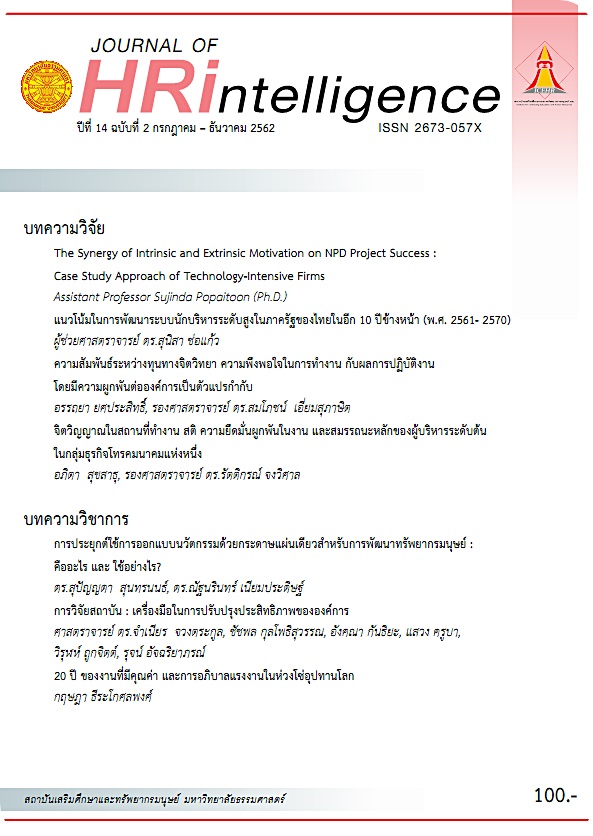
การผนึกแรงจูงใจภายในและภายนอกเพื่อส่งเสริมความสำเร็จโครงการพัฒนาผลิตภัณฑ์ใหม่ การวิจัยด้วยกรณีศึกษาบริษัทที่มุ่งเน้นเทคโนโลยี
Article Sidebar
Main Article Content
บทคัดย่อ
วัตถุประสงค์งานวิจัยนี้ เพื่อค้นหาลักษณะการผนึกแรงจูงใจภายในและภายนอกของทีมพัฒนาผลิตภัณฑ์ใหม่ให้คงอยู่ตลอดช่วงการดำเนินโครงการตั้งแต่ระยะเริ่มต้น ระหว่างดำเนินงานและสิ้นสุดโครงการ ปัจจุบันนี้นักวิชาการพบว่าการผนึกแรงจูงใจภายในและภายนอกมีความสำคัญมากสำหรับทีมพัฒนาผลิตภัณฑ์ใหม่ โดยเฉพาะอย่างยิ่งในบริบทของบริษัทที่มุ่งเน้นเทคโนโลยี ในขณะที่แรงจูงใจทั้งสองประเภทเป็นสภาวะทางอารมณ์ซึ่งอยู่เพียงชั่วคราวเท่านั้น จำเป็นต้องสร้างแรงจูงใจอย่างต่อเนื่องตลอดช่วงโครงการจนกระทั่งสิ้นสุด งานวิจัยด้วยกรณีศึกษานี้ใช้พื้นฐานทฤษฎีการผนึกแรงจูงใจของ Amabile (1993) เพื่ออธิบายบทบาทการผนึกแรงจูงใจภายในและภายนอกของทีมในแต่ละช่วงจนโครงประสบผลสำเร็จ ประโยชน์งานวิจัยนี้ส่งผลต่อวรรณกรรมด้านการจัดการเทคโนโลยี โดยเฉพาะอย่างยิ่งแนวการปฏิบัติด้านการจัดการทรัพยากรมนุษย์เพื่อส่งเสริมการผนึกแรงจูงใจของทีมเพื่อให้โครงการประสบผลสำเร็จตามต้องการ และผลงานวิจัยนี้นำเสนอสมมติฐานเพื่อการศึกษาครั้งต่อไปและอภิปรายผลในทางปฏิบัติ
Article Details
ขอมอบลิขสิทธิ์บทความที่ได้รับการตีพิมพ์ให้แก่สถาบันเสริมศึกษาและทรัพยากรมนุษย์ กรณีมีการฟ้องร้องเรื่องการละเมิดลิขสิทธิ์เกี่ยวกับภาพ กราฟ ข้อความส่วนใดส่วนหนึ่ง และ/หรือข้อคิดเห็นที่ปรากฎในบทความ ให้เป็นความรับผิดชอบของข้าพเจ้าและผู้เขียนร่วมแต่เพียงผู้เดียว
เอกสารอ้างอิง
Amabile, T. M., & Pratt, M. G. (2016). The dynamic componential model of creativity and innovation in organizations : Making progress, making meaning. Research in Organizational Behavior, 36, 157-183.
Bakker, R. M., Boro , S., Kenis, P., & Oerlemans, L. A. (2013). It's only temporary : time frame and the dynamics of creative project teams. British Journal of Management, 24 (3), 383-397.
Cerasoli, C. P., Nicklin, J. M., & Ford, M. T. (2014). Intrinsic motivation and extrinsic incentives jointly predict performance: A 40-year meta-analysis. Psychological Bulletin, 140 (4), 980.
Collins, C. J., & Smith, K. G. (2006). Knowledge exchange and combination : The role of human resource practices in the performance of high-technology firms. Academy of management journal, 49 (3), 544-560.
Deci, E. L. (1975). Intrinsic motivation. New York, US : Plenum Press.
Deci, E. L., & Ryan, R. M. (1985). The general causality orientations scale : Self-determination in personality. Journal of research in personality, 19 (2), 109-134.
Deci, E. L., & Ryan, R. M. (1985). The general causality orientations scale : Self-determination in personality. Journal of research in personality, 19 (2), 109-134.
Frey, B. S. (1997). On the relationship between intrinsic and extrinsic work motivation. International journal of industrial organization, 15 (4), 427-439.
Ghoshal, S., & Nohria, N., (1989). Internal differentiation within multinational corporations. Strategic Management Journal, 10 (4), 323-337.
Gupta, A. K., & Govindarajan, V. (2000). Knowledge flows within multinational corporations. Strategic Management Journal, 21, 473-496.
Kalling, T. (2003). Organization-internal transfer of knowledge and the role of motivation: a qualitative case study. Knowledge and Process Management, 10 (2), 115-126.
Keegan, A., Ringhofer, C., & Huemann, M. (2018). Human resource management and project based organizing : Fertile ground, missed opportunities and prospects for closer connections. International Journal of Project Management.
Kessler, E. H., & Chakrabarti, A. K. (1996). Innovation speed : A conceptual model of context, antecedents, and outcomes. Academy of Management Review, 21(4), 1143-1191.
Locke, E. A., & Latham, G. P. (1990). A theory of goal setting & task performance : Prentice-Hall, Inc.
Lin, H.-F. (2007). Effects of extrinsic and intrinsic motivation on employee knowledge sharing intentions. Journal of information science, 33(2), 135-149.
Makri, M., Lane, P. J., & Gomez-Mejia, L. R. (2006). CEO incentives, innovation, and performance in technology- intensive firms : a reconciliation of outcome and behavior-based incentive schemes. Strategic Management Journal, 27 (11), 1057-1080.
Osterloh, M., & Frey, B. S. (2000). Motivation, knowledge transfer, and organizational forms. Organization Science, 11 (5), 538-550.
Petison, P., & Johri, L. (2006). Driving harmony : philosophy of Toyota Motor Thailand. Strategic Direction, 22 (11), 3-5.
Petison, P., & Johri, L. M. (2008). Localization drivers in an emerging market : case studies from Thailand. Management Decision, 46 (9), 1399-1412.
Potter J. & Wetherell, M. (1987). Discourse and Social Psychology : Beyond Attitudes and Behaviour. London : Sage Publications.
Popaitoon, S., & Popaitoon, P. (2016). Motivation synergy, knowledge absorptive capacity and NPD project performance in multinational automobiles in Thailand. The Journal of High Technology Management Research, 27 (2), 129-139.
Popaitoon, P., & Rayton, B. A. (2012). Employment relationship in context : Commitment-based HR practices in the UK and Thailand. Journal of General Management, 37 (3), 21-37.
Popaitoon, S., & Siengthai, S. (2014). The moderating effect of human resource management practices on the relationship between knowledge absorptive capacity and project performance in project-oriented
companies. International Journal of Project Management, 32 (6), 908-920.
Porter, M. E. (Ed.). (1986). Competition in global industries. Harvard Business Press.
Project Management Institute (PMI). (2008). A guide to the project management body of knowledge (PMBOK® Guide-Fourth edition. Newtown Square, PA : Author.
Schmid, B., & Adams, J. (2008). Motivation in project management : The project manager's perspective. Project Management Journal, 39 (2), 60-71.
Shaw, J. D., & Gupta, N. (2015). Let the evidence speak again! Financial incentives are more effective than we thought. Human Resource Management Journal, 25 (3), 281-293.
Smith, J.A., (1995). Semi-Structured Interviewing and Qualitative Analysis. In : Smith, J.A., Harre, R. & Langenhove, L. V., Rethinking Methods in Psychology. London : Sage Publications.
Szulanski, G. (1996). Exploring internal stickiness : impediments to the transfer of best practices within the firm. Strategic Management Journal, 17, 27-43.
Thailand Board of Investment. (2016). Opportunities in Thailand’s automotive industry. Retrieved from http://www.boi.go.th
Thai Autoparts Manufacturers Association (TAMA, 2018). Retrieved from http://www.thaiautoparts.or.th
Wheelwright, S. C., & Clark, K. B. (1992). Creating project plans to focus product development. Harvard Business Review, 70, 70-82.
Yin, R. K. (2013). Case study research: Design and methods : Sage publications.
Zander, U., & Kogut, B. (1995). Knowledge and the speed of the transfer and imitation of organizational capabilities : an empirical test. Organization Science, 6, 76-92.
Zhao, Z. J., & Chadwick, C. (2014). What we will do versus what we can do : The relative effects of unit-level NPD motivation and capability. Strategic Management Journal, 35 (12), 1867-1880.
