
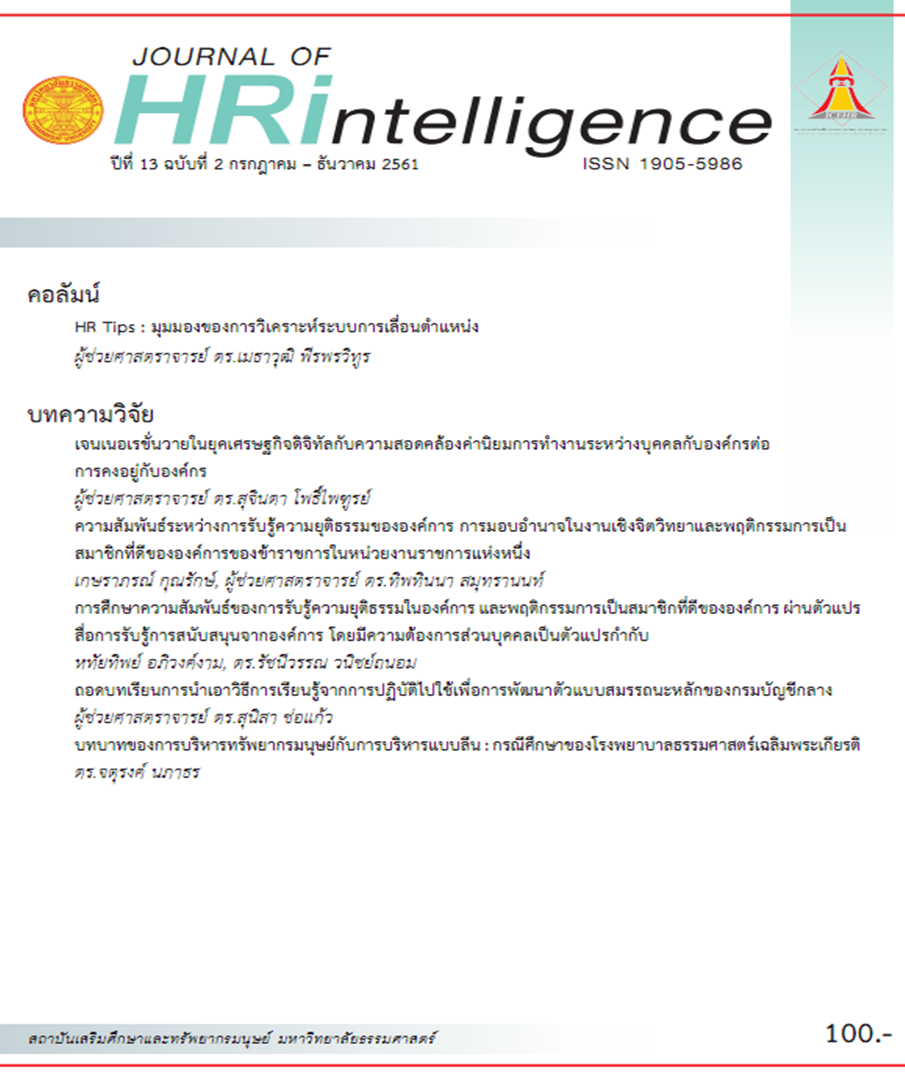
บทบาทของการบริหารทรัพยากรมนุษย์กับการบริหารแบบลีน: กรณีศึกษาของโรงพยาบาลธรรมศาสตร์เฉลิมพระเกียรติ
Article Sidebar
Main Article Content
บทคัดย่อ
งานวิจัยชิ้นนี้มีวัตถุประสงค์เพื่อวิเคราะห์ว่า “การบริหารแบบลีนในองค์การมีผลกระทบต่อตัวพนักงานในองค์การอย่างไร และการบริหารทรัพยากรมนุษย์มีบทบาทอย่างไรในการบริหารแบบลีน?” โดยใช้วิธีการวิจัยเชิงคุณภาพในรูปแบบของกรณีศึกษาของโรงพยาบาลธรรมศาสตร์เฉลิมพระเกียรติ ทั้งนี้ ผลการศึกษาในเบื้องต้นสรุปว่า การบริหารงานแบบลีนในองค์การมีแนวโน้มที่จะทำให้พนักงานออกจากพื้นที่สุขสบาย (Comfort Zone) ของตน มีการเปลี่ยนแปลงวิธีการทำงานของตนเองไปจากเดิม และทำให้พนักงานปฏิบัติงานได้รวดเร็วมากขึ้นในเวลาที่เท่าเดิม ซึ่งก็หมายความว่า ทำให้พนักงานต้องรับภาระงานที่มากขึ้นกว่าเดิม อันอาจทำให้เกิดปัญหาการต่อต้านจากพนักงาน อย่างไรก็ดี ฝ่ายบริหารทรัพยากรมนุษย์ขององค์การมีบทบาทสำคัญยิ่งต่อความสำเร็จในการบริหารงานแบบลีนและการลดปัญหาการต่อต้านจากพนักงานในองค์การ ทั้งในด้านของการเป็นที่ปรึกษาให้กับฝ่ายบริหารหรือผู้บริหารระดับสูงขององค์การเกี่ยวกับอัตรากำลังของพนักงาน การทำหน้าที่กระตุ้นให้พนักงานยอมรับการเปลี่ยนแปลงที่เกิดขึ้นในองค์การอันเนื่องมาจากการนำแนวคิดการบริหารแบบลีนมาปรับใช้ การดูแลความปลอดภัยของผู้ป่วยและพนักงานในบริบทของการบริหารแบบลีนในองค์การ และการดำเนินการฝึกอบรมพนักงานอย่างต่อเนื่องเพื่อให้พนักงานมีความรู้และทักษะในการปฏิบัติงานที่สอดคล้องกับวิธีการบริหารงานแบบลีน รวมถึงสามารถปรับตัวให้เข้ากับการปฏิบัติงานภายใต้บริบทของการบริหารแบบลีนได้ ซึ่งในกรณีนี้ก็หมายความว่า ฝ่ายบริหารทรัพยากรมนุษย์ที่เข้าใจบทบาทของตนเองและรู้จักนำแนวปฏิบัติในการบริหารทรัพยากรมนุษย์เพื่อการเป็นองค์การที่มีสมรรถนะสูง (High-Performance Human Resource Practices) มาปรับใช้ในองค์การย่อมทำให้องค์การสามารถนำแนวคิดการบริหารแบบลีนไปปรับใช้ได้อย่างประสบความสำเร็จ ข้อสรุปจากบทความชิ้นนี้น่าจะเป็นประโยชน์ต่อนักปฏิบัติและนักทรัพยากรมนุษย์มืออาชีพ รวมถึงผู้บริหารและพนักงานขององค์การที่มีแนวคิดที่จะนำแนวคิดการบริหารแบบลีนมาปรับใช้ในองค์การในประเด็นที่ว่า ในการตัดสินใจต่าง ๆ ที่เกี่ยวกับการนำแนวคิดการบริหารแบบลีนมาปรับใช้ ฝ่ายบริหารทรัพยากรมนุษย์ รวมถึงนักบริหารทรัพยากรมนุษย์มืออาชีพควรมีส่วนร่วมในการตัดสินใจในทุกขั้นตอน ตั้งแต่การริเริ่มนำแนวคิดการบริหารแบบลีนมาปรับใช้ในองค์การไปจนถึงการนำแนวคิดการบริหารแบบลีนไปปฏิบัติจริงในองค์การ
Article Details
ขอมอบลิขสิทธิ์บทความที่ได้รับการตีพิมพ์ให้แก่สถาบันเสริมศึกษาและทรัพยากรมนุษย์ กรณีมีการฟ้องร้องเรื่องการละเมิดลิขสิทธิ์เกี่ยวกับภาพ กราฟ ข้อความส่วนใดส่วนหนึ่ง และ/หรือข้อคิดเห็นที่ปรากฎในบทความ ให้เป็นความรับผิดชอบของข้าพเจ้าและผู้เขียนร่วมแต่เพียงผู้เดียว
เอกสารอ้างอิง
Abdullah, S.R.S. and Keenoy, T. (1995). Japanese managerial practices in the Malaysian electronic industry : Two
case studies. Journal of Management Studies, 32, 747-766.
Aboelmaged, M. G. (2010). Six Sigma quality: A structured review and implications for future research. International
Journal of Quality and Reliability Management, 27, 269-318.
Achanga, P., Shebab, E., Roy, R. and Nelder, G. (2006). Critical success factors for lean implementation within
SMEs. Journal of Manufacturing Technology Management, 17, 460-471.
Ahrens, T. (2006). Lean production : Successful implementation of organizational change in operations instead of
short term cost reduction efforts. Lean Alliance. Accessed July 15, 2014, from http://www.lean-alliance.
com/en/images/pdf/la_lean_survey.pdf.
Anderson-Connelly, R., Grunberg, L., Greenberg, E. and Moore, S. (2002). Is lean meam? : Workplace transformation
and employee well-being. Work, Employment and Society, 16, 389-412.
Arnheiter, E.D. and Maleyeff, J. (2005). The integration of lean management and Six Sigma. The TQM Magazine,
17, 5-18.
Arthur, J.B. (1994). Effects of human resource systems on manufacturing performance and turnover. Academy of
Management Journal, 37, 3, 670-687.
Bamber, G.J., Gittell, J.H., Kochan, T.A., and von Nordenflytch, A. (2009). Up in the air : How airlines can improve
performance by engaging their employees. Ithaca, NY : Cornell University Press.
Bamber, G.J., Stanton, P., Bartram, T., and Ballardie, R. (2014). Human resource management, lean processes, and
outcomes for employees: towards a research agenda. International Journal of Human Resource Management,
25, 21, 2881-2891.
Batt, R. (2002). Managing customer services : Human resource practices, quit rates, and sales growth. Academy
of Management Journal, 45, 3, 587-597.
Ben-Tovim, D.I., Bassham, J.E., Bolch, D., Martin, M.A., Dougherty, M. and Szwarcbord, M. (2007). Lean thinking
across a hospital : Redesigning care at the Flinders Medical Center. Australian Health Review, 31, 10 - 15.
Besharov, M. (2014). The relational ecology of identification: How organizational identification emerges when
individuals hold divergent values. Academy of Management Journal, 57, 1485 - 1512.
Bhasin, S. (2012). An appropriate change strategy for lean success. Management Decision, 50, 439-458.
Boselie, P., Dietz, G. and Boon, C. (2005). Commonalities and contradictions in HRM and performance research.
Human Resource Management Journal, 15, 67 - 94.
Bowen, D.E. and Ostroff, C. (2004). Understanding HRM-firm performance linkages : The role of the ‘strength’ of
the HRM system. Academy of Management Review, 29, 203 - 221.
Bruce, M., Daly, L. and Towers, N. (2004). Lean or agile : A solution for supply chain management in the textiles
and clothing industry. International Journal of Operations and Production Management, 24, 151 - 170.
Bruun, P. and Mefford, R.N. (2004). Lean production and the Internet. International Journal of Production Economics,
89, 247-260.
Carter, B., Danford, A., Howcroft, D., Richardson, H., Smith, A., and Taylor, P. (2011). Lean and mean in the civil
service : The case of processing in HRMC. Public Money and Management, 31, 115-122.
Carter, B., Danford, A., Howcroft, D., Richardson, H., Smith, A., and Taylor, P. (2012). Lean and ‘nothing gets done
and no one knows why’ : PCS and workplace control of Lean in HM Revenue and Customs. Industrial
Relations Journal, 45, 416-432.
Carter, B., Danford, A., Howcroft, D., Richardson, H., Smith, A., and Taylor, P. (2013). Stressed out of my box:
Employee experience of lean working and occupational ill-health inn clerical work in the UK public sector.
Work, Employment and Society, 7, 747 - 767.
Comm, C. and Mathiasel, D. (2008). Implementing a lean enterprise approach to achieve business excellence.
International Journal of Business Excellence, 1, 448-456.
De Menezes, L.M., Wood, S. and Gelade, G. (2010). The integration of human resource and operation management
practices and its link with performance : A longitudinal latent case study. Journal of Operations Management,
28, 455 - 471.
Deming, W. E. (1986). Out of the crisis. Cambridge : MIT Press.
De Souza, L.B. and Pidd, M. (2011). Exploring the barriers to lean healthcare implementation. Public Money and
Management, 31, 59-68.
Eisenhardt, K. M. (1989). Building theories from case study research. Academy of management review, 14, 4, 532-550.
Gough, R. and Fastenau, M. (2004). Implementing different concepts of lean production : Workers’ experience of
lean production in North American transplants. International Journal of Employment Studies, 12, 91-124.
Gowen, C. R. III, MCfadden, K.L. and Tallon, W.J. (2006). On the centrality of strategic human resource management for healthcare quality results and competitive advantage. Journal of Management Development, 25, 806-826.
Graham, L. (1995). On the line at Subaru-Isuzu : The Japanese model and the American worker. Ithaca, NY : Cornell
University Press.
Green, S.D. (2002). The human resource management implications of lean construction : Critical perspectives and
conceptual chasms. Journal of Construction Research, 3, 147-165.
Grugulis, I. and Lloyd, C. (2010). Skill and the labor process : The conditions and consequences of change. In P.
Thompson and C. Smith (Eds.), Working life : Renewing labor process analysis (pp.91-112). Houndmills :
Palgrave Macmillan.
Huselid, M.A. (1995). The impact of human resource management practices on turnover, productivity, and corporate
financial performance. Academy of Management Journal, 38, 3, 635-672.
Jiang, K. Lepak, D.P., Hu, J. and Baer, J.C. (2012). How does human resource management influence organizational
outcomes? A meta-analytic investigation of mediating mechanisms. Academy of Management Journal,
55, 6, 1264-1294.
Jones, R., Latham, J. and Betta, M. (2013). Creating the illusion of employee empowerment: Lean production in
the international automobile industry. The International Journal of Human Resource Management, 24, 1629-1645.
Jorgensen, B. and Emmitt, S. (2008). Lost in transition : The transfer of lean manufacturing to construction. Enginering,
Construction, and Architectural Management, 15, 383-398.
Kashefi, M. (2009). Job satisfaction and/or job stress: The psychological consequences of working in ‘high
performance work organizations’. Current Sociology, 57, 809-828.
Koeijer, R.J., Paauwe, J. and Huijsman, R. (2014). Toward a conceptual framework for exploring multilevel relationships
between Lean management and Six Sigma, enabling HRM, strategic climate and outcomes in healthcare.
The International Journal of Human Resource Management, 25, 21, 2911-2925.
Kollberg, B., Dahlgaard, J.J., and Brehmer, P.-O. (2007). Measuring lean initiatives in health care settings : Issues
and findings. International Journal of Productivity and Performance Management, 56, 7 - 24.
Lado, A.A. and Wilson, M.C. (1994). Human resource systems and sustained competitive advantage : A competencybased perspective. Academy of Management Review, 19, 699-727.
Laureani, A., Antony, J. and Douglas, A. (2010). Lean Six Sigma in a call center : A case study. International Journal
of Productivity and Performance Management, 59, 757 - 768.
Liker, J. (2004). The Toyota way, 14 principles of management from the world’s greatest manufacturer. New York :
NY : McGraw Hill.
Linehart, J., Huxley, C. and Robertson, D. (1997). Just another car factory? Lean production and it discontents.
Ithaca, NY : Cornell University Press.
MacDuffie, J. P. (1995). Human resource bundles and manufacturing performance : Organizational logic and
flexible production systems in the world auto industry. Industrial and Labor Relations Review, 48, 197-221.
Paauwe, J. (2009). HRM and performance : Achievements, methodological issues and prospects. Journal of
Management Studies, 46, 129-142.
Paauwe, J., Wright, P. and Guest, D. (Eds.). (2013). HRM and performance : What do we know and where should
we go? In HRM and performance : Achievements and challenges (pp.1-13). Chichester: Wiley.
Parker, M. and Slaughter, J. (1995). Unions and management by stress. In S. Babson (Ed.), Lean work : Empowerment
and exploitation in the global auto industry (pp.43-53). Detroit, MI : Wayne State University Press.
Piercy, N. and Rich, N. (2009). Lean transformation in the pure service environment : The case of the call service
center. International Journal of Operations and Production Management, 29, 54-76.
Plsek, P.E. (2013). Accelerating health care transformation with Lean and innovation : The Virginia Mason experience.
Boca Raton : FL : CRC Press.
Radnor, Z. and Osborne, S.P. (2013). Lean : A failed theory for public services? Public Management Review, 15,
265 - 287.
Radnor, Z., Walley, P., Stephens, A. and Bucci, G. (2006). Evaluation of the Lean approach to business management
and its use in the public sector. Edinburgh : Scottish Executive.
Rahbekm E., Pedersen, G. and Huniche, M. (2011). Determinants of lean success and failure in the Danish public
sector - A negotiated older perspective. International Journal of Public Sector Management, 24, 403-420.
Shadur, M.A., Rodwell, J.J. and Bamber, G.J. (1995). Factors predicting employees’ acceptance of lean production.
Human Relations, 48, 1403-1425.
Shah, R., Chandraskeran, A., and Linderman, K. (2008). In pursuit of implementation patterns: The context of Lean
and Six Sigma. International Journal of Production Research, 46, 6679 - 6699.
Stewart, P., Danford, A., Richardson, M. and Pulignano, V. (2010). Workers’ experiences of skill training and
participation in lean and high performance workplaces in Britain and Italy. Employee Relations, 32, 606-624.
Stewart, P., Murphy, K., Danford, A., Richardson, T., Richardson, M. and Wass, V. (2009). We sell out time no more:
Workers struggles against lean production in the British car industry. London : Pluto Press.
Strauss, A. and Corbin, J. (1990). Basics of qualitative research (Vol. 15). Newbury Park, CA : Sage Publications.
Sun, L.Y., Aryee, S. and Law, K.S. (2007). High-performance human resource practices, citizenship behavior, and
organizational performance: A relational perspective. Academy of Management Journal, 50, 3, 558-577.
Thailand Lean Award. (2017). History of Thailand Lean Award. Accessed 5 October 2017 from http://www.tpif.
or.th/tpif/lean_award/?page_id=17.
Thammasat University Hospital. (2017). Background and history of Thammasat University Hospital. Accessed
5 November 2017 from http://hospital.tu.ac.th/ab_hospital.php.
Thirkell, E. and Ashman, I. (2014). Lean towards learning : Connecting Lean thinking and human resource management
in UK higher education. The International Journal of Human Resource Management, 25, 21, 2957-2977.
Torella, M.S., Falzon, P. and Morais, A. (2012). Participatory design in Lean production : Which contribution from
employees? For what end? Work, 41, 2706-2712.
Tracey, M.W. and Flinchbaugh, J.W. (2006). How human resource departments can help lean transformation.
Target, 22, 5-10.
Turner, C.M. (2012). Implement a Lean management system : Create change through improvement. North Charleston,
SC : Createspace.
Vidal, M. (2007). Lean production, worker empowerment and job satisfaction : A qualitative analysis and critique.
Critical Sociology, 33, 247-278.
Waring, J.J. and Bishop, S. (2010). Lean healthcare : Rhetoric, ritual, and resistance. Social Science and Medicine,
71, 1332-1340.
Womack, J. and Jones, D. (2003). Lean thinking. London: Simon and Schuster.
Womack, J. and Jones, D. (2005). Lean solutions : How companies and customers can create value and wealth
together. New York, NY : Free Press.
Womack, J., Jones, D., and Roos, D. (1990). The machine that changed the world. New York, NY : Harper.
Wright, P.M. and McMahan, G.C. (1992). Theoretical perspectives for strategic human resource management.
Journal of Management, 18, 295-320.
Yin, R. K. (2014). Case study research : Design and methods. Sage Publications.
