
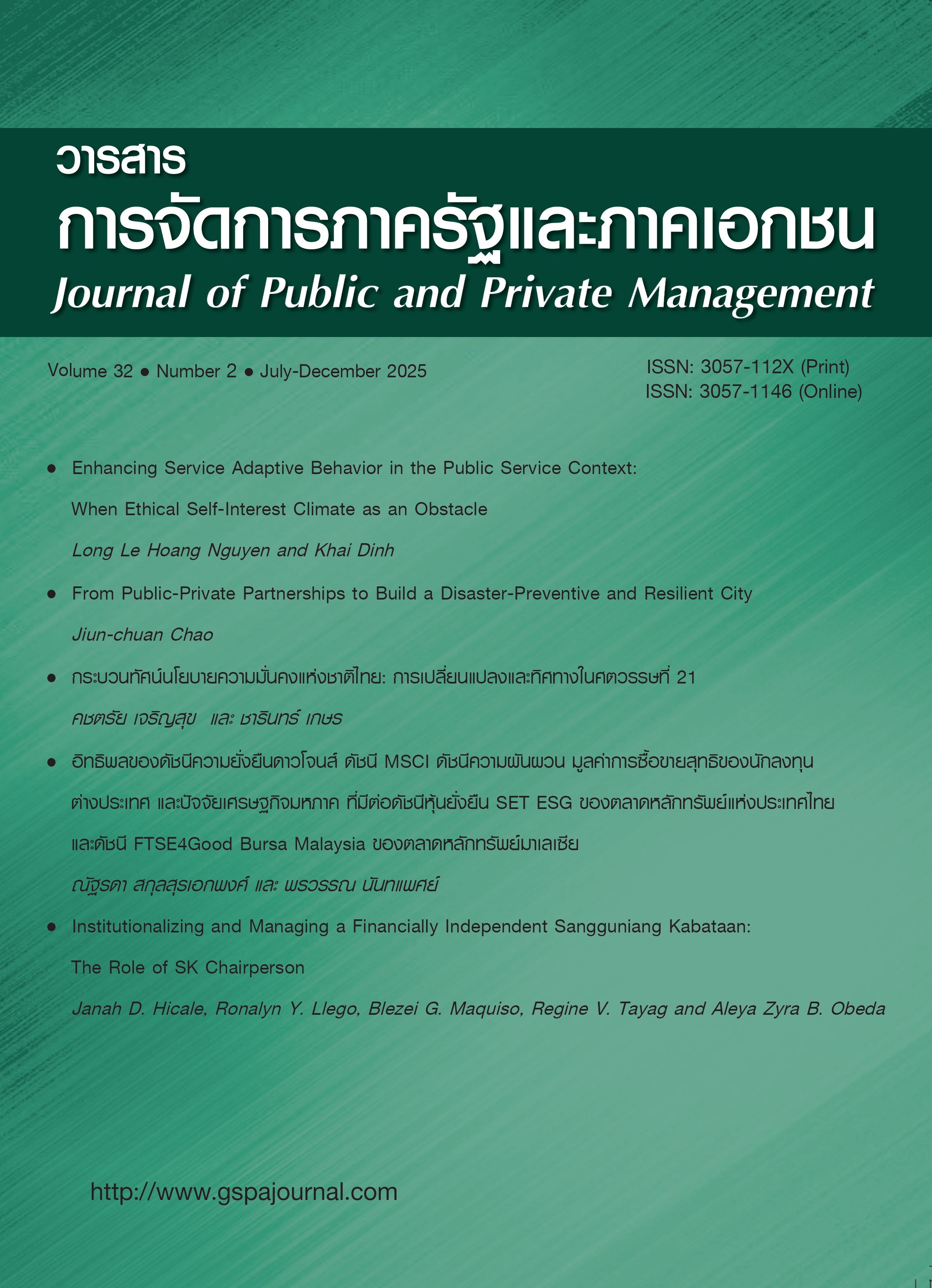
กระบวนทัศน์นโยบายความมั่นคงแห่งชาติไทย: การเปลี่ยนแปลงและทิศทางใน ศตวรรษที่ 21
คำสำคัญ:
นโยบายความมั่นคงแห่งชาติ, พลวัตรความมั่นคง, ความมั่นคงแบบองค์รวม,, การวิเคราะห์นโยบาย, ยุทธศาสตร์ชาติบทคัดย่อ
นโยบายความมั่นคงแห่งชาติไทยมีพลวัตการเปลี่ยนแปลงอย่างต่อเนื่องตอบสนองต่อบริบทโลกที่สลับซับซ้อน จากแนวคิดความมั่นคงแบบรัฐเป็นศูนย์กลาง (State-Centric Security) ได้พัฒนาไปสู่แนวคิดความมั่นคงแบบองค์รวม (Comprehensive Security) ซึ่งครอบคลุมมิติทางการเมือง เศรษฐกิจ สังคม สิ่งแวดล้อม และความมั่นคงทางไซเบอร์ บทความนี้ได้วิเคราะห์นโยบายความมั่นคงแห่งชาติไทย โดยใช้กรอบการวิเคราะห์นโยบาย 5 ขั้นตอน (Five-Step Policy Analysis) เพื่อระบุปัญหา ปัจจัยกำหนดนโยบาย สภาพแวดล้อมของนโยบาย ทางเลือกเชิงนโยบายและข้อเสนอแนะเชิงนโยบาย
การเปลี่ยนแปลงกระบวนทัศน์ด้านความมั่นคงของไทยได้รับอิทธิพลจากปัจจัยภายในและปัจจัยภายนอกประเทศ อาทิ การเปลี่ยนแปลงเชิงภูมิรัฐศาสตร์ ความมั่นคงทางเศรษฐกิจ ภัยคุกคามทางไซเบอร์ และการบูรณาการความร่วมมือระหว่างประเทศ นโยบายความมั่นคงแห่งชาติในปัจจุบันให้ความสำคัญกับ 5 มิติหลัก ได้แก่ 1) การรักษาความสงบภายในประเทศ 2) การป้องกันและแก้ไขปัญหาความมั่นคง 3) การพัฒนาศักยภาพด้านความมั่นคง 4) การส่งเสริมความร่วมมือด้านความมั่นคง และ 5) การพัฒนากลไกการบริหารจัดการความมั่นคง ท้ายที่สุดของบทความนี้ ได้ให้ข้อเสนอแนะเชิงนโยบายที่ชี้ให้เห็นถึงความจำเป็นในการสร้างฉากทัศน์เพื่อวิเคราะห์ภัยคุกคาม การให้รัฐสภามีบทบาทกำกับดูแลเชิงนโยบาย และการปรับยุทธศาสตร์ของกองอำนวยการรักษาความมั่นคงภายในราชอาณาจักร เป็นมาตรการและแนวทางนโยบายที่ควรดำเนินการเพื่อให้ประเทศไทยสามารถรับมือกับภัยคุกคามที่ซับซ้อนและไม่แน่นอนในศตวรรษที่ 21 ได้อย่างมีประสิทธิภาพและมั่นคงถาวร
Downloads
เอกสารอ้างอิง
Acharya, A. (2017). Constructing security community in Southeast Asia: ASEAN and the problem of regional order (3rd ed). Routledge.
Ariyasirichot, W. (2023). Public policy design using systems thinking (3rd ed.). Ariyasirichot Limited Partnership.
Bilveer, S. (2007). The Talibanization of Southeast Asia losing the war on terror to Islamist extremists. Bloomsbury Publishing.
Burusphat, K. (2010). Compilation of instructional materials: Public policy issues, unit 5 Security policy. Sukhothai Thammathirat Open University.
Caballero-Anthony, M. (2016). An introduction to non-traditional security studies: A transnational approach. SAGE Publications.
Caballero-Anthony, M., & Gong, L. (2020). Non-traditional security issues in ASEAN: Agendas for action. ISEAS Publishing.
Cairney, P. (2021). The Politics of Policy Analysis. Palgrave Macmillan.
Chulsiriwong, C. (2008).Terrorism in Southeast Asia [Research Reports, Faculty of Political Science, Chulalongkorn University]. Chula Digital Collections.
Deewattanakul, P. (2023). Public Policy and Planning. Chulalongkorn University Printing.
Dye, T. R. (2005). Understanding Public Policy (11th ed). Prentice hall.
Hameiri, S., & Jones, L. (2015). Governing borderless threats: Non-traditional security and the politics of state transformation. Cambridge University Press.
Institute of Security Studies. (2024a). Implementation of the National Security Policy and Plan (2023–2027). Security Perspectives Journal, 14(October 2023–January 2024), 85–90.
Institute of Security Studies. (2024b). Security operations under the framework of the National Security Policy and Strategy. Security Perspectives Journal, 16(June–July 2024), 77–80.
Intergovernmental Panel on Climate Change. (2021). Climate change 2021: The physical science basis. Cambridge University Press.
Kenaphoom, S. (2021). Public Policy Analysis based on Political Science Assumptions. Journal of Public and Private Management. 28(2), 43-67.
Meebunlue, J. (2010). National security: Building a sustainable Thai nation. Strategic Studies Center, National Defence Studies Institute.
Napapornpipat, R. (2019). A perspective on development for enhancing national security. Security Perspectives Journal, 1(June–September 2019), 1–11.
National Security Council Act. (2016, September 26). Royal Thai Government Gazette, 133(85), 1–8.
National Security Policy and Plan. (2015). National security policy and plan for implementation. Journal of National Security, 1(1), 11–14.
Nettatsan, L. (2018). Deforestation in Southeast Asia and ASEAN’s mechanisms for problem management. Office of the Council of State of Thailand.
Office of the National Security Council. (2002). Office of the National Security Council. Chulalongkorn University Printing.
Office of the National Security Council. (2022). National Security Policy and National Security Plan (2023–2027). Office of the National Security Council.
Office of the National Security Council. (2023). National Security Policy and National Security Plan (2023–2027). Office of the National Security Council.
Pathranarakul, P. (2021). Contemporary Public Administration Theory (2nd ed). Rattanatrai.
Pawakapan, P. (2024). Infiltrating society: The Thai military’s internal security affairs. Same Sky Books.
Poonkham, J. (2017). “Neighbors”: Power dynamics, security, and international relations. Faculty of Political Science, Thammasat University.
Preecharush, D. (2023). Elites and power in Southeast Asia. Matichon Publishing.
Raksereepitak, Y., & Tantayakul, S., (2022). Thai army and cybersecurity policy for non-traditional threats. Ramkhamhaeng Journal of Public Administration. 5(2), 461-481.
Rung-Uthai, D. (2015). Security cooperation among countries in Southeast Asia under ASEAN: An analysis of development and readiness for the establishment of the ASEAN Security Community. Chulalongkorn University Printing.
Socquet-Clerc, K., Su-Yen, S. K., Fitriani, F., Gomez, M. A., & Lam, N. V. (2023). Cybersecurity governance in Southeast Asia. Geneva Centre for Security Sector Governance.
Sornsil, S. (2022). Thai National Security Policy and the Dimension of Deliberative Policy. Journal of Thonburi University, 15(1), 105-115.
Thangthong, K. (2022). Threats and national security policy. Security Perspectives Journal, 13(June–September 2022), 14–25.
Thiprat, P. (2013). Parliamentary oversight of the security sector: Principles, mechanisms, and practices. P. Press Co., Ltd.
United Nations Office on Drugs and Crime. (2019). Transnational organized crime in Southeast Asia: Evolution, growth, and impact. UNODC.
World Economic Forum. (2024). Global risks report 2024. Marsh Mclennan and Zurich Insurance Group.
World Health Organization. (2020). WHO report on COVID-19 and national security: Lessons from the pandemic response. WHO.
ดาวน์โหลด
เผยแพร่แล้ว
รูปแบบการอ้างอิง
ฉบับ
ประเภทบทความ
สัญญาอนุญาต

อนุญาตภายใต้เงื่อนไข Creative Commons Attribution-NonCommercial-NoDerivatives 4.0 International License.

