
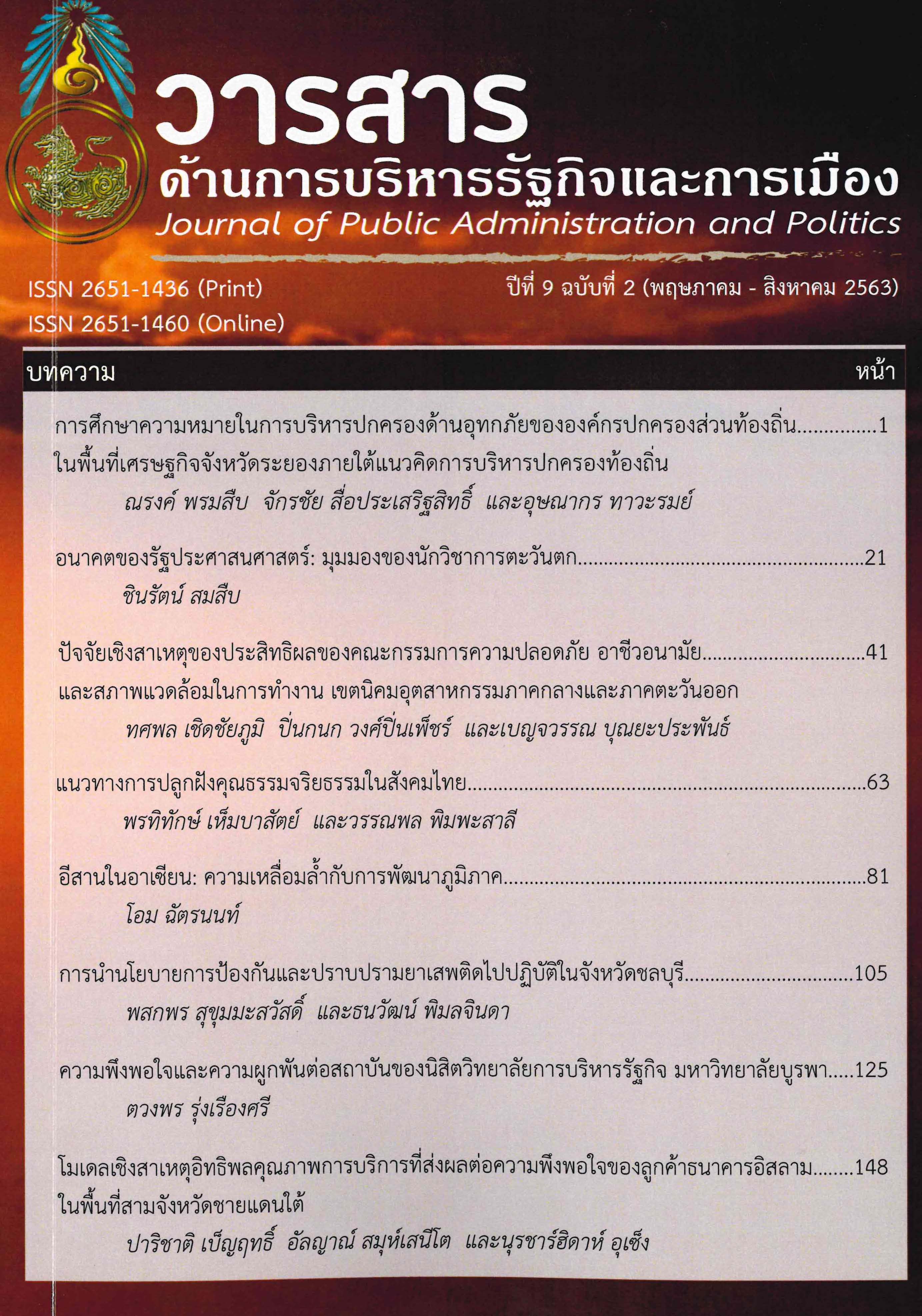
ISAN IN ASEAN: INEQUALITY AND REGIONAL DEVELOPMENT
Article Sidebar
Main Article Content
Abstract
Northeast Thailand or Isan is the largest region of the country, in terms of both area and population. Although the region is becoming one of the growth areas in economic development strategies, including in ASEAN Community, its problems of poverty and inequality continue to be higher than other parts of Thailand. This study employs qualitative documentary research and international political economic analysis to explain regional development linking international development policies and spatial development at the national level, especially on the issue of inequality in Northeast Thailand. There are three findings of the research. Firstly, the regionness in the Northeast has changed in accordance with international contexts. The current regional development, in particular, has created a spatial framework that facilitates the market system. Secondly, the regional development has related to capitalism and transforming roles of the state in overcoming constraints to the expansion of the market. Finally, according to the theory of uneven geographical development, it is difficult to reduce regional inequality because that approach of development theoretically creates competition between areas to attract investment and economic activities that can be moved across borders.
Article Details
References
- กุลลดา เกษบุญชู มี้ด. (2556). กระบวนการเข้าสู่ความเป็นสากลของระบบทุนนิยมและเสรีนิยมใหม่. วารสารสังคมศาสตร์ คณะรัฐศาสตร์ จุฬาลงกรณ์มหาวิทยาลัย, 43(2), หน้า 7-43.
- คณะกรรมการบูรณาการนโยบายพัฒนาภาค. (2561). แผนพัฒนาภาคตะวันออกเฉียงเหนือ ในช่วงแผนพัฒนาเศรษฐกิจและสังคมแห่งชาติ ฉบับที่ 12 (พ.ศ. 2560 - 2564). สำนักงานคณะกรรมการพัฒนาการเศรษฐกิจและสังคมแห่งชาติ. สืบค้นจาก http://www.nesdb.go.th/ewt_dl_link.php?nid=7526
- ณัฐพล แสงอรุณ. (2556). การพัฒนาเมืองหลักและผลกระทบต่อความเจริญของภาค: กรณีศึกษาภาคตะวันออกเฉียงเหนือ. (ดุษฎีนิพนธ์) สาขาวิชาสหวิทยาการ บัณฑิตวิทยาลัย มหาวิทยาลัยธรรมศาสตร์, กรุงเทพฯ.
- ปนัดดา ภู่หอม. (2561). EEC ภาคต่อ Eastern Seaboard: ก้าวสำคัญการลงทุนไทย: Economic Hot Issue, สืบค้นจากhttps://www.gsb.or.th/getattachment/a7529f4e-ae04-44cd-9d50e2bf9588bd7f/14MC_hotissue_internet_EEC_ex.aspx
- ปวริศร เลิศธรรมเทวี, วรรณิวภา พัวศิริ, และวิภาวี รุ่งวณิชชา. (2560). การพัฒนาเขตเศรษฐกิจพิเศษตามแนวทางของอาเซียน: รายงานการวิจัยฉบับสมบูรณ์. กรุงเทพฯ: สำนักงานเลขาธิการสภาผู้แทนราษฎร.
- ปิ่นแก้ว เหลืองอร่ามศรี. (2561). หลังเขตเศรษฐกิจพิเศษ. เชียงใหม่: คณะสังคมศาสตร์ มหาวิทยาลัยเชียงใหม่.
- ผาสุก พงษ์ไพจิตร, บรรณาธิการ. (2557). สู่สังคมไทยเสมอหน้า. กรุงเทพฯ: มติชน.
- พอพันธ์ อุยยานนท์. (2560). เศรษฐกิจอีสาน: พัฒนาการและการเปลี่ยนแปลง. กรุงเทพฯ: สำนักพิมพ์แห่งจุฬาลงกรณ์มหาวิทยาลัย.
- พัฒนา กิติอาษา. (2557). สู่วิถีอีสานใหม่. กรุงเทพฯ: วิภาษา.
- สำนักงานคณะกรรมการพัฒนาการเศรษฐกิจและสังคมแห่งชาติ (สศช.). (2554). ทิศทางการพัฒนาภาค ในแผนพัฒนาฯ ฉบับที่ 11 พ.ศ. 2555-2559. กรุงเทพฯ: สำนักนายกรัฐมนตรี.
- สำนักงานคณะกรรมการพัฒนาการเศรษฐกิจและสังคมแห่งชาติ (สศช.). (2559). ร่างแผนพัฒนาเศรษฐกิจและสังคมแห่งชาติ ฉบับที่ 12 (พ.ศ. 2560-2565). เอกสารการประชุมประจำปีของ สศช. กรุงเทพฯ: สำนักนายกรัฐมนตรี.
- สำนักงานคณะกรรมการพัฒนาการเศรษฐกิจและสังคมแห่งชาติ (สศช.). (2561). รายงานสถานการณ์ความยากจนและความเหลื่อมล้ำในระดับภาคของประเทศไทย. กรุงเทพฯ: สำนักพัฒนาข้อมูลและตัวชี้วัดสังคม, สศช.
- สำนักงานคณะกรรมการพัฒนาการเศรษฐกิจและสังคมแห่งชาติ (สศช.). (2562). ผลิตภัณฑ์ภาคและจังหวัดแบบปริมาณลูกโซ่ ฉบับ พ.ศ. 2560. กรุงเทพฯ: สำนักนายกรัฐมนตรี.
- สุวิทย์ ธีรศาศวัต และดารารัตน์ เมตริกานนท์. (2541). ประวัติศาสตร์อีสาน หลังสงครามโลกครั้งที่สองจนถึงปัจจุบัน. ขอนแก่น: คณะมนุษยศาสตร์และสังคมศาสตร์ มหาวิทยาลัยขอนแก่น.
- อรรถจักร์ สัตยานุรักษ์. (2557). ประชาธิปไตย คนไทยไม่เท่ากัน. กรุงเทพฯ: มติชน.
- Alvaredo, F., and Gasparini, L. (2015). Recent trends in inequality and poverty in developing countries. In Anthony, B.A., and Francois B. (Eds). Handbook of income distribution. Amsterdam: North Holland.
- ASEAN Secretariat. (2016). Initiative for ASEAN Integration (IAI) work plan 3. Jakarta: ASEAN Secretariat.
- ASEAN Secretariat. (2017). ASEAN Framework Action Plan on Rural Development and Poverty Reduction 2016-2020. Jakarta: ASEAN Secretariat.
- Asian Development Bank. (2012). Asian Development Outlook 2012: Confronting Rising Inequality in Asia. Manila: ADB.
- Asian Development Bank. (2015). Greater Mekong Subregion Statistic on Growth, Connectivity and Sustainable Development. Manila: ADB.
- Credit Suisse. (2018). Global wealth report 2018. Zurich: Credit Suisse Research Institute.
- Feeny, D. (2003). The political economy of regional inequality: The Northeast of Thailand 1800-2000. Crossroads: An Interdisciplinary Journal of Southeast Asian Studies, 17(1), pp. 29-59.
- Glassman, J. (2004). Thailand at the margins: internationalization of the state and the transformation of labour. Oxford: Oxford University Press.
- Gugler, P., & Vanoli, L. (2017). Convergence or divergence of prosperity within the ASEAN Community?: A crucial issue for the success of the ASEAN economic community (AEC) process. International Journal of Emerging Markets, 12(3), pp. 610-624.
- Harris, D. (2008). Uneven development. In Steven N. D., & Lawrence E. B. (Eds). The New Palgrave dictionary of economics (2nd ed.). Palgrave: Macmillan.
- Harvey, D. (1996). Justice, nature and the geography of difference. Oxford: Basil Blackwell.
- Harvey, D. (2010). The enigma of capital and the crises of capitalism. London: Profile Books.
- Hettne, B. (2005). Beyond new regionalism. New Political Economy, 10(4), pp. 543-571.
- Hettne, B., and Söderbaum, F. (2002). Theorising the rise of regionness. In S. Breslin, C.W. Hughes, N. Phillips,
- B. Rosamond (Eds). New regionalism in the global political economy (pp. 33-47). London: Routledge.
- Jayasuriya, K. (2013). Regulatory state with dirigiste characteristics: Variegated pathways of regulatory governance. In Dubash N., & Morgan, B. (Eds). The rise of the regulatory state of the South: Infrastructure and development in emerging economies (pp. 185-197). Oxford University Press.
- Kiely, R. (2012). Spatial hierarchy and/or contemporary geopolitics: What can and can’t uneven and combined development explain?. Cambridge Review of International Affairs, 25(2), 231-248.
- Kmonwatananisa, N. (2008). Thailand’s management of regional and spatial development. National Economic and Social Development Board.
- Lao, R., Parks, T.I., Sangvirojkul, C., Lek-Uthai, A., Pathanasethpong,
- A., Arporniem, P., Takkhin, T., and Tiamsai, K. (2019). Thailand’s inequality: Myths & reality of Isan. Bangkok:
The Asia Foundation.
- Phatharathananunth, S. (2016). Rural transformations and democracy in Northeast Thailand. Journal of contemporary Asia, 46(3), pp. 504-519.
- Piketty, T. (2014). Capital in the Twentieth First Century. Cambridge, Massachusetts, London, England: Belknap Press of Harvard University Press.
- Rock, M. T. (2017). Dictators, democrats and development in Southeast Asia: Implications for the rest. New York:
Oxford University Press.
- Stiglitz, J. E. (2012). The price of inequality. New York: W.W. Norton and Company.
- Wei, Y. D., (2015). Spatiality of regional inequality. Applied Geography, 61(2015), pp. 1-10.
- World Bank. (2017). World development indicator. Retrieved from http://databank.worldbank.org/data/reports.aspx?Code=NY.GDP.MKTP.KD.ZG&id=1ff4a498&report_name=PopularIndicators&populartype=series&ispopular=y
- World Economic Forum. (2018). The inclusive development index 2018: Summary and data highlights. Geneva:
World Economic Forum.
